The realm of Physical Access Control Systems (PACS) has transformed into an integral component of enterprise risk management, characterized by auditable and policy-driven approaches.
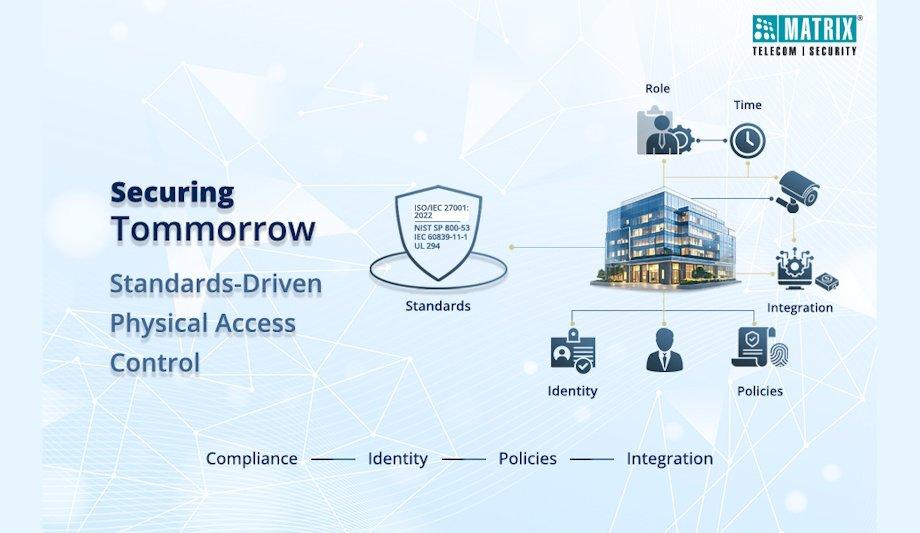
Modern access systems now treat each door interaction as a data point and each credential verification as a means of control. Global standards such as ISO/IEC 27001:2022 emphasize the importance of establishing physical security zones and controlling entry points to prevent unauthorized access.
Physical Access Authorization and Standards
NIST SP 800-53's guidelines further underscore the necessity of formal physical and environmental protection practices, including identity-aligned access policies and routine reviews—avoiding ad-hoc exceptions.
Contemporary deployments meet product and performance standards, such as UL 294 and IEC 60839-11-1, ensuring system integrity and effective operation. When based on validated components, access systems facilitate fluid operations and scalable security infrastructure.
Embracing Industry Standards
Organizations must pivot from reactive to proactive security strategies to align with industry standards
Organizations must pivot from reactive to proactive security strategies to align with industry standards. The focus lies on three primary outcomes: ensuring authorized access, maintaining auditable activity logs, and evolving with security challenges.
Standards like ISO/IEC 27001 and NIST SP 800-53 advocate incorporating these elements into information security protocols. A significant challenge remains in updating outdated authentication systems to more secure solutions.
Advanced Authentication Methods
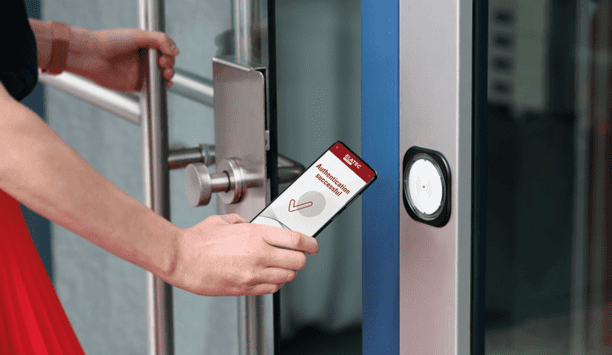
Modern PACS systems are transitioning from easily compromised RFID cards and PINs to sophisticated authentication methods. Mobile NFC, biometric, and facial recognition technologies safeguard against credential sharing and unauthorized access, offering both frictionless and secure user experiences.
Policy-Driven Access Control
Robust access control systems apply multi-dimensional enforcement policies, such as role-based access, temporal control, and zone management. These strategies restrict access to sensitive areas according to roles, business hours, and designated zones, meeting industry standards for structured governance.
Specialized Features in Regulated Environments
To comply with niche regulations, industries like healthcare and finance require specially designed systems
To comply with niche regulations, industries like healthcare and finance require specially designed systems. For example, manufacturing sectors integrate safety protocol access restrictions, ensuring certified personnel only enter high-risk areas.
A key part of robust security is detailed logging, providing instant alerts and reports for immediate incident escalation and traceability.
Today, PACS does not function in isolation but as part of a comprehensive IT framework. By utilizing IP-based networking and PoE devices, these systems simplify expansion and uptime. Integration with fire alarms, video surveillance, and HR systems provides a cohesive security posture, automating responses to emergencies and verifying events through video.
A Comprehensive Security Solution
Matrix transforms traditional security into a unified, innovative system that meets and anticipates future challenges.
Offering solutions like biometric door controllers and cloud-based management, Matrix delivers compliance and scalability, making physical security an effortless, seamless experience. Within this evolving landscape, Matrix positions itself as a frontrunner, providing cutting-edge solutions that redefine industry standards.
Security is most effective when it is invisible yet invincible. Today, Physical Access Control Systems (PACS) have evolved into an auditable, policy-driven layer of enterprise risk management—where every door event is a data point, and every credential decision is a control.
Standards and frameworks increasingly expect this: ISO/IEC 27001:2022 explicitly calls for physical security perimeters to prevent unauthorized physical access to information and associated assets, pushing organizations toward defined zones, controlled entry points, and consistent enforcement.
Physical access authorization
In parallel, NIST SP 800-53’s Physical and Environmental Protection (PE) control family formalises practices like physical access authorization and access control at entry/exit points, reinforcing the need for identity-aligned access policies and review cycles—not ad-hoc badge exceptions. From a system assurance standpoint, modern deployments also lean on product and performance standards such as UL 294 (testing for access control system units) and IEC 60839-11-1 (minimum functionality and performance requirements for electronic access control).
Net-net: when Physical access control systems are built on recognized controls and validated components, teams move fluidly, compliance becomes operationalised, and security infrastructure scales cleanly with growth—without becoming a bottleneck.
Industry standards focus
Understanding what industry standards actually require
To remain future-ready, organizations must shift from reactive monitoring to proactive enforcement. Industry standards focus on three measurable outcomes:
- Authorized Access Only: Ensuring only verified individuals gain entry to specific zones.
- Auditable Activity: Maintaining a clear, provable record of every entry and exit.
- Evolutionary Security: Ensuring systems remain resilient as physical and cyber threats evolve.
This aligns with globally recognized frameworks such as ISO/IEC 27001, which mandates physical access control systems as part of information security governance, and NIST SP 800-53, which outlines requirements for organizations handling sensitive assets.
Frictionless and secure authentication
One of the largest compliance gaps in legacy systems is outdated authentication. Modern Physical Access Control Systems are moving away from easily shared or cloned RFID cards and PINs toward high-assurance credentials.
- Mobile & Biometric Solutions: Utilising mobile NFC, fingerprints, or face recognition ensures that security is as easy as a glance or a tap.
- Reducing Risk: These methods significantly reduce the likelihood of credential sharing and unauthorized entry.
Intelligence-driven policies: Role + location + time
Industry-grade physical access control systems are never "one user = one door". Standards expect enforcement across multiple dimensions to ensure structured governance:
- Role-Based Access: Allowing only authorized staff into sensitive areas like R&D zones or server rooms.
- Temporal Control: Restricting access based on shifts or business hours.
- Zone Management: Limiting visitor movement beyond reception areas.
Advanced features for regulated environments
For industries such as banking, healthcare, and pharmaceuticals, certain preventive features are now the expected baseline:
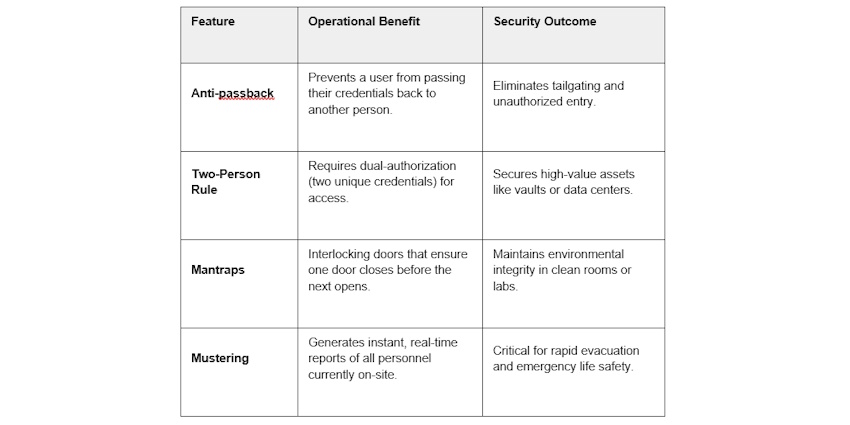 |
| Advanced features for regulated environments |
Beyond the Basics While general standards provide the framework, niche regulations demand specialized execution. For example, In Manufacturing, their systems integrate with safety protocols to ensure that high-risk machinery zones are only accessible to personnel with valid, up-to-date safety certifications, grounding digital policy in physical reality.
Auditability: If It Isn’t Logged, It Didn’t Happen
A major red flag in modern audits is the inability to generate reports instantly. The system must provide:
- Real-Time Alerts: Immediate notifications for tamper attempts or forced-open doors.
- Instant Escalation: Automated notifications via email or SMS.
- Audit Trails: Downloadable historical reporting and incident traceability.
The power of infrastructure and integration
Modern Physical Access Control Systems no longer operate in isolation. They integrate directly into the IT backbone using IP-based networking and PoE-powered devices, simplifying expansion and improving uptime. Furthermore, integrating with fire alarms, video surveillance, and HR systems ensures that the security posture is holistic—where a fire alarm triggers an automatic unlock policy and a door event is verified by video.
Matrix transforms the security from a standalone hardware setup into a unified IT backbone. By using IP-based networking and PoE-powered devices, they simplify the infrastructure while ensuring that a fire alarm can trigger an automatic unlock or a door event can be instantly verified by video.
Conclusion: The matrix standard
A modern physical security posture is more than a technical requirement; it is a commitment to excellence. When the Physical Access Control Systems are secure by design, policy-driven, and audit-ready, they become a silent partner in the business’s success.
In this landscape, Matrix stands as a beacon for organizations seeking more than just hardware. Matrix provides a holistic ecosystem where physical security meets cutting-edge innovation—offering everything from biometric door controllers to cloud-based multi-site management. With Matrix, users don’t just meet the industry standards of today; they define the standards of tomorrow. Experience a world where security is seamless, compliance is effortless, and the facility is truly future-ready with Matrix.