Building managers are facing increased demands concerning security, cost-management, and compliance. A recent whitepaper suggests that the strategic implementation of smarter digital access solutions could help meet these demands without escalating workloads or expenses.
The rapid pace at which organizations are expanding, downsizing, or adding new locations requires facility managers to handle access flexibly. Many essential functions are now managed by third-party contractors who require access to buildings while ensuring security is maintained.
New security and access solutions must compete for budget by demonstrating Total Cost of Ownership (TCO) and delivering real Return on Investment (ROI).
Flexible Access Management Solutions
Traditional mechanical locking systems are not equipped for the demands of today's dynamic environments, which are increasingly becoming the standard across sectors. Furthermore, physical, cyber, and hybrid threats, alongside stringent regulatory frameworks like the EU's NIS2 guidance and the upcoming Cyber Resilience Act (CRA), intensify the need for comprehensive, integrated security and access management solutions.
These challenges are particularly pressing in critical sectors such as infrastructure, finance, healthcare, energy, transport, and ICT.
Programmable Digital Key Benefits
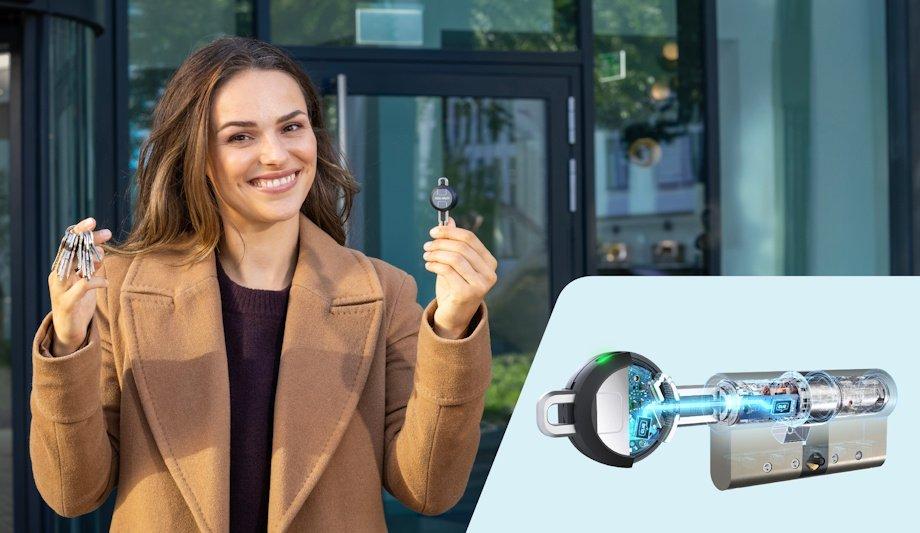
ASSA ABLOY’s CLIQ system provides personalized access control and logs every entry for easy auditingWhile mechanical keys are familiar, digital solutions offer the advantage of adaptable, time-based access authorizations that can be quickly and flexibly modified. Smart keys can be programmed or de-authorized in seconds, reducing risks associated with lost keys and eliminating costs related to changing locks. Digital solutions also enhance user safety by integrating access control with other building technologies like fire protection systems.
Automated audit capabilities inherent in digital systems support compliance efforts, making manual access tracking with mechanical keys—a time-consuming or sometimes impossible task—obsolete. Compliance with NIS2 regulations includes tracking and logging access events, something digital systems achieve effortlessly.
The Move to Smart Key Systems
"Switching from mechanical to digital access management is not straightforward," states Jochen Wizemann, Head of Business Development for Key-based Digital Cylinders at ASSA ABLOY. "Large systems cannot always be changed overnight, necessitating a gradual, scalable transition as budgets permit. A well-designed smart key system can facilitate this change."
Smart key systems provide an efficient means to transition from mechanical locks to sophisticated digital access, enhancing access management flexibility across various organizations. Electronic cylinders replace old mechanical ones without damaging doors or needing new wiring, while intuitive software allows facility managers precise control over employee and contractor access.
Implementation of ASSA ABLOY’s CLIQ System
ASSA ABLOY's CLIQ system offers personalized access rights management, with each access event logged for easy audit trail generation. This feature simplifies compliance with the latest regulations such as NIS2 and CRA. The extensive CLIQ ecosystem, featuring over 60 cylinder and padlock variants, can meet diverse access management needs.
Wizemann highlights the system's broad adoption in demanding environments, stating, "CLIQ is trusted by organizations such as the London Ambulance Service, Düsseldorf’s stadium, and various utility sites. It ensures secure and flexible management across locations like the Amsterdam World Trade Center and schools in Europe, providing a demonstrable ROI."
How CLIQ Systems Facilitate Access
CLIQ systems are user-friendly: authorized keys open the locks when inserted into the right cylinder. Key programming for access rights can be done with a few software clicks. CLIQ keys, powered by a standard battery that lasts up to ten years, eliminate the need for wiring or wall modifications.
Users can manage the system locally via CLIQ Local Manager or remotely through CLIQ Web Manager. The CLIQ Go app provides small businesses the flexibility to manage access themselves, paving the way for a seamless transition from mechanical to digital access control.
Security, cost-management, and compliance demands placed on building managers have grown significantly.
The key to meeting them all without increasing workload and costs could be the strategic implementation of smarter digital access, as a new whitepaper explores.
Facility managers to manage access of locations
As organizations upscale, downsize or onboard new locations faster than ever, facilities managers must be able to manage access flexibly and to adapt on the fly. The boom in service contracting means many essential building functions are now handled by third-party providers rather than employees: they need access to complete their work while keeping the premises secure.
At the same time, new access and security solutions must battle for budget and justify their Total Cost of Ownership (TCO), producing real Returns on Investment (ROI) in the process.
Security and access management
Mechanical locking was never designed for this kind of demanding, dynamic environment. Yet it is becoming the ‘new normal’ in many sectors.
In addition, physical, cyber and ‘hybrid’ physical-cyber security threats loom larger than ever, as do strict regulations designed to protect critical sectors from these threats, including the EU’s NIS2 guidance and forthcoming Cyber Resilience Act (CRA)1. Clearly, compliance within a complex regulatory landscape and the implementation of joined-up security and access management are critical challenges, particularly in sectors on which NIS2 obligations fall most heavily: infrastructure, finance/banking, healthcare, energy, transport, and ICT sites such as data centers.
Programmable key access management
One valued benefit of the mechanical key is its familiarity. In many cases, a mechanical locking system with patent-protected cylinders and keys may be the appropriate solution. However, unlike mechanical security, a digital solution offers the ability to allocate time-based rather than blanket access authorisations, and to amend them quickly and flexibly.
A digital credential, such as a smart key, can be programmed or de-authorized in seconds, negating the threat of a lost key in circulation, not to mention the cost of changing cylinders and re-keying. The ability for building technology to connect solutions for access, fire protection and escape routes, for example, may also enhance user safety and facilities management.
With a digital solution, audit capability is automated for each lock and user, benefitting compliance efforts; manual access tracking with mechanical keys is either time-consuming or, in many cases, impossible. Tracking and tracing access is one requirement of NIS2 regulations.
Smart key system
“Of course, switching from mechanical to digital access management is not as simple as flicking a switch,” says Jochen Wizemann, Head of Business Development for Key-based Digital Cylinders at ASSA ABLOY. “Many organizations have large systems which they cannot change all at once, so digital systems must be scalable gradually over time as budgets allow. The right programmable smart key system can offer this.”
Smart key systems are the fastest, least disruptive way to switch mechanical security for intelligent digital access. They immediately upgrade the flexibility of access management in organizations of every size and type. Electronic or electromechanical locking cylinders simply slot into place instead of the legacy mechanical devices, without door damage or wiring. Intuitive software and programmable digital keys issued to authorized site users gives facilities management teams granular control over the movements of staff and contractors.
The major advantages of ASSA ABLOY CLIQ®
With a key-based digital access management system like ASSA ABLOY’s CLIQ solution, it becomes straightforward to grant access rights which are personalized to an individual’s precise needs and level of authority. Because every access event is logged by the system, audit trails can be generated with a few clicks in the software control panel – streamlining compliance obligations with the latest generation of regulations such as NIS2 and the CRA. The CLIQ ecosystem includes more than 60 different cylinder and padlock types, ensuring almost any need can be met with a CLIQ solution.
“Adaptability, scalability, security, convenience and trust are just some of the reasons CLIQ has been adopted in some of the most demanding environments for access management,” adds Jochen Wizemann. “CLIQ is trusted to manage access and protect secure spaces by the London Ambulance Service, at Düsseldorf’s 55,000-capacity stadium, at sensitive and dispersed water and electricity utilities sites, in Amsterdam’s World Trade Center, and at small offices, hospitals and schools all over Europe. It provides reliable, flexible security and can deliver a concrete ROI, as modeling in the new whitepaper illustrates, alongside advice and checklists for decision-makers looking to upgrade from mechanical to digital access management.”
How to use CLIQ systems
CLIQ systems are simple for everyone. A user inserts their programmable CLIQ key into a cylinder. If the key is authorized, the lock opens. CLIQ is equally easy to administer. To program a key with access rights, to a door or group of openings, takes a few clicks in the software.
Update and revalidate the key using a remote updater or the optional Bluetooth® functionality, and it is ready to use. Because the power is inside every key – a single, standard battery with a lifetime of up to 10 years for standard user keys – there is no wiring or broken walls during installation, and no expensive mains electricity consumed during operation.
With a choice of software for managing on a local PC (CLIQ Local Manager) or online from anywhere (CLIQ Web Manager), plus the CLIQ Go app for small businesses who wish to manage access for themselves, CLIQ simplifies the switch from mechanical to flexible, secure digital access almost anywhere.