Mechanical Locks

ASSA ABLOY will be exhibiting at Global Security Exchange (GSX) 2026 from September 14 - 16 at the Georgia World Congress Center in Atlanta, Georgia. The company invites attendees to visit the ASSA ABLOY booth #1421, where it will showcase its latest innovations in digital access solutions and software, doors, frames, and mechanical hardware. Visit the booth to see first-hand the products and solutions that are transforming facility operations across the country. More secure environments &ldq...

For more than 90 years, ASSA ABLOY has pioneered electromechanical locking technology — continuously innovating since the first effeff electric strike was patented in 1932 and Abloy began developing high-security electric locks in 1978. Today, electromechanical locks represent the intelligent evolution of mechanical security, combining trusted engineering with seamless digital connectivity for safer, smarter, more efficient building management. Modern electromechanical devices transform t...
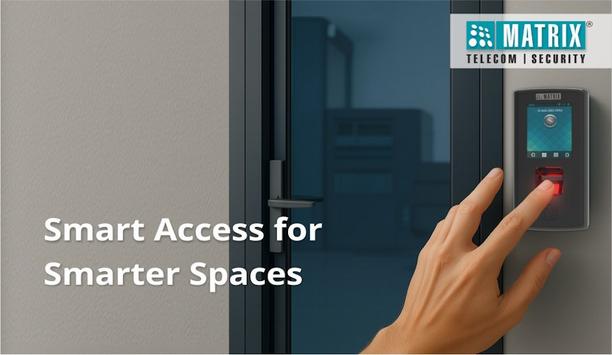
Security has become a fundamental requirement for modern businesses. From protecting physical assets to ensuring employee safety and regulatory compliance, organizations increasingly rely on digital security infrastructure. One of the most important components of this infrastructure is the Door Access Control system, which determines who can enter a facility, where they can go, and when they can access specific areas. Global demand for access control technology The global demand for access c...

Security, cost-management, and compliance demands placed on building managers have grown significantly. The key to meeting them all without increasing workload and costs could be the strategic implementation of smarter digital access, as a new whitepaper explores. Facility managers to manage access of locations As organizations upscale, downsize or onboard new locations faster than ever, facilities managers must be able to manage access flexibly and to adapt on the fly. The boom in service c...
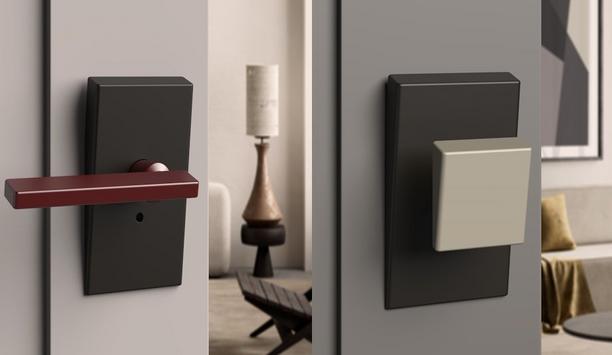
Schlage, a pioneer in door hardware innovation for over a century, introduces the third limited-edition collection from Pin & TumblerTM A Studio by Schlage — The Aspect Collection. This collection innovates the interior door hardware market with bold, geometric designs that fuse solid forms with warmth and ease. Features Inspired by the design style of Soft Brutalism, the Aspect Collection features powerful lines and purposeful movement to create a dynamic visual effect. From...
Schlage, America’s Most Trusted Lock Brand1 and pioneer in door hardware innovation for over a century, together with NterNow, a leading on-demand, self-guided tour software platform for single-family properties, are showcasing solutions in the Schlage booth at the 2026 International Builders’ Show (IBS) in Orlando. NterNow recently joined Schlage as part of the Allegion portfolio – providing a first-ever opportunity at IBS 2026 for builders and show attendees to experie...
News
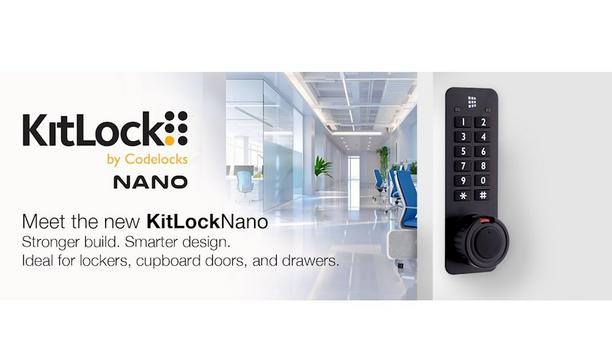
Codelocks launches its KitLockNano, a redefined compact lock, engineered with a stronger build and smarter design. The upgraded lock delivers improved performance and functionality in the same ultra-small footprint as the original, while including a key override for complete control in any situation. Ideal for lockers, cabinets, and drawers, the KitLockNano addresses the growing demand for modern, reliable access control in environments like workplaces, sports facilities, and hotels. Reengineered to meet modern demands “The KitLockNano has been completely reengineered to meet modern demands. While it stays true to its compact form, everything else has been improved, from usability to durability,” said Jo Milne-Rowe, Managing Director at Codelocks. “On top of this, it provides the perfect balance between style and substance. We've created a lock that not only looks contemporary and sophisticated but also provides the flexibility end-user customers need for a range of different storage scenarios, thanks to its dual-function capability.” The KitLockNano’s Private Function allows repeated use of the same code for dedicated users, while the Public Function enables temporary four-digit codes that automatically erase after use. A red/blue LED indicator provides an at-a-glance locked/unlocked status. Dual functionality “Dual functionality means organizations using the KitLockNano in applications such as hot-desking offices, sports clubs, or events and conference spaces get more out of their locker and cabinetry solutions. The same lockers can be used as private storage or for short-term, multiple occupancy without having the hassle and costs associated with keys,” said Jo Milne-Rowe. Installing the KitLockNano is simple, as the lock easily retrofits into existing cam lock placements using just two additional fixings. New installations require only three small holes, allowing locksmiths and installers to fit the lock in minutes. It can be surface-mounted or fitted flush, maintaining a clean aesthetic while ensuring easy battery access. The key override remains accessible, making it simple for facilities managers to regain access if needed. It is also available in vertical or right-hand horizontal orientations. Makes maintenance and management easier The KitLockNano makes maintenance and management easier. Powered by two AAA batteries, it can perform up to 15,000 operations per battery cycle, includes a low battery indicator function, and has comprehensive code management with Master, Sub-Master and Technician. It is IP54 rated and equipped with a key override that is protected by a dust cover over the key cylinder. Part of the KitLock by Codelocks range, the KitLockNano is a convenient and stylish alternative to traditional key-operated locker locks.
Schlage, America’s Most Trusted Lock Brand and pioneer in door hardware innovation for over a century, now announced the latest limited release from Pin & Tumbler™ A Studio by Schlage — the Refined Finishes Collection. Designed to elevate everyday spaces with subtle sophistication, the collection introduces three new finishes that embody quiet elegance and refined design. Design innovation “Design innovation is not always about bold statements — it’s also about harmony and balance,” shared Heather Jacobson, Product Manager, Pin & Tumbler Studio, adding “With the Refined Finishes Collection, we set out to capture the kind of understated beauty that completes a space. Each finish is thoughtfully crafted to complement standout design elements while introducing its own sense of calm and character.” Three elevated hues Designed with smooth, understated surfaces that offer subtle visual depth, the Refined Finishes Collection was thoughtfully developed to suit a wide range of interior esthetics, making each finish feel like a natural extension of the individual style, not just a functional detail. Available in three elevated hues — Matte White, Forest Shadow and Golden Bronze — each finish was curated to complement Schlage’s modern design forms featured in the Collins trim and Latitude lever for a cohesive, elevated look. Matte White – Ideal for bright, streamlined spaces; this finish offers a clean, minimalist appeal that complements contemporary interiors. Forest Shadow – A soft, calming neutral, Forest Shadow layers effortlessly with statement pieces, creating a tranquil and relaxed atmosphere. Golden Bronze – Rich, timeless gold tones deliver soft radiance and warmth, balancing versatility with refined sophistication. Schlage’s innovative combined interior platform Built on Schlage’s innovative combined interior platform, the Refined Finishes Collection delivers versatile functionality with a sleek, elevated design. Each product in the collection seamlessly transitions between a non-locking function for hall or closet doors and locking function for bedroom and bathroom privacy, offering homeowners flexible solutions to suit their spaces. Installation is quick and straightforward, making it an ideal upgrade for those seeking refined style and enhanced utility without the need for professional tools or expertise. The Refined Finishes Collection is available exclusively through Pin & Tumbler™ A Studio by Schlage.
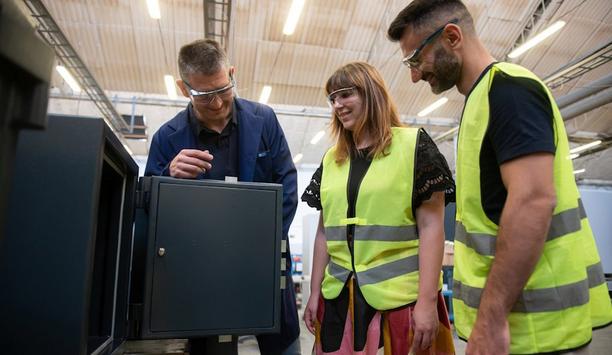
Gunnebo Safe Storage is reinforcing its position in Europe by combining large-scale manufacturing with advanced locking technology across its full range of safe storage solutions. With specialist sites now operating as a single platform, the company has created one of the most comprehensive secure storage operations on the continent, with recent integrations being central to its success. High-security locking systems The Markersdorf facility in Germany, one of Europe’s key manufacturing sites, adds significant capacity to Gunnebo’s ability to produce its entire portfolio of products within Europe. The Primat Group in Slovenia has introduced additional scale for safe production, while WITTKOPP in Germany contributes decades of expertise in high-security locking systems. Locking technology within Europe “By bringing Primat, WITTKOPP and our Markersdorf site into a unified platform, we have connected design, manufacturing and locking technology within Europe,” said Elisabeth Whitefield, Vice President Europe, Gunnebo Safe Storage, adding “This ensures our products meet certification standards, adapt to local market needs and remain available even when global supply chains are disrupted.” Gunnebo’s European portfolio Gunnebo’s European portfolio serves financial institutions, retailers and residential customers. Operating these areas under one organization allows the company to act as a single point of reference for customers with diverse requirements. Beyond reducing delivery times and ensuring compliance, local manufacturing provides the flexibility to tailor solutions to different markets while supporting more sustainable supply chains. Long-standing expertise in high-security mechanical locks “Our customers expect more than a safe,” said Elisabeth Whitefield, adding “They need smart, integrated solutions, backed by technical service capabilities they can rely on. Having all these capabilities in Europe means we can deliver with speed and reliability while keeping quality at the core.” Locking systems are a core element of safe storage, and Gunnebo benefits from having two specialist brands. Tecnosicurezza strengthens the portfolio with electronic solutions, while WITTKOPP contributes long-standing expertise in high-security mechanical locks. Gunnebo safe storage solutions Elisabeth Whitefield concluded: “By keeping research, development and production within Europe, Gunnebo Safe Storage can proactively anticipate and meet evolving demands. This focus strengthens our ability to adapt quickly and reinforces our position as a pioneering hub for safe storage solutions, serving institutional and residential markets with resilience and consistency.”

In the eyes of some, locks are simply used for keeping people out, and for keeping the contents of a building, cabinet or locker safe. But as they know at Codelocks, access control is about so much more than that. It’s about managing spaces and giving people convenient access in ways that can transform how a building or space works and feels. That’s one of the reasons they rarely talk about ‘security’, if at all. If they focus on access control as being simply about protection, then they’re likely to see locks and other access control solutions as just a cost – an expense line on a balance sheet. They’d also overlook one of the biggest changes impacting the industry, and the first of several trends shaping access control in 2026: the change from a cost center to a revenue generator. Entrepreneurs and access – from cost to profit center “There’s been an explosion in short-term rental applications over several years, and I mean much more than just BnBs or holiday homes,” said Jo Milne-Rowe, Managing Director at Codelocks UK. “We’re reaching a point where almost anything that has the potential to be shared and rented out is being. Entrepreneurs are seeing new opportunities, and using access control to turn them into profit-generating realities.” Festival lockers are a booming example. They are simple storage units rented to attendees at music festivals and events. People book online, select the rental duration, and receive a time-sensitive access code instantly. The coded locks allow customers to store belongings without keys, while operators remotely manage thousands of lockers, changing codes automatically between rentals without swapping keys and with minimal staff input. New revenue-making products and services This use of locks to create new revenue-making products and services also changes what customers want. It alters their ‘buying equation’. In applications that focus on short-term product rental to drive revenue, customers are seeking locks that help to improve business fundamentals, like utilization and booking rates. Likewise, they’re looking for locks that improve the customer experience and create an attractive, easy-to-use product. As manufacturers and product innovators, this changes what they need to offer customers in 2026 and beyond. The balancing act–new tech and simple solutions There is a lot of hype around AI at the moment. And understandably, so if using ChatGPT or similar. The UK government is looking for the country to become an ‘AI superpower’, while also using the new technology to do things like free up NHS hospital beds. With all this attention on bleeding-edge technology, however, people can be led to think that access control must follow the same path: that because everyone’s talking about tech, it’s what customers will be demanding in 2026. However, despite the attention lavished on breakthroughs like AI, many customers are still looking for simplicity of operation and maintenance in their access control solutions – even the entrepreneurs. Demanding AI in access control solutions “With any new tech, there’s hype and there’s practical application. European customers aren’t demanding AI in their access control solutions right now,” said Steve Newman, Regional Director for Codelocks Europe. “That’s probably for several reasons, not least because simplicity is something they prioritize.” The demand for simplicity is especially strong in the locker market, where most facility and building managers are responsible for looking after thousands of different lockers that require regular maintenance. In large sites such as student accommodation or government offices, small issues quickly add up to be a large drain on resources. “For lockers – which make up the majority of our business – most customers are choosing either mechanical locks or hard-wired solutions because they want to avoid battery maintenance,” said Mark Samuelson, Director for Codelocks Australia. Hard-wired solutions Mechanical lockers are ideal for short-term, multiple occupancy applications requiring simplicity and minimal maintenance to keep costs low. Hard-wired solutions don’t tick all these boxes, though. The cost of installing new wiring can outweigh the cost of avoiding batteries, leaving mechanical locks as the simplest and best choice. Still, with an eye on the future, they don’t think customers will have to make these kind of choices for much longer. Battery harvesting will soon become popular, using the power in people’s mobile phones to temporarily power a cabinet, door or locker lock. Despite all of this, the real winners in 2026 will be those organizations that listen to their customers. Those companies that focus on solving fundamental customer challenges without over-egging the latest trends. Understanding the real customer “Protection concerns have driven people to effectively over-specify the locks they need, which is neither cost-effective nor necessary,” said Matt Welty, Vice President at Codelocks Americas. “For us, this has been an opportunity. We’ve guided many companies toward the right-fit product, rather than the over-the-top product. It’s about understanding the real customer need and meeting it.” Sustainability in the supply chain The urgency around climate targets and sustainability is growing as 2050 net-zero targets and interim milestones, such as 68% emissions cut by 2030, get closer. Customers everywhere are also more focused on the environmental impacts of their purchases, while supply chain scrutiny is increasing. In access control, sustainability is a consideration on two levels. Practically, people are demanding products that last longer. They need products that can be repaired rather than replaced, and they’re looking to minimize waste. On a procedural level, customers need their products to be certified so they can satisfy procurement requirements. Success in 2026 requires addressing both of these customer needs, building genuinely more sustainable products that are supported by the right certifications and accreditations. Almost all Codelocks products are repairable, which massively reduces waste and promotes a more circular economy. In 2025, as part of the sustainability efforts, Codelocks UK achieved ISO 14001 (environmental management) to help the UK customers with their supply chain requirements; 2026 will be the first year they report the emissions too, giving transparency to the customers for their own emissions reporting. Moving forward with awareness What’s become clear from conversations with Codelocks senior pioneers is that listening to customers has never been more important. Access control in 2026 comes down to understanding what customers actually need, versus what the industry thinks they should want. Whether working with entrepreneurs applying rental models to new spaces, helping facilities managers balance innovation with operational simplicity, or providing repairable locks backed by ISO certifications, success lies in responding to real needs with the right solutions.
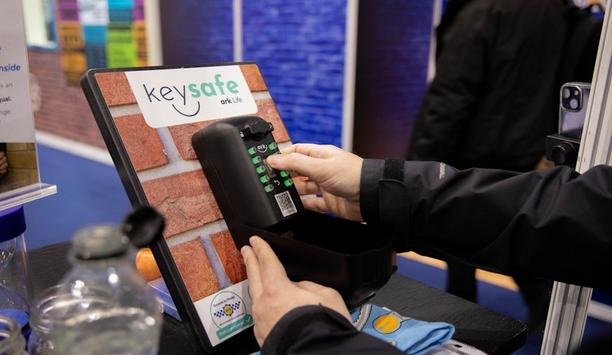
An access management company secured a new set of supporters after one of its maximum-security key safes proved impenetrable at Europe’s largest locksmith exhibition. The Key Safe Company invited locksmiths and industry experts at The Master Locksmiths Association (MLA) Expo to take on a lock-picking challenge, with the opportunity to win the cash inside. They were each given five minutes to pick the company’s formidable ark Tamo key safe, but not one of the 73 master locksmiths who participated was able to pull off the feat. It is widely reported that some key boxes on the market can be easily breached, not just by brute force attacks, but also by stealth picking attempts. Maximum security This is something David Ogden, Founder and Chief Executive of The Key Safe Company, felt strongly about when he developed the ark Tamo. He said: “We wanted to prove that a mechanical key safe could truly deliver maximum security without compromising on usability.” “Too many products on the market claim to be ‘secure’ but fall short when faced with a real-world attack. Our mission was to set a new benchmark to develop a product which locksmiths, security professionals and the general public could trust to provide protection.” Commitment to innovation “When we designed the ark Tamo range, we approached it from the perspective of not only the end users’ convenience, but also as an attacker seeking weak points. Therefore, every mechanism, every material and every tolerance was tested and refined to resist manipulation,” continued David. “Seeing so many skilled professionals attempt to breach the ark Tamo at the Expo, with no success, was a fantastic validation of our engineering and our commitment to innovation.” The ark Tamo features patented, multi-push technology that allows the same button to be used up to four times in one passcode. This world-first enables up to 9.7 million different passcode combinations. An advanced anti-pick mechanism is also included, divorcing the dial from the buttons to prevent known picking techniques. Feedback from locksmiths and industry experts David added: “Seventy-three trained locksmiths attempted to pick the Tamo, via the picking challenge on our stand, and there was not a single successful pick all weekend!” “We offered a five-minute period to pick the key safe, based on competitor key boxes being breached online in less than one minute. The feedback from locksmiths and industry experts was really positive - proven by the hundreds of key safes sold - and we had great engagement around our ark Tamo and ark Tamo Pro products.” The Key Safe Company led two ‘training seminars’, titled Not All Key Safes are Equal, during the Expo at Telford International Centre. The sessions were designed to raise awareness within the industry of exactly what should be classified as ‘safe’ and to highlight the unique features of the ark Tamo range. Precision and engineering David said he was delighted by the industry’s collective response to the ark Tamo and that attending the MLA Expo had been a total success. “Day One of our training sessions was completely full, with no seats left, which was great for our team and we secured fantastic feedback. Our new Tamo display showing the interior mechanisms drew a lot of attention, with locksmiths fascinated by the detail, while the extreme attack testing videos created a real buzz at our stand.” “Overall, the show exceeded our expectations. It’s clear that locksmiths really appreciate the precision and engineering behind the ark Tamo range, and there’s great potential to continue building our presence in the industry.” Designed in-house The ark Tamo is designed in-house at The Key Safe Company, based in Worcester, UK, and has been endorsed by Secured by Design, the official UK Police security initiative that certifies products proven to reduce crime. Tamo Pro is the only mechanical key safe in the world to achieve an LPS1175 Issue 8 B1 security rating from the Loss Prevention Certification Board (LPCB), making it officially the world’s most secure mechanical key safe. The Key Safe Company has sold more than three million of their products worldwide since it launched in 1996, and supply national security distributors such as Aldridge, JMA and Duffels.
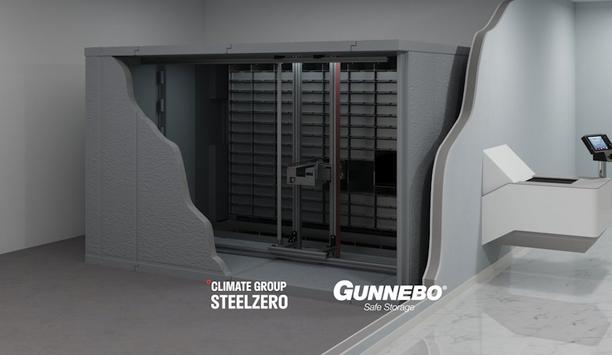
Gunnebo Safe Storage has joined SteelZero, representing a strategic step in the company’s sustainability roadmap and highlighting its determination to tackle the environmental footprint of its material supply chain. As a global corporate initiative of Climate Group uniting organizations committed to accelerating the transition to a net-zero steel industry, SteelZero requires members to commit to using 50% low-emission steel by 2030 and achieving 100% net-zero steel by 2050, while collaborating with partners and influencing sustainable industry practices. Gunnebo Safe Storage’s products Steel is central to Gunnebo Safe Storage’s products, including safes, vaults, strongrooms and secure storage solutions, driving on average 40% of Gunnebo’s total carbon impact. Myriam Bevillon, Head of Research and Development, Quality and Sustainability at Gunnebo Safe Storage, says: “Steel underpins the security and resilience of our products, but it also carries a high environmental cost. By joining SteelZero we can take practical steps to reduce this impact." “The partnership gives us direct access to expertise and collaboration that will support progress across our own operations while contributing to wider industry change.” Transitioning to low-emission steel For Gunnebo Safe Storage, reinforced steel is one of the most significant purchased materials and a key driver of its overall carbon footprint. Transitioning to certified low-emission and near-zero steel is therefore an essential part of its goal to become a net zero business by 2045. The company will now work alongside more than 40 other SteelZero members, together representing demand of over 10 million tons of steel each year. Collectively, this membership base is building the conditions needed for systemic change in the steel sector, encouraging innovation and scaling technologies that reduce carbon intensity. Steel decarbonization Sameen Khan, Senior Manager at SteelZero at Climate Group added: “Steel is one of the largest sources of industrial emissions, and Gunnebo Safe Storage is proving that leadership in steel decarbonization can come from any sector.” “By working closely with their supply chain and prioritizing low-emission steel, they’re showing how collaboration and embedding best practices are essential in accelerating the industry’s transition to net zero.”

Expert commentary
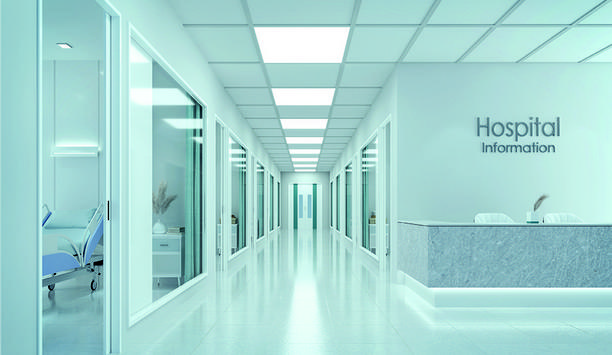
Daniel May of Consort reviews the integration of access control systems in healthcare settings, outlining the benefits and key considerations decision-makers must make throughout product specifications. From patient safety and traversal to the protection of sensitive data and pharmaceuticals, healthcare environments are faced with several operational challenges. And where security remains at the forefront of decision-making, modern access control systems may often hold the answers. Physical security systems Hospitals in particular have developed into multi-faceted spaces that house hundreds to thousands of patients, staff, and visitors at any one time. In England for example, research has found in the three months leading to June 2023, an average of 44,626 people visited major hospital A&E departments each day, with over 16 million attendances typically recorded over the course of a year-not to mention an additional nine million logged at other minor units. For any building, this level of sustained footfall can request severe security difficulties For any building, this level of sustained footfall can invite severe security tests. With that, the need to deploy effective physical security systems in healthcare is clear. And so, as access control continues to become more readily adopted and new products enter the market, decision-makers are reminded to consider the requirements of their building, ensuring they select the solutions most suited to their settings and budget. Security controlled Patient safety will always remain the top priority in healthcare settings, and where matters of health and social care come into question, a diverse set of professional regulatory bodies are tasked with setting and maintaining high standards. When it comes to healthcare premises specifically, patient security and perimeter security often come hand in hand and are amongst the most pressing of challenges that decision-makers must face. To help address operational planning and potential design concerns in the NHS, the Health Building Note (HBN), provides general design guidance for healthcare buildings under HBN 00-01-citing the use of access control measures as a way of maintaining security and protecting the safety of patients, staff, and visitors. Use of access control Hospital buildings control varied levels of access for a number of security purposes Hospital buildings, for example, must control varied levels of access for a number of operational and security purposes. Routine scenarios exist where vulnerable patients are under monitoring and thus refrained from exiting the premises for their own safety, while at the same time, permitted staff must be able to reach their patients and medicines when required. For this, the use of access control is key. Equally, access credentials can also help management teams keep track of those who may be entering or exiting rooms with equipment and pharmaceutical supplies, deterring any unwanted visitors and opportunists in the process. Incorporation of access control systems On a similar note, regulations have set a minimum standard for how personal data should be stored and managed in healthcare environments, giving decision-makers an added responsibility to regulate staff-controlled areas with patient medical records. While instances of personal data breaches are rare, healthcare facilities and professionals are at legal risk should confidential data be found misused or missing. As such, the incorporation of access control systems has become essential in keeping data storage areas secure, with intuitive online systems capable of permitting access to staff with the correct credentials while simultaneously tracking who has requested clearance at digital entry points. HBN guidance Healthcare experts are better fitted to control the sheer volume of people entering and exiting To function effectively, healthcare facilities must always be perceived as safe places by the people who reside within them, and as HBN guidance implies, a unified physical security system can help address key safety and security concerns while enhancing patient and staff experience. Opportunely, access control systems are more accessible and adaptable than ever and combine several technologies such as mechanical locks and automatic doors with electronic access credentials in the form of smartphone apps, badge readers, and biometric scanners. By integrating these systems into the building’s existing infrastructure, healthcare professionals are better equipped to control the sheer volume of people entering and exiting the premises without impairing the general flow of movement and coordination around the facility. Better by design Despite the clear benefits offered to healthcare facilities, there are a number of considerations to be mindful of when choosing an access control solution. Poorly implemented systems can have an adverse effect on security and functionality - quickly costing healthcare organizations time and budget to rectify and replace the inadequate products that don’t meet the building’s requirements. For that reason, decision-makers and design teams are reminded that there is no single solution that fits all healthcare buildings. As such, it’s crucial for decision-makers to understand the systems that are being put in place throughout each of the touchpoints in their facility. Clear collaboration is required during periods of specification, where together, teams can ensure the selected product works on all angles, from meeting fire safety and sustainability standards to aesthetics and scalability. Modern access control products Scalability is a key area that decision-makers must review when selecting access control systemsFrequently overlooked, scalability is a key area that decision-makers must review when selecting access control systems. Such is their diverse nature; healthcare facilities can often change and develop as years go by, and by selecting a system that facilitates growth, such as a cloud-based solution-security and efficiency is long-established. While modern access control products are known for seamless integration, there are some systems that may restrict the ability to use different vendors throughout the remainder of the building’s infrastructure. This, in effect, causes a monopolization of products throughout the estate, which can have an adverse effect on growth by increasing costs and reducing the levels of service associated with the security system already in place. Improve security and safety A scalable and reliable access control system will continue to improve security and safety by adapting to a building’s new requirements-and all while having minimal impact on its operational network. And so, while technology will no doubt continue to influence and transform the access control market, healthcare facilities and their professionals must continue to remain educated on their own systems, ensuring they have the best options in place to keep their patients, staff, and visitors safe and secure for years to come.

Schools were never designed and built with social distancing in mind. So it’s perhaps not surprising that as children returned to schools for the autumn term this year, the prospect of outdoor classes and assemblies was mooted in the media and by the Government. Many in the education sector are making the case that, should there be further COVID-19 outbreaks, in the coming months, it would be better to utilize outside space, rather than resort to closing schools. In the COVID-19 era, head teachers are considering taking learning and large gatherings, such as assemblies outdoors, when possible. Managing ‘class bubbles’, hygiene and ventilation While Dr. Yvonne Doyle, the Medical Director of Public Health England (PHE) has publicly reassured parents that schools are not the ‘drivers’ or ‘hubs’ of COVID-19-19 infection in communities, there is a lot of pressure on school leaders to manage ‘class bubbles’, extra cleaning and hygiene, ventilation, and COVID-19 testing, to protect families and staff. It’s a logical step to switch, in certain circumstances, to outdoor activities where fresh air is on tap, and social distancing is far easier to manage. Specially built outdoor classrooms Across the school and nursery sector, there’s ongoing investment in specially built outdoor classrooms Across the school and nursery sector, there’s ongoing investment in specially built outdoor classrooms, which had been growing in popularity, even before the pandemic. These facilities offer numerous benefits as an extension of existing learning spaces and provide children the opportunity for hands-on learning, beyond a stuffy classroom. However, if outdoor spaces are routinely called upon as part of COVID-19 contingency planning, how can schools ensure that their outdoor classrooms and wider areas are secure, robust, and fit for purpose? When specifying outdoor classrooms and learning spaces, it’s essential to take into account the well-being of the students and staff, who will use them, noise pollution and acoustics. Most importantly, education managers need to ensure the surrounding area is secured and adequately protected from threats, including terrorism. Perimeter security measures for schools How can schools and nurseries secure their perimeters, so that outdoor learning is totally safe for all? A starting point is to seek out architects and suppliers, who have a good understanding of security standards. Worryingly, Jacksons Fencing’s research recently found that only one-third of architects are seeing both LPS 1175 and the UK police initiative, Secured by Design (SBD) physical security standards, specified for schools. This highlights a lost opportunity for architects to propose solutions that are appropriate to the level of risk and needs of the school, without turning the site into an unwelcoming fortress. Helping schools identify specific security needs Head teachers would be wise to work with architects, who not only know the latest security standards inside and out, but are also are willing to play a more advisory role, helping the school identify exactly what is needed. Head teachers should prioritize solutions appropriate to their site’s specific risks It’s also vital that architects don’t simply replace existing fencing and gates, with the same security systems that have been in place for years. Instead, they will need to meet changing needs and risks. Our research finds that teachers often report issues, with the school perimeter and gates, from being climbed over (28%) and causing injury, to gates not locking properly (10%). Head teachers should prioritize solutions appropriate to their site’s specific risks, which sometimes require altering of existing measures. School fencing is an important aspect of any education site. As well as defining its boundary and making a visual distinction between public and private property, the fencing and gates that surround and secure a school, will typically meet a wide variety of other important criteria, including preventing unauthorized entry to the grounds, protecting pupils, staff, and visitors from accidents and injury, deterring theft and anti-social behavior, and reducing the risk of malicious damage, and acts of terrorism. Welded mesh panels for perimeter fencing Popular options for schools include welded mesh panels for perimeter fencing or sports areas, and railing systems to act as demarcation, in order to control foot and car traffic. Within the outlying boundary, barriers, bollards and parking posts will keep pedestrians, and vehicles safe from each other, while timber fencing and gates can be designed to control the flow of people, around the grounds and reduce the areas, where students can be hidden from view. Automated gates and access control Perimeter fencing must be complemented with safe entrances and exits for vehicles and pedestrians. Every school has unique entry-control requirements, determined by factors, such as size, location and the local environment. These needs influence the decisions you make, when preparing technical specifications for school security gates. Do you require gates to be steel or timber, manual or automated, single or double leaf? Specialist suppliers will be in the best position to offer inputs on school gates, which typically need to offer solid security and durability, with a welcoming aesthetic. Specifying access control system When specifying a school access system, it’s important to consider the areas of the school When specifying a school access system, it’s important to consider the areas of the school, such as sports fields, car parks, and children’s play and learning areas, and whether it requires playground segregation. Selected gates should meet the design of the fencing, to create a secure perimeter with no weak points, with automated gates conforming to all current safety regulations. . Noise pollution can be a problem as well, including noise coming in or leaving the school in residential areas. If more teaching is to be carried out outside, it’s worth considering acoustic barriers to reduce noise in and around the school. Timber acoustic barriers for security and privacy Timber acoustic barriers offer security and privacy, and can reduce noise levels, by as much as 32 decibels (in laboratory conditions), so are ideal for city center schools or those located close to busy highways. There are many ways to build an outdoor classroom. Timber products can help to create a welcoming environment, such as wooden shelters, pergolas, fencing, and decking. Always check that high quality timber, ideally guaranteed for 25 years against rot and insect attack, is being used to provide an attractive, cost-effective, safe and sustainable solution, for all weather conditions. DBS approved installers And of course, installers must be DBS approved, so that they can install outdoor classrooms, during school holidays, or within term time, with minimal disruption. The COVID-19 pandemic had a huge impact on schools and learning. While nobody wants to think of fresh outbreaks of the infection, or any other virus, installing an outdoor classroom made from high-quality, long-lasting materials is a great way to future-proof school learning and ensure safety, and preparedness. Putting extra thought and care into the security angle will provide schools with decades of protection against a host of unforeseen events.
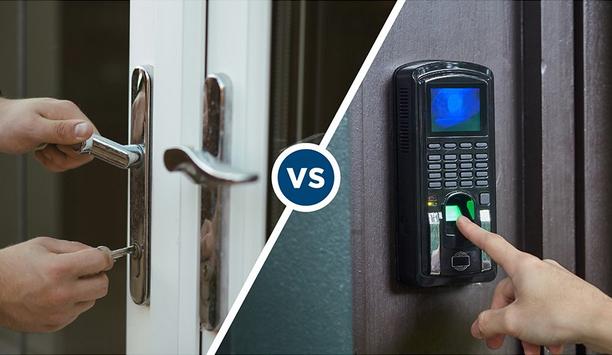
The concept of security has substantially upgraded because of technological advancements. We have seen a shift from mechanical locks to electronic locks and door access control systems which are more relied upon nowadays for watertight security and safety. But, choosing the system that is the best for you requires understanding how both these technologies work. In this article, you will get a clear idea of: How electronic locks are better than traditional locks The difference between access control systems and new locking mechanisms Why biometric technology is the best access control system What are traditional locks? These are mechanical locks having strong metal deadbolts, knob locks, levers, etc. They always require a matching physical key. Mechanical locks are easy to install and can protect houses and small offices. However, their keys can be copied easily. Anyone with a key can open a mechanical lock, no matter if it isn’t the owner. Insight: The only advantage of mechanical locks is they’re very modestly priced, so if your security requirements aren’t very complex, mechanical locks can serve you well. The new-age electronic locks Electronic or digital door locks give you increased control over who can enter your premises, extending greater security and accessibility. They are operated using cards or biometrics. Cards cannot be copied without the owner or the manufacturer’s knowledge. Some smart digital locks also provide information on who accessed your door and when, and any attempts of forced entry. Insight: Although more costly than traditional locks, electronic locks are a better option and investment. What is access control? Access control is a comprehensive system of security that covers all the doors or access points of your premises, only allows entry to people who are registered in the system, exercises surveillance in terms of IDing each user requesting access, and maintains detailed records of all transactions done on the system. The elements required for installing and operating an access control system are: The access reader – This is installed on or beside the door or the access point, is connected to the electric lock, and acts upon the instructions programmed into it by the administrator. The access key – An RFID reader uses an RFID card key, and a biometric reader uses a biometric identifier (fingerprint, palmprint, etc.). The control panel – This stores all the information of the access keys, employees, visitors, etc. and reads commands from the key and sends it to the reader. Electronic lock – The access control door locks are controlled by the control panel. Access control systems go beyond electronic locks as they bring your entire premises under one security framework for convenient monitoring. Why Biometric Access Control Systems Are The Best Bet Biometrics – the science of evaluating features of the human body to establish your identity. Biometric technology has been earning immense approval all over the world in the last two decades. From quick access to managing records of visitors, biometrics does it all, making it the best access control system in use. As a general practice, companies looking to install biometric security solutions should consider the following points to make their decision easier and more accurate: The purpose for which the system is to be installed. The group of employees who will be using it. The area and scale where it is going to function. Understanding Biometric Access Control Mechanisms According to reports, biometric verification was first encouraged by law enforcement agencies in the 1800s to identify criminals. Later, it was adopted by businesses and large companies for recording the attendance of their employees and maintaining records. Today, technological advancements have developed biometric access control & security systems that can analyze an array of biometric identifiers: Facial Recognition Fingerprint Recognition Voice Recognition Iris Recognition Retinal Scans The easiest to install and the most common biometric ACS (access control system) is fingerprint recognition. They’re highly preferred by organizations of all scales and sizes and are easy for employees to operate as well. Next in line is facial recognition, which is slightly expensive due to its equipment and tech, but highly adopted, nevertheless. This has become possible due to facial unlocking systems flooding the smartphone market and making this technology more normalized, plus the onset of the covid-19 pandemic that surged the demands for contactless solutions everywhere. Insight: For this reason, many biometric access control system manufacturers develop scalable devices that can accommodate multiple identifiers as per the client’s necessities. A unique benefit of the voice recognition component in access control mechanisms is ‘convenience with fun’. We cannot deny the expediency of "Hello Google", "Hey Siri" and "Alexa" in Google Assistant and Apple's voice recognition facilities. Voice recognition is a comparatively costlier access control mechanism and so small companies hesitate to employ it. Insight: Voice recognition is a developing technology; it can become cost-efficient in the future. Both iris recognition and retinal scans are ocular-based biometric identification technologies that seem similar but are actually quite different. A retina scan is performed by casting a beam of low-energy infrared light into a person’s eye as they look through a scanner’s eyepiece at close range. Iris scanning uses camera technology to obtain a detail-rich image mapping out the intricate structure of the iris. Overview: Retina scanning is more invasive than iris scanning because the retina is positioned at the back of the eye. Iris scans take a picture of the iris from a distance, whereas retina scanning takes a picture of the iris by putting the person's eye close to the scanner. Insight: Companies looking to install these 2 systems should consider the users as retina scanning works the best for in-person authentication, and iris scanning can be done digitally. How Does Access Control Transcend All Other Locking Systems? The number of benefits that modern access control systems offer is quite evident. They encompass all features of traditional as well as electronic locks and amplify security to a significant level. Moreover, biometric access control raises the bar by eliminating the risks of keys/ proximity cards getting stolen and enforcing identity-based access so that only the one who is authorized can enter.
Security beat
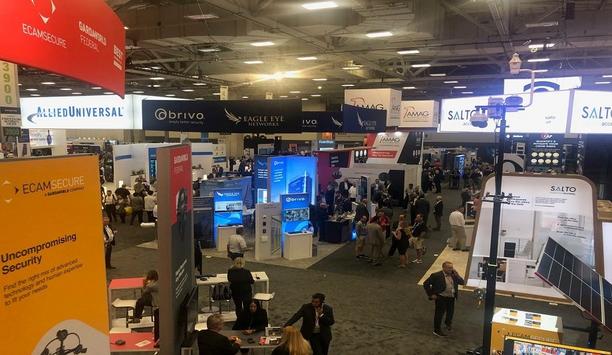
Companies at GSX 2023 emphasized new ways that technologies such as artificial intelligence (AI) and the cloud can address long-standing issues in the security market. Among the exhibitors at the event in Dallas were companies seeking creative ways to apply technology, lower costs, and make the world a safer place. Reflecting on the exhibition, here are some additional takeaways. Expanding AI at the edge i-PRO is a company reflecting the continued expansion of edge AI capability in the security market. Today, more than half of the company’s lineup supports AI at the edge so the customer has a wide choice of form factors when seeking to leverage the feature set. AI processing relay, extended warranty i-PRO is increasing their warranty period from 5 to 7 years, which could be a lifetime warranty in some cases I-PRO also has an “AI processing relay” device that accepts non-AI video streams and applies edge analytics. AI has progressed from a high-end technology to a feature available in a variety of cameras at different price points. i-PRO is also increasing its warranty period from 5 to 7 years, which could be a lifetime warranty in some cases depending on a customer’s refresh schedule and lifecycle management. Active Guard, MonitorCast The company’s video management system (Video Insight) is continuing to build new features including “Active Guard,” an integrated metadata sorter. Their access control platform, MonitorCast, is a Mercury-based solution that is tightly integrated with Video Insight. Their embedded recorders now have PoE built in. “We can move at a faster pace to fill out our product line since leaving Panasonic,” says Adam Lowenstein, Director of Product Management. “We can focus our business on adapting to the market.” Emphasis on retail and other verticals Shoplifting is a timely issue, and retail is a vertical market that got a lot of attention at GSX 2023. “We see a lot of retailers who are primarily interested in protecting employee safety, but also assets,” says Brandon Davito, Verkada’s SVP of Product and Operations. “Shrinkage is a CEO-level priority.” “Retailers are getting more engaged with security posture, instead of letting perpetrators walk,” Davito adds. Intrusion detection Verkada has an intrusion product that will notify a central station if there is an alarm On the alarm side, Verkada has an intrusion product that will notify a central station if there is an alarm, and operators can review videos to confirm the alarm. Other capabilities seeking to discourage trespassers include sirens, strobes, and “talkdown” capabilities. International expansion Verkada continues to expand internationally with 16 offices in all, including Sydney, Tokyo, and London. The core value proposition is to enable customers to manage their onsite infrastructure more simply, including new elements such as PTZ cameras, intercoms, and visitor management. Verkada emphasizes ease of use, including a mobile application to allow access to be managed across the user base. Forging partnerships “We are committed to the channel and industry, and we continue to build relationships and expand our reach,” says Davito. Among the industry relationships is a new partnership with Convergint, which was hinted at during the show and announced later the same day. They are also expanding their partnerships with Schlage, Allegion, and ASSA ABLOY. Working with other verticals They offer new features for K -12 schools, and a new alarm platform is easier to deploy and manage Verkada has also found success across multiple other verticals, notably healthcare, where they integrate with an electronic medical records system. They offer new features for K-12 schools, and a new alarm platform is easier to deploy and manage. They are integrating wireless locks to secure interior doors in schools, looking to secure the perimeter, and installing guest management systems. Transitioning the Mid-Market to the Cloud Salient is squarely focused on the “mid-market,” a large swath of systems somewhere between small businesses and enterprise-level systems. Pure cloud systems are not as attractive to this market, which has a built-out infrastructure of on-premise systems. Adding a camera to an existing system is easier and less expensive than tying it to the cloud. Benefits of cloud It’s a market that may not be ready for pure cloud, but there are benefits to be realized from adding a cloud element to existing systems. “We are continuing to augment our premise-based solutions with added cloud capabilities and flexibility,” says Sanjay Challa, Salient’s Chief Product Officer. The feedback Salient hears from their customers is “I want to own my data.” The hybrid cloud approach offers the right mix of control, flexibility, and unit economics. Cloud add-on capabilities We want to provide the flexibility for customers to go full-cloud as it becomes more economically attractive" Cloud add-on capabilities include bringing more intelligence about system operation to the user via the cloud. Over time, Salient expects to sell more cloud-centric offerings based on feedback from integrators and customers. “We want to provide the flexibility for customers to go full-cloud as it becomes more economically attractive over time,” says Challa. Vaidio AI technology Salient seeks to be a transition pioneer to help customers realize the path to the cloud. Their approach is “crawl, walk, run,” and helping customers make the transition at each stage. Salient has added AI to its product offering, incorporating Vaidio AI technology from IronYun into a powerful suite and broad array of on-premise analytics, which are gaining traction. The seamless approach makes it easy for customers to embrace AI analytics, although Salient remains broadly committed to open systems. Addressing ‘Soft’ Features for Integrators AMAG is in the process of enhancing its product line with the next generation of access control panels. However, “product” is just part of the new developments at AMAG. In addition to “hard” features (such as products), the company is looking to improve its “soft” features, too; that is, how they work with the integrator channel. Integrator channel Rebuilding a process to make your organization more efficient, is relatively easy; it just takes a lot of persistence" “We have the depth of our legacy customer base we can learn from, we just need to close the feedback loop quicker,” says Kyle Gordon, AMAG’s Executive Vice President of Global Sales, Marketing, and commercial Excellence, who acknowledges the value of reinstating face-to-face meetings after COVID. “We are laser-focused on nurturing our integrator channel,” he says. “Developing new features takes time, but rebuilding a process to make your organization more efficient, that’s relatively easy; it just takes a lot of persistence,” says Gordon. More cohesive internal communication is another useful tool, he says. Disrupting the cloud based on price Wasabi is working to make cloud applications less expensive by offering a “disruptive” price on cloud storage, $6.99 per terabyte per month (80% less than hyperscalers). Contending “hyperscalers” like AWS are charging too much for cloud storage, Wasabi is using its own intellectual property and server equipment co-located in data centers around the world. Wasabi sells “hot cloud storage,” which refers to the fact that they only have one tier of storage and data is always accessible. In contrast, a company such as AWS might charge an “egress fee” for access to data stored in a “colder” tier. Cloud storage “We saw that several video surveillance companies had not yet adopted cloud storage, and we saw an opportunity to make it easy to use,” said Drew Schlussel, Wasabi’s Senior Director of Product Marketing. “We just install a little bit of software that allows them to store data in the cloud and bring it back from the cloud.” Performance, protection (cybersecurity), and price Wasabi works with integrators, resellers, and distributors and also integrates with VMS companies Wasabi works with integrators, resellers, and distributors and also integrates with VMS companies such as Genetec and Milestone. Emphasizing performance, protection (cybersecurity), and price, their data centers are certified to SOC 2 and ISO 27001 standards. Faster throughput for weapons detection Xtract One is a young company focusing on weapons detection in a time of accelerated concern about gun issues post-COVID. Founded in Canada and based on technology developed at McMaster University, Xtract One has found a niche in providing weapons detection at stadiums and arenas. These customers already have budgets, and it is easy to shift the money to a newer, faster technology. Madison Square Garden in New York City is among its customers. Cost savings solution Xtract One can increase throughput to 30 to 50 people per entrance per minute (compared to 5 to 6 people per minute when using metal detectors). The solution doesn’t require anyone to empty their pockets and the system alarms on items beyond guns and knives. Using Xtract One allows customers to reduce the number of screening lanes and security staff, providing additional cost savings, all while getting fans through the screening process in half the time. Purpose-built sensors The system uses purpose-built sensors looking for specific characteristics, such as reflective and density properties In addition to stadiums and arenas, Xtract One, formerly Patriot One, is also getting “inbound” interest from schools, hospitals, manufacturers, and other verticals that makeup 50% of their business. “We’re on a rocket ride, mainly because the weapons issues are not going away,” says Peter Evans, CEO and Director at Xtract One. The system uses purpose-built sensors looking for specific characteristics, such as reflective and density properties, all correlated by an AI engine. Providing early warning of violence ZeroEyes is another company focused on weapons detection. Their AI gun detection system works with video images to identify if someone is “brandishing” (carrying) a weapon. In other words, the system does not detect concealed weapons. Identifying someone carrying a weapon provides early warning of a possible violent act. Increased response with AI-enables images Images are identified by AI and sent to a monitoring center where a human confirms the image before contacting first responders. Knowing the location of a shooter enables staff to lock entry points, move people to safety, and direct first responders. The company was founded to leverage existing camera views to stop mass shootings and gun violence by reducing response times.

Convergint Technologies’ rapid growth has come through a combination of organic growth and acquisitions — they have acquired 35 companies since 2014. Growth has been a focus since day one when the founders started the systems integration company with 10 colleagues in a basement. Today, the diverse company includes more than 5,000 employees globally. As technology has advanced and business practices have evolved, Convergint’s core values and beliefs have guided their path forward. Customer-centric approach Convergint’s culture is a critical aspect of the company, from the executive level to frontline colleagues. “It is essential that the companies we look to acquire and develop partnerships with directly align with our people-first, customer-centric, inclusive culture centered on colleagues and customers,” says Mike Mathes, Executive Vice President, Convergint Technologies. “This approach has allowed us to maintain and grow our number of colleagues across our acquisitions and enables us to continue being our customers’ best service provider.” Integration practices Many practices have to be form-fitted to each individual acquisition A simple but important consideration as Convergint grows through acquisitions is: No two companies are the same. While some integration practices can be standardized across the company, many practices have to be form-fitted to each individual acquisition, says Mathes. “Our objective is not to come in and immediately implement change. We want to build on what has already been successful within the local market and share our learned experiences. There is plenty we can learn from each other and create a much better organization.” Mathes says that Convergint’s view of a successful acquisition is that 1+1=3. “The end result is always much more impactful than what we anticipated,” he says. “Every acquisition brings with it an experienced leadership team, dedicated and skilled colleagues, vertical market and technological expertise. Most acquisitions are in geographies where we do not already operate, so with every acquisition, we increase our capability to serve our customers much better.” Also, the network of Global Convergint Technology Centers (CTCs) helps expand clientele, and the Convergint Development Center (CDC) offers new support capabilities allowing acquisitions to grow at a very high rate. Expanding service Are there more acquisitions to come? Mathes says Convergint is always open to further expanding its footprint across the globe, improving its ability to service customers, deepening their technical expertise, and continuing to expand service offerings across the current and new vertical markets. However, the current focus remains on several key factors: service to colleagues, customers, and communities. “While obviously, acquisitions fuel our growth, the addition of these organizations to Convergint has really improved our ability to service clients on a global basis,” says Mathes. Acquiring ICD Security Solutions in Asia, for example, made Convergint a pioneer in that market for U.S.-based multi-national companies. Meeting customers demand “Convergint does not weigh market conditions when making an acquisition decision,” says Mathes. Rather, they are primarily focused on meeting or exceeding their customer’s needs on a local to a global level. They see acquisitions as a potential way to extend their geographic reach so they can be closer to customers. An acquisition might also expand technological or vertical market expertise. “The end goal is for us to enhance our service capabilities by attracting and retaining talented colleagues and leaders to better service our customers,” says Mathes. Enhancing and expanding services Convergint identifies how to leverage the expertise to further enhance and expand current service options“Economies of scale” have not been a consideration. They have never sought to acquire companies and restructure them in the process, for example. Rather, each company brings forth a unique skillset, is carefully vetted by the executive team and provides purpose in the company's mission and vision for the future.” “Frontline colleagues are Convergint’s most valuable assets,” says Mathes. Rather than restructuring and eliminating skilled, knowledgeable colleagues, Convergint identifies how they can leverage the expertise to further enhance and expand current service options for customers. “Our colleagues and their skill sets are our competitive advantage—they remain an essential element to our success,” says Mathes. Demand for integrator services “We continue to experience a growing demand for innovative solutions across electronic security, fire alarm, and life safety,” says Mathes. “As companies innovate further and rely on technologies such as artificial intelligence, cybersecurity, IoT, and cloud solutions, we expect to see an increased demand for integrator services. Our customers demand a local service provider who is responsive and can meet their needs, which is why Convergint aims to be its customers’ best service provider.” This year, Convergint is celebrating its 20th anniversary. In 2021, they will continue to focus on the same critical components that have dominated since day one taking care of colleagues, customers, and the communities where they operate.
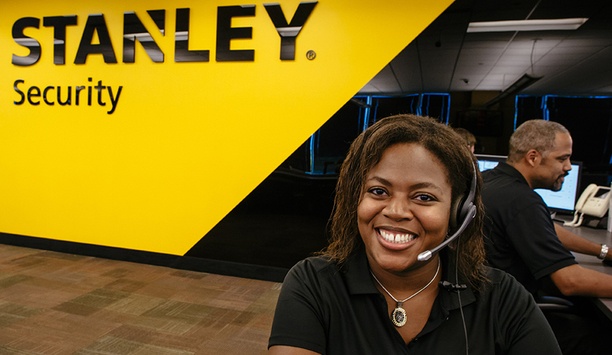
As security embraces IT-centric solutions, it can provide business value over and above security. Now in charge of managing a variety of data – e.g., from video platforms – a company’s security function has access to a range of new metrics. While security may use video to analyze a security event, machine learning can analyze the same data for other business capabilities, such as quality control or when a policy has been breached. “It’s the same camera, but with dual purpose,” says Matt Kushner, President of STANLEY Security. STANLEY Security, one of the largest integrators with a global footprint, has positioned itself at the center of the industry’s transformation by information technology (IT) and the Internet of Things. “Security will become an expanded business partner with corporations,” Kushner comments. In response to the trend, STANLEY is hiring more IT-oriented technicians and salespeople within the IT community and who can “speak at the C-level,” Kushner comments. Sonitrol is the most recognised brand by law enforcement for verified response Data centers, higher education and logistics STANLEY manages very large, multi-national clients. As a consequence, the STANLEY security organization has some of the best and brightest minds for enterprise-class security. To maintain that level of talent, STANLEY is committed to education. “We bring them into the family and focus on education, such as IT and IoT training. That’s critical in a world where unemployment is less than 3%. Finding good people, growing good people, and retaining good people – we do that exceptionally well at STANLEY,” says Kushner. STANLEY’s strong vertical markets including data centers, higher education, and logistics. They are also strong in multi-location installations (such as banking.) STANLEY has a big footprint throughout North America and Europe. PACOM access control and 3xLOGIC cloud-based solutions In addition to STANLEY’s core integrator business, the company also manages several manufacturing brands such as PACOM access control and 3xLOGIC cloud-based solutions. Mergers and acquisitions have been commonplace in the integrator spaceBeyond its company-owned integrator locations under the STANLEY brand, the company also owns Sonitrol, the strongest brand in the market for verified response with 65 franchises in North America. Sonitrol is the most recognized brand by law enforcement for verified response. Mergers and acquisitions have been commonplace in the integrator space, and Kushner says that STANLEY is “open and actively looking for properties that fit our commercial growth strategy.” He notes that STANLEY focuses on the commercial side of the market, where there are good margins and continuing growth. They pay less attention to the residential side which is “being heavily disrupted.” Strong partnerships with manufacturers STANLEY has strong partnerships with several manufacturer partners, through which they bring new breakout technologies to market from emerging companies. An example is Evolv Technology, a manufacturer of gun and bomb detection technology. “We see them as a leading provider of the technology, and they are, in my mind, a very disruptive provider,” says Kushner. STANLEY is also collaborating with a company – to be announced – that provides a unique gunshot detection technology, he says. STANLEY is also cooperating with dormakaba to implement Switch Tech, a Bluetooth wireless core that can replace any standard mechanical lock core. Existing locks can be transformed into electromechanical locks in minutes. STANLEY is also developing a tight integration with Lenel’s mobile credentialing system. STANLEY is also cooperating with dormakaba to implement Switch Tech GSX 2019 and ISC West 2020 At the recent GSX 2019 show in Chicago, Kushner says STANLEY heard a lot about cybersecurity, especially customers wanting to make sure they are investing in cyber-hygiene and who are looking to expand into providing cyber protection. “In concert with cyber-hygiene, they are looking for health monitoring or assurance that network devices are operating properly,” he says. “They want to ensure their security platforms are cyber-secure and up to date with the latest software versions.” STANLEY is also a big proponent of cloud offerings, and Kushner hints at a big announcement at the upcoming ISC West show in Las Vegas of additional cloud offerings and/or partnerships. “There will be a variety of new solutions to be introduced, including hosted solutions and applications that benefit both security and that add new value to businesses overall.”
Case studies

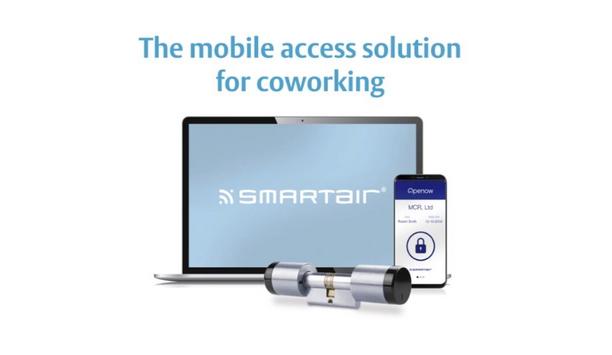
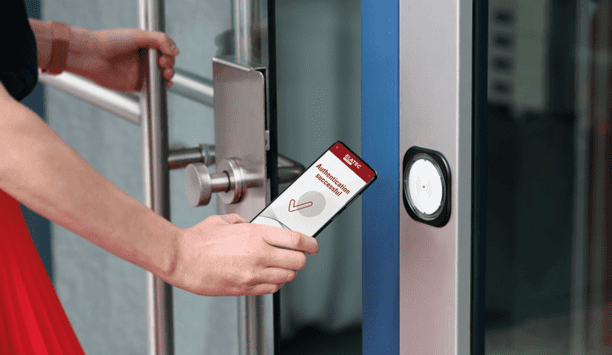
Stadiums require access technologies which are versatile, durable, reliable and easily scalable. Finding a single system which meets all these needs, and simultaneously offers digital devices for the wide range of opening types in a typical stadium, is not straightforward. In many cases, security managers resort to running two security systems in parallel. This creates added workload and complexity, especially when they must deploy a mix of digital control and mechanical cylinders at different openings. Existing stadium infrastructure For a security upgrade at their 18,000-capacity stadium, Spanish football club UD Almería wanted to transition from traditional mechanical locks to digital access control. They sought a solution which could accommodate these diverse needs and enable centralized management from a single, intuitive software interface. Ease of installation within existing stadium infrastructure and the ability to equip doors which receive lots of robust traffic were further criteria. UD Almería chose ASSA ABLOY as partner to digitalise their access. Their SMARTair digital access system includes wireless locks for many access points and mobile keys or smart cards for user convenience. The same solution now also offers centralized management of eCLIQ smart keys, electronic cylinders and padlocks. This combined solution enables the stadium to secure all their different access points digitally. Complex stadium projects By adding CLIQ devices within a SMARTair solution, organizations gain total traceability of access in a single system – saving security managers’ time and hassle. They can manage access even at remote locations with durable CLIQ cylinders and programmable keys, all from the familiar SMARTair interface. In addition, the team at Almería benefited from technical support provided by ASSA ABLOY specifiers with expertise working on digital access solutions for complex stadium projects. The complementary benefits of SMARTair and eCLIQ ensure Almería’s needs are met without compromising on security or flexibility. Reliable, durable eCLIQ and SMARTair devices have low maintenance requirements, minimizing ongoing costs. “With our SMARTair and eCLIQ system, I feel the stadium is well protected, day and night,” confirms Ignacio Martín-Calpena Miranda, Director of Facilities and Infrastructure, UD Almería. Convenient visitor management All users and access points are managed online from SMARTair TS1000 Web software. Installed devices include SMARTair i-max escutcheons and knob cylinders for glass doors, plus SMARTair integrated wall readers for office turnstiles. These are supplemented with eCLIQ smart key-operated digital cylinders, CLIQ Wall PDs and eCLIQ padlocks for gates and tool cages. This entire digital system operates without cables to or around any openings: both SMARTair and CLIQ devices are wireless and were installed quickly, between home matches, without invasive structural work. The club security team chose SMARTair for real-time control and oversight of offices, locker rooms and physio suites. Here, authorized staff use customized RFID cards which double as ID badges or mobile keys in the SMARTair Openow® app. Visitors and external contractors receive time-limited access through mobile keys sent directly to their own app, streamlining convenient visitor management. Interior service zones Alongside this, eCLIQ cylinders protect technical rooms and interior service zones. Maintenance staff and security personnel, including police, carry an eCLIQ smart key programmed with individual access permissions. “Managing SMARTair and eCLIQ doors within a single system, via TS1000, has greatly simplified our work,” adds Ignacio Martín-Calpena Miranda. For added convenience, every CLIQ smart key also has an RFID chip inside which can be programmed to unlock authorized doors secured with SMARTair devices. Aligning CLIQ with SMARTair gives facilities managers the choice of mobile credentials or RFID credentials (smart cards, fobs, or badges) for SMARTair devices, smart keys for CLIQ cylinders or smart keys with RFID tags for both SMARTair and CLIQ devices. Retrofitting existing doors Retrofitting existing doors was simple: installers simply replaced the mechanical cylinder with an eCLIQ cylinder, without wiring or batteries. Power is carried to the cylinder via the user’s battery-powered key. This hybrid installation ensures all Almería’s diverse access needs were met – only ASSA ABLOY could provide such a connected, unified system. “When organizations extend their SMARTair digital access solution with CLIQ battery-free cylinders, they implement complete oversight for their premises, including any outdoor spaces,” explains Gabriel García, Key Account Manager at ASSA ABLOY Opening Solutions. “There’s no cabling and no more need for mechanical keys – just smart, flexible management.” Implementing digital access Both CLIQ electronic and electromechanical cylinders and the SMARTair out-of-the-box system are part of a suite of connected Digital Access Solutions from ASSA ABLOY. When they are deployed together, security teams can manage even more doors from their SMARTair software interface. They can implement digital access almost anywhere, without drilling or causing damage to the building structure. The broad range of openings already covered by SMARTair are supplemented with a range of more than 60 CLIQ and eCLIQ cylinder types, making every access point secure.
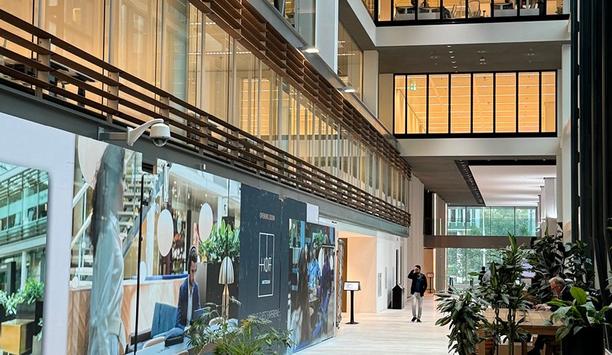
World Trade Center (WTC) Amsterdam is home to more than 300 companies. The commitment of its security team to providing a safe working environment in WTC’s fixed and flexible offices goes without saying. However, building managers wanted more from their access solution. More than just an office space, WTC Amsterdam has complementary onsite facilities, including childcare, a gym, physiotherapy clinic, bar/café, dry cleaning service, and more. Modern digital solution Modern digital solutions would provide better oversight of movement around the building All its facilities must be cleaned and serviced regularly: they sought a more time-efficient way to manage the many contractors and suppliers who come and go every day. They also hoped a modern digital solution would provide better oversight of movement around the building, including usage data to improve maintenance scheduling. For convenience during installation and day-to-day management, they targeted a wire-free solution – for simpler, less disruptive switching of 1,000 doors from mechanical locks to digital access – and intuitive management, allowing for easy changing of individual access authorizations, even at the last minute. ASSA ABLOY’s smart key digital access system With all these criteria in mind, WTC Amsterdam managers decided on ASSA ABLOY’s smart key digital access system, eCLIQ. They upgraded doors from mechanical to digital access simply by swapping the existing cylinder for an eCLIQ device. Doors are unlocked by battery-powered user smart keys, with a typical battery lifespan of 10 years. “Providing these doors with wired access control would be a huge job and become costly. Instead, we opted for the eCLIQ solution,” explains Sander Borggreve, Facility Manager at WTC Amsterdam. Concrete improvements in operations Scheduling is further simplified by storing keys with a Traka key management system The ROI in terms of workflow benefits has been significant. “Granting temporary controlled access to third parties is very easy with the eCLIQ system. We can set access for a certain period of time, but we can also revoke it at any time,” says Sander. Scheduling is further simplified by storing keys with a Traka key management system. After removing a key from the cabinet, authorized team members enter it into the adjacent eCLIQ Wall Programming Device. In seconds, the key is issued with its fine-grained access rights – covering both door-by-door and time validity. eCLIQ system maintenance and operations With the eCLIQ system, WTC Amsterdam gained not only control but also insights into usage and user flows. This data now informs maintenance and operations, reducing the overall Total Cost of Ownership for the solution. “eCLIQ works very pleasantly in practice. My employees are very satisfied with how the keys work,” says Rutger Barendse of D&B The Facility Group, who provides security staff for WTC Amsterdam. “It is easy as pie!” adds Sander.
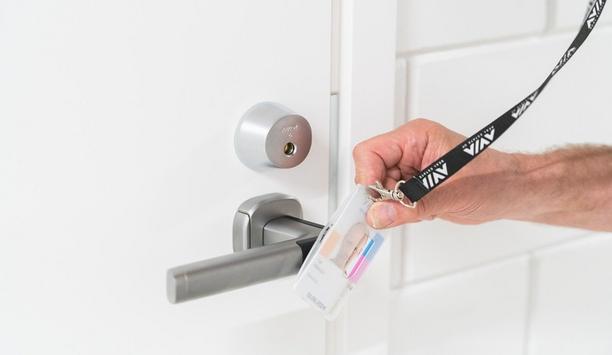
Managing access to and around Helsinki Airport is a complex task. Around 15,000 people work there daily pre-pandemic passenger numbers hovered around 60,000 to 70,000. Challenges faced Only authorized people should have access to many areas at an airport. The management of movement — by passengers, staff, and contractors— is critical to Finavia’s mission to deliver an efficient service. They sought new access solutions to help. Finavia staff and customer safety is paramount. In addition, every new access control device must: Facilitate the move to keyless security at the airport, which aims to enhance user convenience. Offer compatibility so Finavia can secure all types of openings, from doors and cabinets to fences and cargo. Integrate seamlessly with the existing access control system and software used at Helsinki Airport. Meet essential requirements for securing such a sensitive site: safety, functionality, durability and usability. Solution With Aperio H100 battery-powered handles, all types of airport doors are connected Partnering with ASSA ABLOY gave Finavia a vast choice of solutions to meet its complex security needs. With Aperio H100 battery-powered handles, all types of airport doors are connected to their access control system. This Aperio solution with inbuilt RFID capability was easy to install without the cabling that traditional devices require. “We see in real-time who will open the lock and when, and we can modify and grant access rights, remotely,” explains Kari Mäkinen. Programmable, secure ID cards Authorized building users come and go with programmable, secure ID cards. It’s much more convenient than a mechanical key, “The access cards of both Finavia personnel and staff of other companies are easily programmed with necessary access rights,” he adds. “When employees change, their access is disabled. Or if the card gets lost, it can be completely removed from the system. With mechanical keys, that process is much harder.” Durability, security of supply, and usability Multiple compatible ASSA ABLOY solutions are deployed alongside wireless Aperio and CLIQ door devices. Keyless, mobile-operated padlocks secure fencing and cargo. An antimicrobial coating on door handles helps to prevent germ spread and reassures staff. The availability of all these solutions from a single manufacturer helped Finavia to create a unified, integrated system at Helsinki Airport. “Safety, functionality, durability, security of supply, and usability were the reasons we chose the ASSA ABLOY solution,” said Kari Mäkinen, Senior Access Control Specialist at Helsinki Airport.
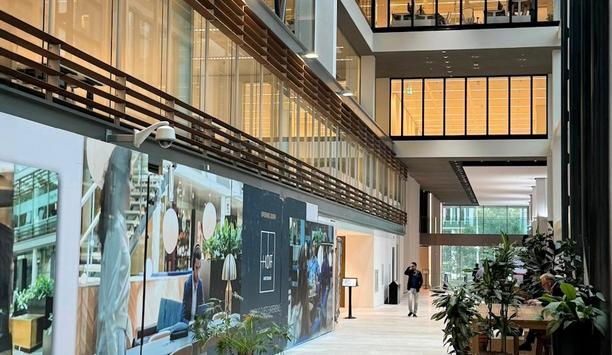
World Trade Center (WTC) Amsterdam is home to more than 300 companies. The commitment of its security team to providing a safe working environment in WTC’s fixed and flexible offices goes without saying. However, building managers wanted more from their access solution. More than just an office space, WTC Amsterdam has complementary onsite facilities, including childcare, a gym, physiotherapy clinic, bar/café, dry cleaning service, and more. All its facilities must be cleaned and serviced regularly: they sought a more time-efficient way to manage the many contractors and suppliers who come and go every day. Modern digital solution Modern digital solution would provide better oversight of movement around the building They also hoped a modern digital solution would provide better oversight of movement around the building, including usage data to improve maintenance scheduling. For convenience during installation and day-to-day management, they targeted a wire-free solution – for simpler, less disruptive switching of 1,000 doors from mechanical locks to digital access – and intuitive management, allowing for easy changing of individual access authorizations, even at the last minute. Digital access system With all these criteria in mind, WTC Amsterdam managers decided on ASSA ABLOY’s smart key digital access system, eCLIQ. They upgraded doors from mechanical to digital access simply by swapping the existing cylinder for an eCLIQ device. Doors are unlocked by battery-powered user smart keys, with a typical battery lifespan of 10 years. “Providing these doors with wired access control would be a huge job and become costly. Instead, we opted for the eCLIQ solution,” explains Sander Borggreve, Facility Manager at WTC Amsterdam. Concrete improvements in operations Scheduling is further simplified by storing keys with a Traka key management system The ROI in terms of workflow benefits has been significant. “Granting temporary controlled access to third parties is very easy with the eCLIQ system. We can set access for a certain period of time, but we can also revoke it at any time,” says Sander. Scheduling is further simplified by storing keys with a Traka key management system. After removing a key from the cabinet, authorized team members enter it into the adjacent eCLIQ Wall Programming Device. In seconds, the key is issued with its fine-grained access rights – covering both door-by-door and time validity. Maintenance and operations With the eCLIQ system, WTC Amsterdam gained not only control but also insights into usage and user flows. This data now informs maintenance and operations, reducing the overall Total Cost of Ownership for the solution. “eCLIQ works very pleasantly in practice. My employees are very satisfied with how the keys work,” says Rutger Barendse of D&B The Facility Group, who provide security staff for WTC Amsterdam. “It is easy as pie!” adds Sander.

Mul-T-Lock is working with Charnwood Lock and Key for Loc8me, a premier student accommodation management agency to provide dedicated master key systems enabling secure and efficient access for maintenance of its growing property portfolio. Since its establishment in 2008, Loc8me has grown to have over 6,000 tenants living with them and they manage over 2,500 properties across Loughborough, Bristol, Durham, Newcastle, Nottingham, Leeds, Manchester, Hull, Leicester, Liverpool, and Birmingham. Highest level of security Loc8me relies on Charnwood Key to deliver Mul-T-Lock key suites that can simplify access To ensure the ongoing maintenance of properties, Loc8me relies on Charnwood Lock & Key to deliver specialist Mul-T-Lock master key suites that can streamline access for property management processes, while ensuring the highest level of security for residents. Says Raffaele Russo, Founder of Loc8me: “For a lot of students, moving into a student home is a huge step in their independence and we want to make sure we offer the best environment for them. This includes placing a great emphasis on customer service and making them feel truly at home, with all their maintenance needs taken care of." Mul-T-Lock as a master key suite Russo added: “Working with Charnwood Lock & Key enabled us to embrace Mul-T-Lock as a master key suite we could rely on." "We have one set for each of our property developments and our associated landlords, ensuring we can maintain overall security, while balancing necessary access for our maintenance teams to ensure our homes are kept to a high standard.” Mul-T-Lock's advanced security solutions Charnwood Lock and Key played a pivotal role in implementing Mul-T-Lock's advanced security solutions for Loc8me's properties. This included considering the flexible security requirements to accommodate the many different sites while not compromising on the high level of protection, operational excellence and advanced quality assurance. Says Harry Stafford of Charnwood Lock & Key: “Loc8me places a great emphasis on creating and maintaining the best co-living experiences for students. Maintenance services are naturally key to this success. We had no hesitation in recommending Mul-T-Lock’s renowned master key suites to manage authorized access as and when required." Mul-T-Lock's master key systems Mul-T-Lock's master key systems for student redefine security and comfort in the student sector Stafford added: “The benefits of the system include flexibility for user-friendliness and ease of use, with limited key duplication that we can manage here. With Mul-T-Lock's advanced master key systems in place, Loc8me can effectively manage access control across its growing student housing properties, enhancing security for residents and providing peace of mind for property managers.” Mul-T-Lock's master key systems for student accommodation redefine security and convenience in the student housing sector. Tailored to the unique needs of accommodation providers like loc8me, Mul-T-Lock's solutions offer control and flexibility. Individual sector requirements Jamie Jagpal, Mul-T-Lock’s Product Manager added: “Our bespoke master key systems can be created to suit individual sector requirements, often guided by our long-term partners such as Charnwood Lock & Key." "What Loc8me demonstrates is by creating an established solution, it can evolve with the company’s requirements, especially with its mission to be a major management agency university in the country. We are proud to play a role in enhancing the safety and convenience of such high-end student housing."
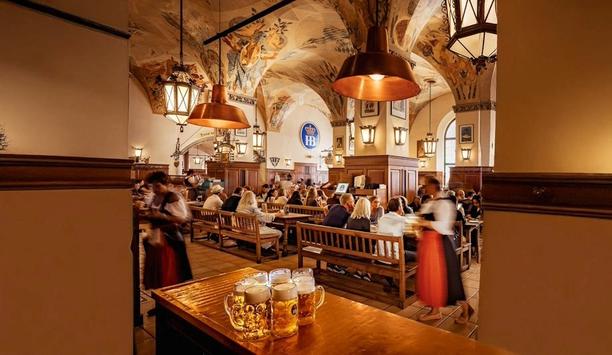
Munich’s Hofbräuhaus enjoys an iconic status, as both a heritage property and a spiritual home for lovers of German beer. “In this historic building is the world’s most famous tavern,” explains its Security Manager, Robert Graßl, adding “The whole world goes in and out. Security is very important.” Bavarian Duke Wilhelm V commissioned Munich’s original Hofbräuhaus in 1589, initially as a brewery to supply the Wittelsbacher Hof. Moved at the end of the 19th century and severely damaged during World War II, it underwent reconstruction in 1958. It now attracts tourists and city locals, seating up to 3,000 guests indoors and a further 400 in the beer garden. Access rights management Digital devices and low-impact skills were needed to assure compliance with origin protection Although the building is an important heritage monument, it requires 21st-century digital access to keep site users safe and streamline day-to-day operations. They wanted fast, secure access rights management for employees and service providers – including up to 100 waiters working each shift – within a unified system that could authorize access at both the Hofbräuhaus and their food production facility in Brunntal. Of course, inobtrusive digital devices and low-impact installation were a necessity to ensure compliance with heritage preservation regulations. Digital access for a famous heritage building Many electronic access products and technologies are not appropriate for historic buildings. An eCLIQ key-based digital access solution is different: eCLIQ cylinders are compatible with the strict monument preservation requirements at the Hofbräuhaus. They have a flush fit, so don’t even appear to be part of an electronic locking system. With wireless installation at the doors, devices blend with the building interior. “We can exchange a mechanical cylinder 1:1 with an eCLIQ cylinder without having to modify anything on the door or install cables,” confirms Miriem Hammoudi, Business Development Manager at ASSA ABLOY Sicherheitstechnik GmbH. ASSA ABLOY fitted around 100 eCLIQ locking cylinders and supplied 340 eCLIQ programmable keys for Hofbräuhaus managers to issue to relevant staff and service contractors. Easy operation for flexible, cost-efficient management Every eCLIQ key has an integrated chip and is programmable individually for the keyholder Every eCLIQ key has an integrated chip and is programmable individually for the keyholder. The versatility of eCLIQ is demonstrated when a key is lost: Access authorizations are removed rapidly – simply by reprogramming cylinders – ensuring security is maintained. The eCLIQ system also helps manage workflows for service providers, such as cleaners: Their access is enabled on a time-limited basis. A standard battery inside each programmable electronic key powers the cylinder or padlock on insertion – and encrypts data transfer between cylinder, key and system – so no external power source or wiring is needed. Scalable web-based platform The Hofbräuhaus team manages their system via a flexible, scalable web-based platform, CLIQ Web Manager: “I can program keys from anywhere or also block them quickly if a key has been lost or if someone is no longer allowed to enter,” says Robert Graßl. He adds, “And I can install any cylinder in any door by adjusting the length. I don’t have to carry extra stock which is really cost effective.” New master key system With the hosting solution chosen, access data is stored securely at ASSA ABLOY, accessible anytime and from any location, which is an ideal configuration for managing large systems or multiple locations. Their system is easy to expand anytime – future-proofing Hofbräuhaus access. “The situation before the new master key system was installed was problematic,” says Robert Graßl, adding “Keys were distributed and nobody knew who held them. Now, everyone carries only one key programmed with details of where and when they can enter. It’s perfect.”
Products

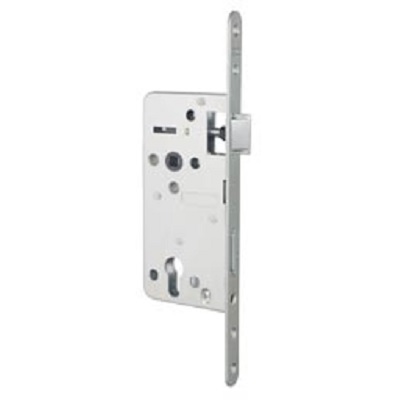
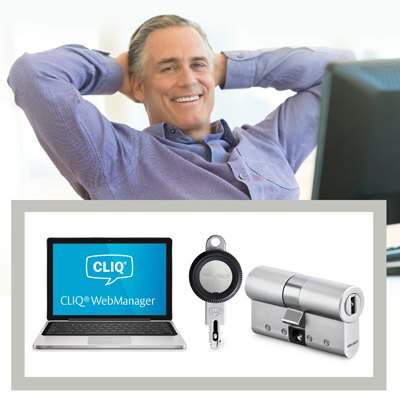

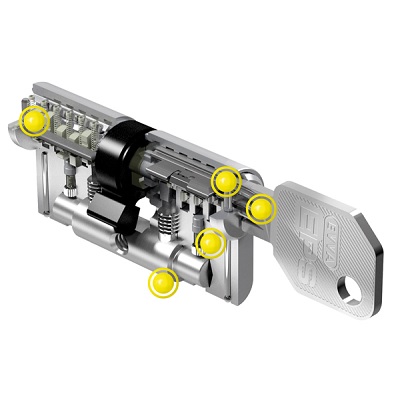
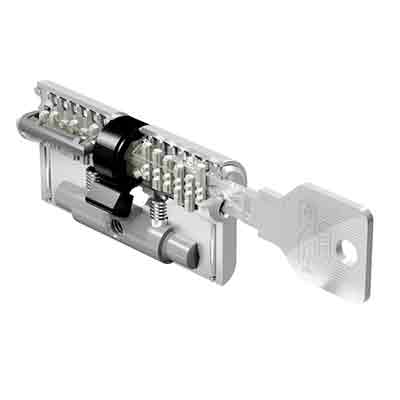
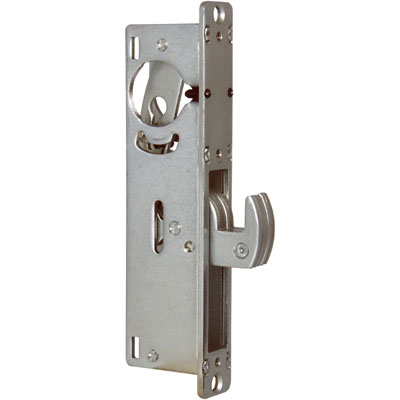
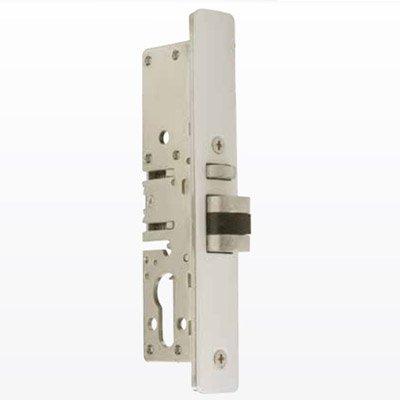
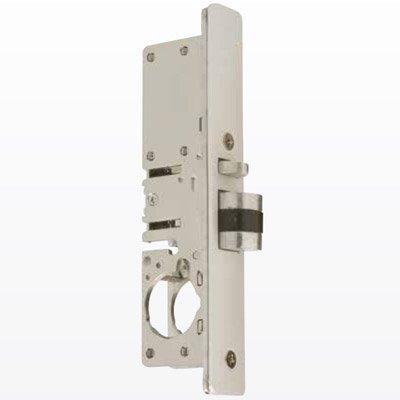
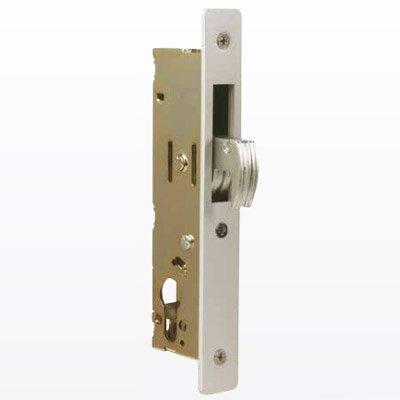
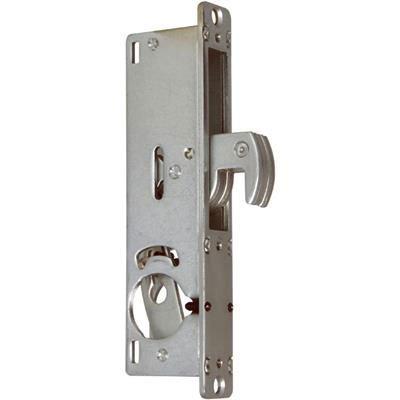
Round table discussion

Cost is a reality to be managed. No matter how powerful or desirable a technology may be to a customer, the sale often comes down to the basic question: Can I afford it? And affordability extends not just to the purchase price, but to the cost of technology over its lifespan. In addition to advances in technology capabilities, the security industry has also achieved inroads to make its offerings more worth the cost. We asked this week’s Expert Panel Roundtable: What is the physical security industry doing to make more affordable and cost-effective technology solutions for end users?

The new school year is a good time to reflect on the role of security in protecting our schools. From video to access control to some newer technologies, our Expert Panel Roundtable found plenty to talk about when we asked this week’s question: How does security technology make our schools safer?