

Deploying security robots at a company is about more than providing and programming the hardware. There is also an element of “change management” involved in smoothing the way for robots to play a security role working side-by-side with human counterparts.
Rising Popularity Of Security Robots
As security robots increase in popularity, more companies are adapting to such cultural challenges
"As security robots increase in popularity, more companies are adapting to such cultural challenges. Many Fortune 100, technology, finance and defense companies have begun using security robots, and some are asking to expand their implementation", says Travis Deyle, CEO and co-founder of Cobalt Robotics. "It is a complex solution that involves merging technology with people."
“More people are looking at how they can deploy and test this technology, dipping their toes in the water,” says Deyle. “Financially the risk is low, but culturally it is pretty acute. It is a very visible piece of technology moving through your most sensitive spaces and interacting with employees.”
Change Management
“Doing change management and addressing the cultural implications inside the company are the biggest challenges we face,” Deyle adds. “We have to make sure that people know what the robot is there for, what it does and how it helps them. There is a social contract between companies and employees about what information is being collected and how is it being used.” The technical onboarding of a robot is the easy part, says Deyle. “The robot goes in, maps out the space; it takes about an hour. The bigger part is the cultural onboarding.”
The process involves working closely with the company’s communications team to manage how the use of robots is messaged throughout the company. Deyle suggests doing a Q&A event where employees can touch and feel the robot and get comfortable. “We tailor the interaction to the individual company,” he says.
Importance Of Communication
Communication with employees, tenants, clients, law enforcement, etc. is very important
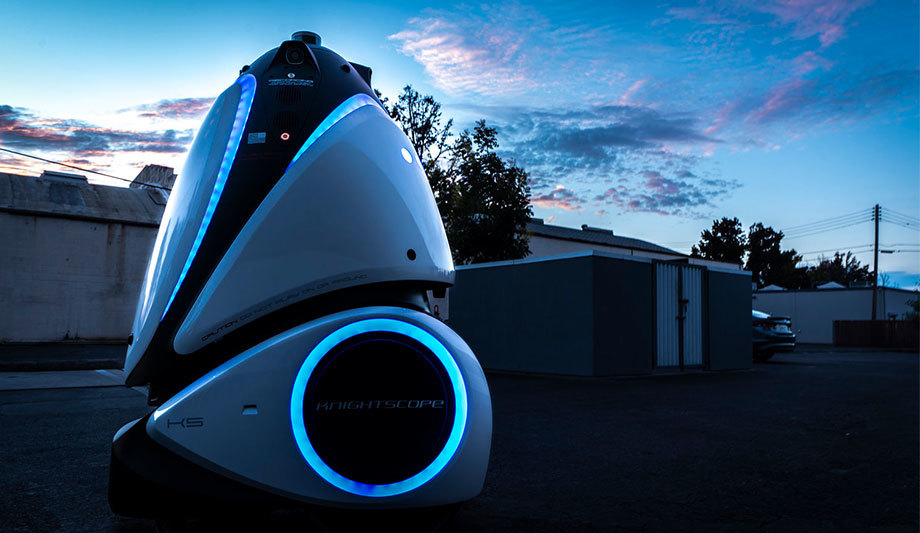
Communication with employees, tenants, clients, law enforcement, etc. is very important and, if done well, all goes smoothly, agrees William Santana Li, Knightscope Chairman and CEO. “Showing up with a 400-pound, 5-foot-tall autonomous robot, deploying it and not telling anyone what is happening is ill advised!”
Knightscope also advises potential end users to identify clearly the areas of improvement needed in a security program to guide the deployment of robots. Beware of “Science Fiction Disease,” whose symptoms include unrealistic expectations or fears emanating from Hollywood depictions of robots over the years. Expectations should be spelled out: Keep ongoing and clear communications between the provider and the client, continuing to make improvements together.
Future Of Robotics And AI
Users should also think clearly through their source of funding, including the second and future years of an implementation. Communication is key, involving stakeholders from the CSO to facilities, purchasing to human resources, finance to the CEO. The future of robotics in corporate America is more than the development of the technology.
Given advances in artificial intelligence (AI), sensors and software, the technology is the easy part. Thinking more broadly about how robotics can excel in the corporate environment – and make companies safer – is the next big obstacle on the path to effectively using the powerful technology.