India’s video surveillance sector is undergoing a notable transformation as STQC Essential Requirements (ER) compliance emerges as a crucial factor in procurement decisions.
Previously dominated by specifications like camera resolution and pricing, the market now prioritizes compliance with cybersecurity, device integrity, and regulatory standards. This shift is driven by the Ministry of Electronics and Information Technology (MeitY), which is enhancing the implementation of Essential Requirements under the IoT System Certification Scheme (IoTSCS). This change necessitates a reevaluation of how surveillance infrastructure is assessed and deployed.
Impact on Surveillance Deployments
Experts forecast this transition will fundamentally alter surveillance strategies for government bodies, manufacturing facilities, smart cities, transportation hubs, educational institutions, healthcare settings, and critical infrastructure projects.
STQC ER compliance involves adherence to IoTSCS, focusing on cybersecurity and technical benchmarks like secure firmware, encryption protocols, device hardening, secure communications, and network security. Compliance aims to bolster the cybersecurity and reliability of surveillance systems across India, not merely fulfill regulatory requirements.
New Challenges for Organizational Safety
Traditionally, CCTV purchases focused on specifications such as megapixel count and storage
Traditionally, CCTV purchases focused on specifications such as megapixel count and storage. However, with the integration of surveillance systems into enterprise IT networks, the role of CCTV cameras has evolved. These devices, now part of critical organizational networks, pose potential cybersecurity risks that could affect operational continuity, data protection, and overall security.
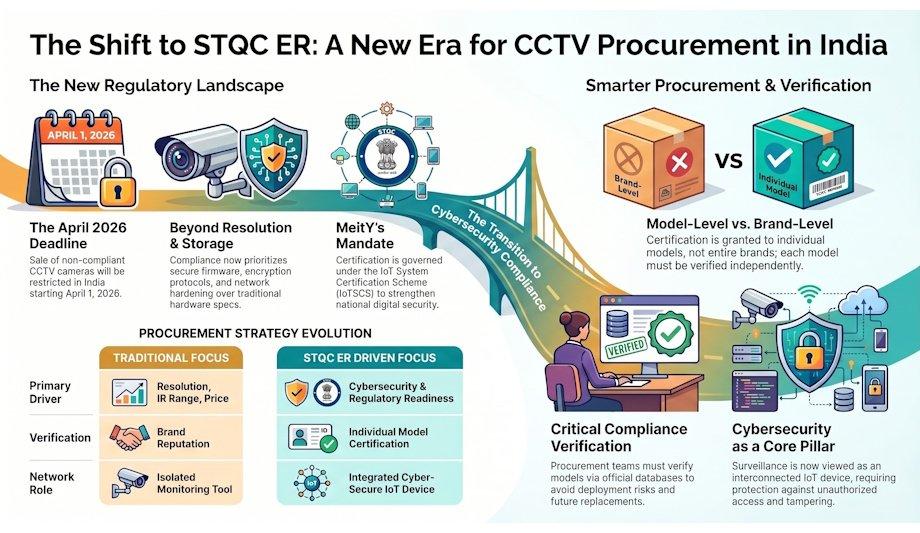
The push for STQC ER compliance is further driven by the Government of India’s mandate to halt the sale of non-compliant cameras starting April 1, 2026. This development is causing organizations to reassess their procurement strategies with a focus on compliance readiness. The certification evaluates devices on aspects like secure firmware, encryption standards, network hardening, and device reliability. Experts warn against viewing STQC ER compliance as mere paperwork, emphasizing its significant long-term operational impact.
Clarifying Certification Misunderstandings
A prevalent issue within the surveillance industry is the misunderstanding regarding STQC ER compliance. Some believe that certified products from a brand imply compliance for all its cameras. However, compliance is assessed at the individual model level, necessitating procurement teams and integrators to verify each model through official databases to avoid procurement risks and deployment hurdles.
Consequently, organizations are prioritizing cybersecurity in their surveillance infrastructures
The growing focus on STQC ER compliance signifies a broader industry shift towards viewing surveillance through a cybersecurity lens. Once isolated monitoring tools, modern CCTV systems are now integrated with enterprise networks, cloud platforms, and analytics engines.
This interconnectedness raises concerns about unauthorized access, firmware tampering, weak encryption, and other vulnerabilities. Consequently, organizations are prioritizing cybersecurity in their surveillance infrastructures.
Compliance Over Specifications
Industry experts note a move from specification-led to compliance-led procurement. Decision-makers now assess factors such as STQC ER compliance, cybersecurity readiness, secure firmware, encryption standards, and regulatory alignment. This marks a maturation in India’s surveillance landscape where compliance and cybersecurity become key indicators of reliability.
The emphasis on STQC ER compliance is anticipated to significantly influence India's surveillance market by enhancing cybersecurity, boosting manufacturing standards, reducing vulnerabilities, and strengthening trust. As compliance awareness grows, STQC ER is poised to become a standard requirement rather than an optional feature. The transition is expected to drive demand for systems designed with an emphasis on cybersecurity and regulatory conformity.
India’s CCTV and video surveillance industry is witnessing a major shift as STQC ER compliance rapidly becomes one of the most critical parameters in surveillance procurement decisions. What was once considered a specification-driven market focused primarily on camera resolution, storage, and pricing is now evolving into a compliance-driven ecosystem where cybersecurity, device integrity, and regulatory readiness are becoming non-negotiable.
With the Ministry of Electronics and Information Technology (MeitY) strengthening the implementation of Essential Requirements (ERs) under the IoT System Certification Scheme (IoTSCS), industry stakeholders are increasingly being forced to rethink how surveillance infrastructure is evaluated and deployed.
Reshape surveillance deployments
According to industry experts, this transition is expected to fundamentally reshape surveillance deployments across government institutions, manufacturing plants, smart cities, transportation hubs, educational campuses, healthcare facilities, and critical infrastructure projects.
STQC ER compliance refers to the Essential Requirements certification framework governed under the IoT System Certification Scheme (IoTSCS) by MeitY. The framework evaluates CCTV cameras against defined cybersecurity and technical standards, including secure firmware, encryption protocols, device hardening, secure communication mechanisms, and network security preparedness.
The objective of STQC ER compliance is not limited to regulatory approval alone. It is increasingly being viewed as a critical step toward strengthening the cybersecurity and reliability of surveillance infrastructure deployed across India.
Critical organizational networks
For years, CCTV procurement decisions were largely driven by operational specifications such as megapixel count, IR range, analytics, and storage capabilities. However, the rapid integration of surveillance systems into enterprise IT networks has fundamentally changed the role of CCTV cameras.
Modern surveillance cameras are now connected IoT devices operating within critical organizational networks. As a result, cybersecurity vulnerabilities in surveillance infrastructure can directly impact operational continuity, data protection, and enterprise security.
Reassess surveillance procurement
The growing urgency around STQC ER compliance has also been driven by the Government of India’s mandate restricting the sale of non-compliant CCTV cameras from 1st April 2026, pushing organizations to reassess surveillance procurement and compliance readiness.
The certification framework evaluates surveillance devices against cybersecurity and technical parameters such as secure firmware, encryption standards, network hardening, secure communication protocols, and device reliability. Industry experts believe organizations treating STQC ER compliance as merely a documentation requirement may be underestimating its long-term operational significance.
Official certification databases
A major concern emerging across the surveillance industry is the widespread misunderstanding around how STQC ER compliance actually works.
Many buyers assume that if a surveillance brand has certified products, all cameras under that brand automatically become compliant. However, industry specialists emphasize that STQC ER compliance is granted at the individual model level—not at the brand level.
This means procurement teams, consultants, and system integrators must verify each deployed camera model individually through official certification databases rather than relying solely on brand claims. As surveillance compliance enforcement becomes stricter, improper verification could potentially create procurement risks, deployment delays, or future replacement challenges for organizations.
Industry-wide transformation
The growing focus on STQC ER compliance also reflects a larger industry-wide transformation: surveillance systems are increasingly being viewed through the lens of cybersecurity.
Traditionally, CCTV systems were isolated monitoring tools. Today, they are integrated with enterprise networks, command centers, cloud platforms, analytics engines, and remote monitoring applications.
This interconnected environment has elevated concerns around:
- Unauthorized access
- Firmware tampering
- Weak encryption
- Unsecured communication protocols
- Supply chain vulnerabilities
- Remote exploitation risks
As a result, organizations are beginning to prioritise cyber-secure surveillance infrastructure alongside operational performance. Industry observers believe this shift will significantly influence future CCTV procurement strategies across both public and private sectors.
Compliance-led procurement
Another important shift highlighted by industry experts is the movement from specification-led procurement toward compliance-led procurement. Increasingly, consultants and decision-makers are expected to evaluate:
- STQC ER compliance status
- Cybersecurity readiness
- Secure firmware mechanisms
- Encryption standards
- Interoperability
- Government-recognized certifications
- Long-term regulatory alignment
This marks a broader maturation of India’s surveillance ecosystem, where compliance and cybersecurity are becoming essential indicators of infrastructure reliability.
Demand for surveillance systems
The growing emphasis on STQC ER compliance is expected to have a far-reaching impact on India’s surveillance landscape.
Experts believe the shift could:
- Improve overall cybersecurity preparedness in surveillance deployments
- Encourage higher manufacturing and testing standards
- Reduce the deployment of vulnerable surveillance devices
- Increase trust in critical infrastructure surveillance systems
- Strengthen India’s broader digital security ecosystem
As enforcement tightens and awareness increases, STQC ER compliance is expected to become a baseline requirement rather than a differentiating feature in the Indian CCTV market. Industry leaders also believe this transition will accelerate demand for surveillance systems designed with cybersecurity and regulatory readiness at their core.
Conventional surveillance specifications
As conversations around surveillance cybersecurity continue to evolve, OEMs like Matrix Comsec are increasingly emphasising the importance of greater awareness around STQC ER compliance and its long-term implications for procurement, deployment, and infrastructure security.
Industry experts believe organizations must now look beyond conventional surveillance specifications and evaluate CCTV infrastructure through the lens of cybersecurity preparedness, compliance validation, and long-term operational reliability.
With India steadily moving toward a more compliance-driven surveillance ecosystem, STQC ER compliance is expected to play a defining role in shaping future CCTV deployments across both public and private sectors.