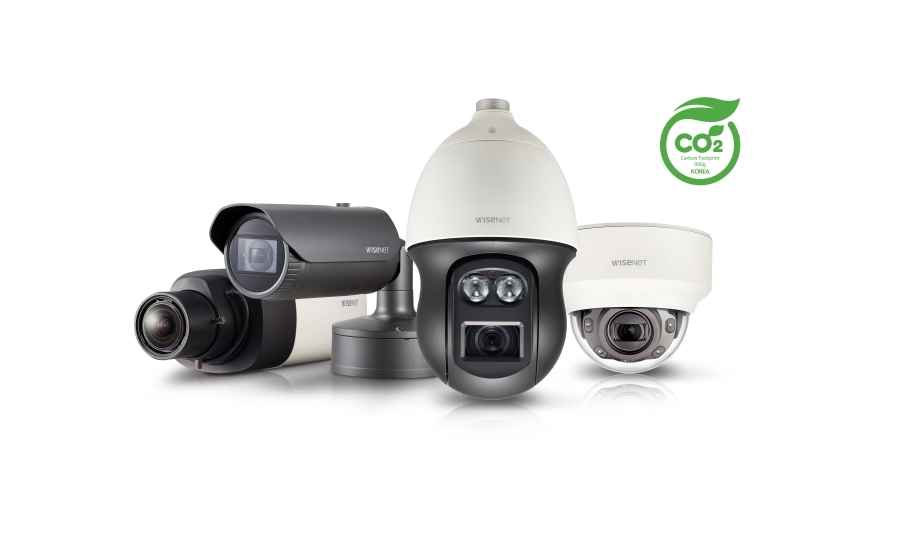

Hanwha Techwin America, a global supplier of IP and analog video surveillance solutions, recently acquired the Carbon Footprint certification for its network cameras (XNB-6000, XND/O-6080R, XNP-6370RH), which are now recognized as environment-friendly products that minimize greenhouse and carbon dioxide emissions.
The Carbon Footprint certification was first created by the non-profit organization Carbon Trust, which was founded in 2007 by the United Kingdom government to confront climate changes. The certification measures the carbon emissions from the entire product life cycle including the production, distribution, use and disposal. Then the emission levels are assessed for its impact on the environment in accordance with international evaluation measurement standards (PAS 2050) to determine eligibility for certification.
Low-Carbon Consumption Cameras
The name Carbon Footprint is a reference to trace back the "footprints" of carbon emission in the product life cycle. Since 2007, this system has spread across the globe, including Korea, which adopted its own "Carbon Footprint Labeling System" in 2009. The system involves labeling the product with the carbon emissions from its product life cycle. It is supervised by the Ministry of Environment and certified by the Korea Environmental Industry & Technology Institute.
Carbon Footprint certification is a meaningful step toward establishing an environmentally conscious product management system
After acquiring the first Carbon Footprint certification for CCTV in Korea with its box camera (SCB-3001) in November 2010, Hanwha Techwin continued to contribute to the promotion of low-carbon consumption culture as it acquired the second certification for two cameras (SNB-6004, SNP-6200RH) in March 2014, the third one for one camera in February 2016 (SNP-6320RH), and the fourth one for four more cameras in 2017 (XNB-6000, XND/O-6080R, XNP-6370RH).
Environmentally Conscious Product
Carbon Footprint certification measures the carbon emission from the production to disposal of a product. Most of carbon emissions from Hanwha Techwin's cameras occurred during the usage stage, accounting for around 90% of all carbon emission from production to disposal. Hanwha was able to further reduce greenhouse gas and carbon emissions by reducing the amount of power required during usage and improving the packing materials.
A member at Hanwha Techwin said that this Carbon Footprint certification is a meaningful step toward establishing an environmentally conscious product management system.