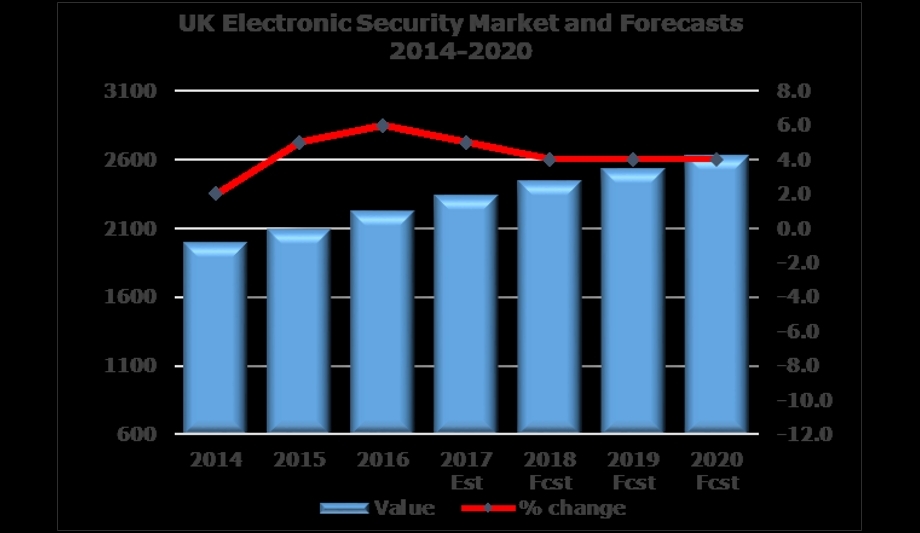

The total UK electronic security market, comprising of products - electronic access controls, intruder alarms and closed-circuit television (CCTV) - and associated services, was estimated at approximately £2.35 bn in 2017. This was an increase of around 5% during the year and followed two years of strong growth in 2015 and 2016. Growth was driven by technological advancements boosting replacement demand and improving new build and RMI expenditure across key market sectors.
Expansion Of CCTV Product DistributionCCTV accounts for the majority of the market in value terms, with a 52% share
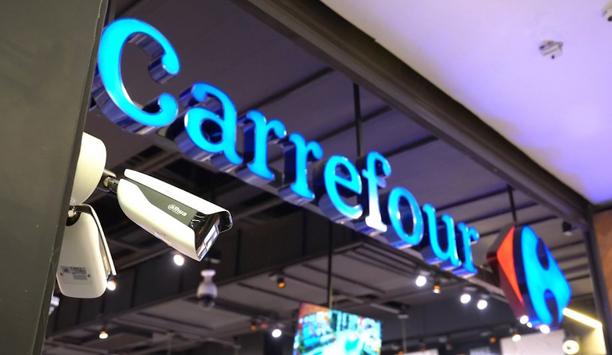
CCTV accounts for the majority of the market in value terms, with a 52% share. This sector has seen the greatest levels of innovation and new product development, and the recent shift in focus by major Chinese manufacturers from cost to technological development has eased the level of price competition over the last year or two. Technology has also become more affordable, leading to a continued shift away from analog to digital products.
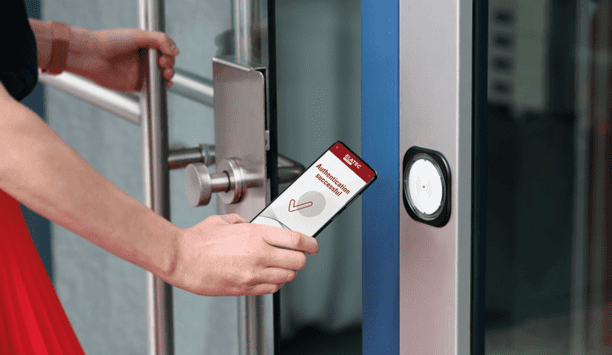
In the access control sector, product development and wider availability of products have been a key driver of growth as has the performance of the UK construction sector, particularly in commercial offices and housebuilding. In addition, access control products have not been subject to price deflation experienced in other sectors, thereby enabling relatively consistent value growth.
Intruder Alarm Market
The intruder alarm market experiences long replacement cycles and a high level of competition in relation to other security options, particularly in the non-residential sector. However, in the residential sector, growth has remained positive in line with increased housebuilding and product development focused on ease of installation.
Value growth is likely to come from increasing adoption of new technologies in both the new and replacement sectors
Integration has continued as a key theme, both between products within the electronic security sector, and also beyond with wider business enterprise systems within Smart Buildings and home products within Smart Homes. The development of smart home products and integration with other security products and home management systems should offer significant opportunities for value growth going forward.
Smart Home Technology Integration
“Increasing competition remains a key feature of the market, with many established competitors struggling to maintain market share, due to intense competition from Chinese companies at all levels of the market” said Hayley Thornley, Head of Research at AMA Research. “This in turn has led to significant merger and acquisition activity in the market since 2015, with companies aiming to achieve scale and provide end-to-end solutions.”
The prospects for the electronic security sector overall are reasonably good. Value growth is likely to come from increasing adoption of new technologies in both the new and replacement sectors. While construction output growth is expected to ease over the next 2-3 years, output remains relatively high by historical standards and this should continue to provide opportunities for manufacturers and installers of electronic security equipment.
Electronic Security Installations
Housebuilding has grown considerably between 2015 and 2017, with output increasing by 33%
Government capital spending levels are also set to increase, particularly in infrastructure and also in local government and health. These are all potential opportunities for electronic security, particularly with the recognition that some of the public sector installed base has become outdated and fallen behind in technology terms due to spending cuts and austerity.
Housebuilding has also grown considerably between 2015 and 2017, with output increasing by 33%, and there remains considerable scope to expand the level of electronic security installations in homes. Intruder alarm installations are estimated at around a third of homes, and the improved range and availability of CCTV products/ and smart locks etc., should support their wider installation in the residential market.
Analytics And Cloud-Based Solutions
While industry sources report that price pressures have eased somewhat in the last couple of years, the focus on service packages and securing longer term revenue is expected to continue. Specifiers will also continue to focus on the whole life cost of the electronic security system, including replacements, add-ons and management costs, which will influence their choice of products and operating systems. These factors should drive the wider uptake of IP, wireless technology, analytics and cloud-based services.