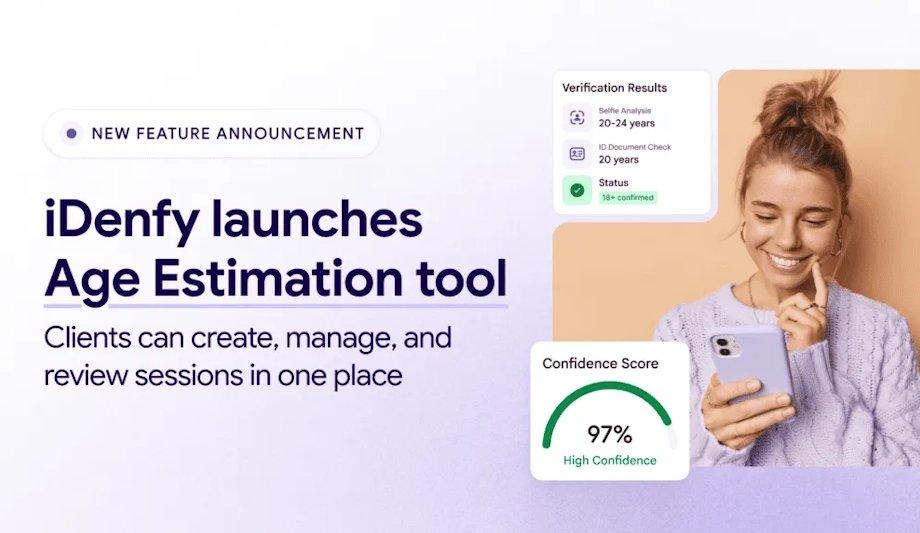
iDenfy, an enterprise known for its identity verification, compliance, and fraud prevention solutions, has unveiled its new Age Estimation tool, enhancing its onboarding software dashboard capabilities.
The upgrade permits the creation, management, and evaluation of age verification sessions independently from iDenfy's standard identity verification metrics. This allows users the option to adopt a non-document-based Age Estimation workflow, facilitating greater user conversions while maintaining adherence to age verification protocols.
Age Verification Workflow
The Age Estimation feature is designed to determine if a user meets the minimum age requirement and can be executed via a real-time selfie or an uploaded photograph if compliance policies necessitate it, as seen in industries like iGaming and financial services.
Traditionally, iDenfy's platform demanded users upload a government-issued ID photo for age verification. With the new Age Estimation feature, users can bypass this step and verify their age using only selfie biometrics, where the system evaluates age based on facial characteristics.
Standalone API Integration
Businesses using the age estimation feature can configure age limits and a buffer zone
iDenfy has developed the age estimation as a standalone function with its unique permission framework, billing structure, and API endpoints, which means partners needing only age verification can access this feature without implementing the full identity verification suite. Consequently, users can access a comprehensive session list, generate tokens, and access detailed session pages from a centralized view, all supported by custom settings, encoded verification URLs, and complete API documentation.
Businesses using the age estimation feature can configure age limits and a buffer zone, requiring users to capture a live selfie compared against these limits. The tool's accuracy in estimating age within a three-year margin allows businesses to control age restrictions on their products. If a user's estimated age is clearly above the limit, they pass quickly with a selfie. However, users nearing the legal age limit will be redirected for a certified ID document check within the same session to confirm the document's date of birth.
Precision in Age Verification
According to Domantas Ciulde, CEO of iDenfy, the enhancement addresses a prevalent challenge observed among partners in age-regulated markets. "Age estimation only works if the people using it can actually see what’s happening inside each session. We improved our product against disguises such as makeup or a mustache to precisely estimate people’s age and brought it into the dashboard with its own sessions list and detail view," commented Ciulde.
This integrated approach eliminates the need for manual record reconciliation across various tools
By obtaining verified age data, businesses reduce the risk of minors accessing restricted products or content, while minimizing personal data collection.
Many users can prove their age with a selfie alone, enabling compliance with regulations like the UK Online Safety Act, the EU Digital Services Act's age assurance guidelines, GDPR's data minimization principle, and emerging age verification laws in the US and Australia.
Streamlined Compliance Monitoring
With age estimation and document verification occurring within a single session and dashboard, compliance monitoring becomes more efficient. This integrated approach eliminates the need for manual record reconciliation across various tools. "Centralizing session creation and results in one dashboard view might sound like a small operational detail, but for partners that run age checks at scale, it removes a lot of manual tracking that used to happen outside our platform," added Domantas Ciulde.
The Age Estimation tool is currently available to iDenfy partners, offering integration via API or Dashboard, with round-the-clock support from iDenfy's team to ensure seamless setup without additional coding.
iDenfy, the global identity verification, compliance, and fraud prevention business, announced the launch of its Age Estimation tool integrated into its onboarding software dashboard.
This new Age Verification upgrade gives the ability to create, manage, and review age verification sessions on their own, separately from iDenfy’s standard identity verification flow metrics, while still relying on the same level of security. That means iDenfy’s users will now be able to choose an alternative, non-document-based Age Estimation workflow, designed to convert more users while still complying with age check requirements.
Age verification workflow
Age Estimation is a process that determines whether a user meets a minimum age requirement using a real-time selfie or via an uploaded document with the picture, if that requires a compliance policy, such as iGaming or financial industries.
It is also commonly used by platforms that must confirm age eligibility before granting access to certain products or content. Previously, iDenfy’s platform offered an age verification workflow that required the end-user to upload a photo of their government-issued ID document. Now, with the new add-on of Age Estimation, this step can be removed, and the user can only be asked to capture their selfie biometrics. The system then determines the person’s age based on their facial features.
Official API documentation
Rather than treating age estimation as a feature bundled inside a broader onboarding flow, iDenfy has built it out with its own permission structure, billing model, and API endpoints, so its partners that only need Age Estimation checks are not required to adopt the full identity verification stack to access it.
As a result, iDenfy’s users can view a full sessions list, generate tokens, and open a detailed session page from a single, centralized view, all supported by their own custom settings, fully encoded verification URLs, and official API documentation.
Configurable age limit
When a business enables the age estimation flow, the end user is asked to capture a live selfie, which is compared against a configurable age limit and buffer zone set by the business. It is worth mentioning that iDenfy’s age estimation tool can estimate people’s age within 3 years of gap accuracy, and control the age limit businesses want to provide access to their products.
Users who are clearly above the age threshold pass in seconds using only a selfie. On the other hand, users whose estimated age falls near the legal limit are automatically routed to a certified ID document check within the same session, where the date of birth on the document, not the model’s estimate and make the final decision.
Personal data businesses
iDenfy claims that most young adults who are over 25 are considered easily verifiable. However, many companies have a hard time differentiating 18 to 24 age category. These users often still look young, and their facial features can be shaped by genetics or other external factors that potentially can mislead their verification systems.
According to Domantas Ciulde, the CEO of iDenfy, the update reflects a broader pattern the company has noticed among its partners that operate in age-restricted and regulated markets: “Age estimation only works if the people using it can actually see what’s happening inside each session. We improved our product against disguises such as makeup or a mustache to precisely estimate people’s age and brought it into the dashboard with its own sessions list and detail view,” commented Domantas Ciulde.
Validated age data reduces the risk of underage access to restricted products, platforms, and content, while limiting how much of the personal data businesses need to collect in the process. Because most users pass on a selfie alone, companies avoid asking their entire user base to submit a government ID just to prove they are old enough. This supports compliance with regulations such as the UK Online Safety Act, the EU Digital Services Act’s age assurance guidance, and GDPR’s data minimisation principle, as well as emerging state-level age verification laws in the United States and Australia’s under-16 social media restrictions.
Centralizing session creation
Because the estimate and the document fallback now run inside the same session and the same dashboard, review and audit work move faster too. Compliance teams can see what was checked without needing to reconcile records across separate tools.
“Centralizing session creation and results in one dashboard view might sound like a small operational detail, but for partners that run age checks at scale, it removes a lot of manual tracking that used to happen outside our platform,” added Domantas Ciulde, the CEO of iDenfy.
The Age Estimation dashboard module is available now to iDenfy partners, who can integrate through API or Dashboard, with 24/7 support available from iDenfy’s team to guarantee a smooth setup without any additional coding.