 |
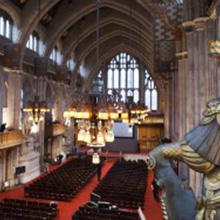
| The Video Smoke Detection (VSD) solution chosen enabled a wide field of view, reducing the number of detection points needed |
The particular challenges for professionals tasked with ensuring high levels of fire detection for heritage buildings can be complex. Rarely built with fire safety in mind, historic buildings are often composed of highly flammable materials making them susceptible to fire. Detection and prevention solutions are therefore hugely important.
Simon Jenkins of solution provider FireVu gives an insight into delivering fire safety systems that respect the integrity of the building and deliver the protection required.
Given that listed buildings can’t be altered aesthetically, the greatest challenge is seamlessly and unobtrusively blending modern systems into the fabric of the building. This calls for technological and aesthetic creativity.
Some issues are more challenging than others. Plain interiors, for instance stone or tiled spaces, can make it especially difficult to hide fire detection and prevention systems. Even drill holes are generally prohibited.
Nevertheless, solutions to fire safety specifications must comply with the ramifications of their listed status.
Our work on London’s Guildhall illustrates the type of challenge faced and the possible solutions of ensuring fire safety in a listed building.
Guildhall has been a place of deep historical interest for the country since 1411. It was here that Thomas Cranmer and Lady Jane Grey were tried, Chopin played his last public performance and it contains memorials to such great national figures as Nelson, Wellington and Churchill.
It is particularly known to the public for the Lord Mayor’s Banquet in the Great Hall where the Prime Minister’s annual keynote speech is reported with interest by national media. And let’s not forget popular culture in the form of Harry Potter and Dick Whittington. In short, it is a national treasure.
 |
| The fire detection system had to be unobtrusive, not leave an imprint on the stone facades and ornate decoration |
The Great Hall and medieval crypts required a fire detection system that would not compromise the historic and decorative integrity of the building. The system had to be unobtrusive, not leave an imprint on the stone facades and ornate decoration that at first inspection presented few options.
The Video Smoke Detection (VSD) solution chosen enabled a wide field of view, reducing the number of detection points needed.
At some cost original lighting fittings were recreated to provide a discreet home for visual detectors for the medieval crypt. Located above the stage and from the balconies, the solution for the Great Hall is almost undetectable, hidden in the wooden structures. Only the most astute and alert would notice, from close-up the presence of a fire detection system.
Other sophisticated systems were considered. Infrared offers much of the VSD solution, but the latter offers combined security as well accompanying video providing situational awareness. Aspirating systems needing more points and attachments made the issue of discreet systems a problem. Moreover, there is the issue of smoke stratification.
Atria and similar spaces present special issues. The less predictable air flow and stratification of smoke means it does not always, or takes longer to reach detection systems that trigger alerts and suppression systems. This can be a key issue for aspirating systems that require smoke to reach detection points, not so for infrared and VSD.
Each fire detection system offers its particular strengths for the specific requirements of the building, whether it is aspirating, infrared or VSD. Every heritage building project requires sensitivity and creativity. The key is not a compromise as such, but the use of a creative approach balanced with the most effective fire detection and prevention system for the building in question. Guildhall shows that nothing need be compromised to reach a solution that satisfies architects, consultants and the client.