|
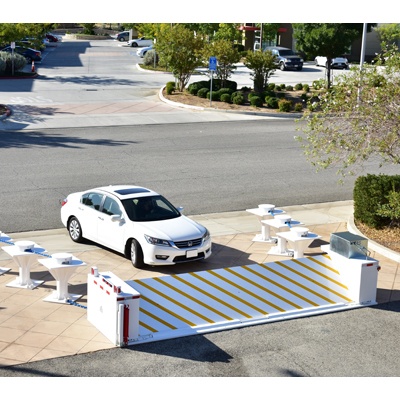
| The DSC7000 beam barricade meets and exceeds Department of State standards for closing time requirements |
"We are immediately hiring an additional 40 employees and running two shifts to assure we meet the parameters of this order, which will help save the lives of American and NATO forces as the surge goes forward in Afghanistan," reports David Dickinson, Delta Scientific Senior Vice President. "All of us at Delta Scientific are excited about our continued role of supplying defensive equipment designed to help provide safety and security to our troops."
In a recent event this past April, a truck bomber attempted to crash through gates at the U.S. Consulate in Peshawar, Pakistan but a Delta Scientific vehicle barricade was raised to stop the attacking vehicle, saving scores of lives. The barricade survived the explosion and continued to operate.
Built at the request of U.S. Federal government force protection specialists for initial fast deployment, the totally self-contained MP5000 is towed into position and controls vehicle access within 15 minutes. Throughout Iraq and Afghanistan, such as at Camp Victory, the 16-foot clear opening model is especially popular as large-tracked vehicles, such as Strikers, can pass through the barricade. No excavation or sub-surface preparation is required. Once positioned, the mobile barricade unpacks itself by using hydraulics to raise and lower itself off its wheels. A DC-powered pump then raises or lowers the barrier. The 12 foot (3.6 m) mobile deployable vehicle crash barrier carries a K4 rating (M30 ASTM rating), stopping a 7.5 ton (6400 Kg) vehicle traveling 30 mph (48 kph). The 16 foot (4.8 m) version carries both a K4 and K8 rating (M40 ASTM).
Installing in less than four hours, the 12 to 30-foot wide (3.7 to 9.2 m) DSC7000 beam barricade meets and exceeds multiple agency - DOS (US Department of State), DOD (US Department of Defence), USACE ACP (US Army Corps of Engineers, Access Control Points) and USACE EFO (US Army Corps of Engineers, Emergency Fast Operating) - standards for closing time requirements and is suitable for applications where a fast-acting K12 barricade is needed to provide security. By closing in less than a second, an attack vehicle cannot speed through an opened barrier.
"A major concern was that any vehicle barricades could be deployed quickly as installers are targets for snipers," adds Dickinson. "Thus, these barricades not only help protect lives after they are installed but safeguard troops during the actual installation process as well."