 |
| OPTEX’s REDSCAN analyzes speed, size and distance of object within 30m radius and is unaffected by lighting conditions |
Take off for new detector of flying passports
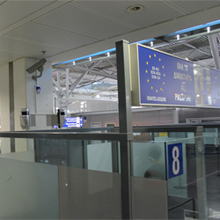
An international airport in Europe has been chosen to conduct trials regarding the best equipment to detect documents that are being passed or thrown over the passport control area in order to achieve illegal entry; something that has been noticed in airports worldwide.
Authorities at the airport have previously tested video based detection equipment to catch any illegal activity, but due to the speed at which objects were moving, these methods proved unsuccessful. The original trial delivered virtually no captures and the system experienced numerous false alarms. Due to the sheer volume of passengers passing through passport control daily this became problematic and it became clear a better device was needed.
The airport needed a device accurate enough to capture objects being thrown at high speed, and that would not be affected by any other elements in its view, such as light or reflection. It was also essential for the device to be flexible in its position with a wide enough field of vision and a high enough detection speed to catch objects moving at a fast rate.
REDSCAN Solution
The system integrator in charge of installing the system thought of using a solution based on OPTEX’s laser sensor, REDSCAN, which analyses speed, size and distance of the object within 30m radius horizontally or vertically and is unaffected by lighting conditions. nsquare worked with OPTEX’s special project team to find a customized firmware adapted to the speed of the flying objects and this ensured a 100% detection rate with no false alarms.
Two REDSCAN detectors were placed at wall height inside the passport control hall to scan the critical area. Any objects detected are analyzed and their exact X and Y coordinates are transmitted to the connected camera which then ‘look’ straight at the objects and when the system was tested with high definition cameras, the person throwing the object could be identified using the digital zoom.