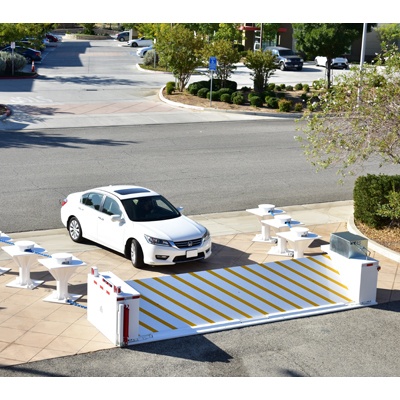
Controlling vehicle access is a critical aspect of maintaining security in high-risk zones. Rising barricades are one effective solution for managing entry to sensitive areas like government buildings, airports, and military bases. Here, we explore what rising barricades are, their uses, and their key components.
Understanding Rising Barricades
Rising barricades are robust security tools designed to restrict vehicle access swiftly and efficiently. These barriers can be manually operated or automated through sensors, allowing them to be raised or lowered as needed. Common formats include wedge barriers and bollards, which are prevalent in ensuring perimeter security.
Applications of Rising Barricades
Rising barricades are robust security tools designed to restrict vehicle access swiftly and efficiently
The primary function of rising barricades is access control. They are deployed to manage entry to authorized areas, acting as secondary security layers or regulating vehicle flow on roadways or parking lots. Such systems are commonplace in high-security environments like embassies, military installations, and power stations.
Key Components of Rising Barricades
Despite the variety of rising barriers available, they all share a fundamental mechanism for adjusting between open and closed positions. The visible components of these systems often include structures like wedges or bollards, designed to withstand impacts from fast-moving vehicles. In some cases, tire spikes are integrated as an additional deterrent.
Control and Hidden Systems
The operational aspect of a rising barricade is managed by a control system. This comprises cameras, scanners, sensors, and controls for emergency activation or deactivation. These systems may allow either direct or remote control, ensuring they cater to different security needs. Under the surface, the raising and lowering mechanism—which could be hydraulic, electric, or pneumatic—is accompanied by housing for protection when not in use.
Implementation and Benefits
Rising barriers generally have two positions: open or closed. They can be activated manually or via sensors, providing a reliable secondary level of security. By selecting crash-test-rated versions, facilities ensure protection against vehicles moving at high speeds, making them a potent element in secure perimeter strategies.
Advantages of Rising Barricades
The use of rising barricades provides customizable control system options, a subtle appearance that blends with the environment, and robustness that stands up to high demands. These attributes make rising barricades a durable and effective part of any comprehensive access control framework.
Controlling vehicle access is critical in high-security zones, and maintaining a secure perimeter requires effective access control solutions.
Using a rising barricade is an effective method for controlling vehicle access to designated areas, such as government offices, airports, and military installations. Take a look at what a rising barricade is and how it works with this informative guide.
What is a rising barricade?
Rising barricades provide a high level of security in a rapidly deployable format. They consist of a solid barrier that can raise and lower into position as needed. Control of the mechanism can be manual or with the aid of sensors. Common types of traffic barriers include wedge barriers and bollards.
What Is a Rising Barricade Used for? Rising barricades are used to limit access to an area. They are excellent access control solutions that can be quickly activated or deactivated. Depending on the type of barrier, they can be used for applications such as:
- Restricting vehicle access to a designated area
- Secondary control measures on secure properties
- Timing vehicle access to a roadway or parking area
Rising barricades are typically considered high-security tools. You will most often find these types of access control systems on secure properties, such as embassies, military bases, airports, and power plants.
What are the components of a rising barricade?
Several different types of rising barriers exist, and each one has a unique combination of components. When exploring what a rising barricade is, you will notice that no matter the type of barrier, they all share a mechanism for raising and lowering it into open and closed positions.
The main components of a rising barricade include:
- Visible structures: The visible part of the barricade is typically a wedge or bollard. These are high-security devices designed to stop a vehicle traveling at significant speed. Some systems incorporate tire spikes as a secondary measure.
High-security applications
Lower security barriers may use arms or beams to limit access. Crash-tested versions of beam barricades can be effective at controlling access in and out of private facilities, vehicle sales lots, and commercial properties. They are commonly used with a secondary control system for high-security applications.
- Control systems: The control systems are the brains of the barricade. They may include cameras, digital scanners, sensors, and emergency activation or stop buttons. Control panels allow either direct or remote access to the drive mechanism. Some of these components are visible to users, while others are hidden.
- Hidden components: The hidden parts of a rising barricade include the mechanism that raises and lowers it and the control systems. The drive mechanism can be hydraulic, electric, or pneumatic, depending on users needs and site capabilities.
Additional hidden components
Additional hidden components include the barricade housing or pit and its power supply. The housing must be sufficient to protect and contain the barricade when not deployed while still allowing vehicle traffic. In the case of beam barricades, the housing is in the form of two buttresses, one on either side of the road.
Power can be in the form of electricity, hydraulics, or air pressure systems. This will depend on what utilities are available on the site and how much access you have to them during construction.
How does a rising barricade work?
The basics of rising barriers are fairly simple. The standard position may be either open or closed. For example, a rising bollard that is a secondary line of access control may be kept lowered into its housing and only deployed when a perimeter system is breached. When activated through a control panel, the barricade rises into position. This is a common application on military bases.
In other cases, the barrier is kept deployed and removed to allow access. Either way, users can activate the barrier through a manual switch, sensors, or other secure methods.
What are the benefits of using rising barricades?
Rising barriers provide a long-lasting, secure perimeter. They are highly durable and designed to integrate well with other access control systems. The benefits of using a rising barricade include:
- Customisable control systems
- Discreet appearance
- High effectiveness
Select crash-test-rated barricades for the most effective protection available. These are tested to ensure they can stop vehicles traveling at designated speeds, so you know they will keep your location secure.