
IDIS has debuted a powerful suite of features to bring critical failover capabilities and peace-of-mind to users of the company’s innovative technology offerings. Bringing together existing, improved, and new failover features, IDIS addresses multiple threats to crucial video surveillance operations with IDIS Critical Failover, a collection of five capabilities that strengthen the fault tolerance of your CCTV infrastructure.
“If any part of video surveillance infrastructure fails, it’s critical to first recognize the failure and then initiate appropriate alternative or redundant technologies to minimize loss of data. Full redundancy of every component in your infrastructure is prohibitively expensive and adds unnecessary complication in most cases, and manual recognition and resolution costs precious time and risks gaps in footage,” notes Keith Drummond, Senior Director, IDIS America, “IDIS Critical Failover reduces both of these issues, through a multi-layered collection of capabilities spread across the devices in your infrastructure.”
IDIS Critical Failover Features
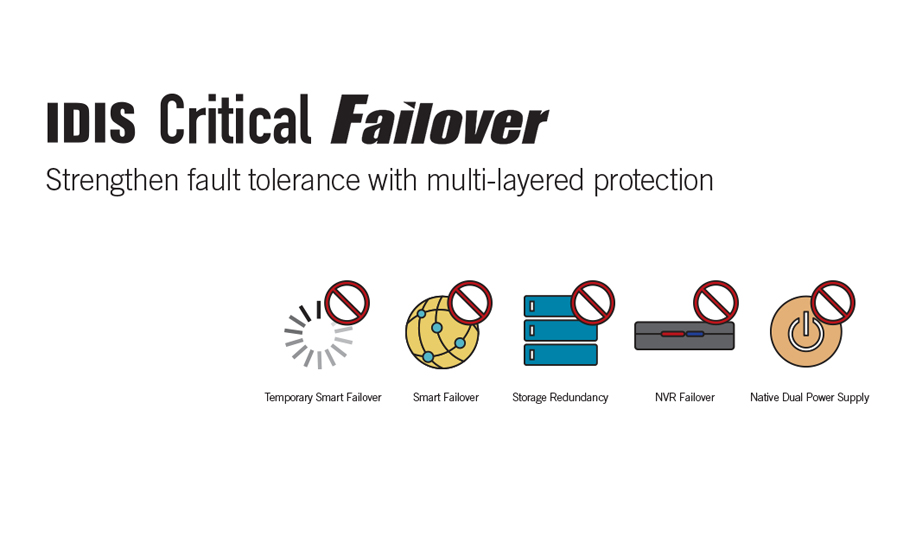
IDIS Critical Failover consists of five parts: Temporary Smart Failover, Smart Failover, Storage Redundancy, NVR Failover, and Dual Power Supply.
“If any part of video surveillance |
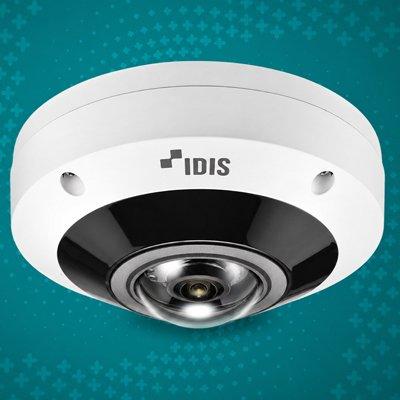
- If you experience a problem with network instability, Temporary Smart Failover starts recording to an internal recording session buffer (of at least 60MB), ensuring there is no break in the data being sent to the NVR. For longer network issues, such as a complete failure of the link between the camera and the NVR, Smart Failover takes over. When the IP camera and NVR become disconnected, the camera instantly begins recording to an internal SD card. It records at the original quality until half of the SD card is filled up and then adjusts the quality to ensure a full 24 hours of footage is captured on just a 32GB card. H.265 cameras add support for SDXC cards, with a theoretical limit of 2TB. Once the network link is restored, all of the data is automatically transferred to the NVR, leaving no incident unrecorded.
- Storage Redundancy exists inside the NVR (DR-8364D) in the form of native RAID 1 or RAID 5 support. With RAID 1 support, the NVR stores two identical copies of the data, so if one disk fails, the data is retrieved from the second one. RAID 5 stores the data and additional parity data in separate locations, providing the same redundancy, but more efficiently than RAID 1.
- NVR Failover protects against the failure of the entire NVR, which a standby NVR. Both the primary and standby NVR continuously monitor one another to quickly switch to the functioning NVR during a failure, reducing the risk of data loss and decreasing failover response times.
- Finally, Native Dual Power Supplies (DR-8364D) provides a redundant power supply in case the first one fails, increasing uptime and reducing the risk of data loss.