|
| ASSA 580 electric lock with split spindle function and ASSA 179E-2 emergency exit device were selected |
Evacuation in case of fire is a challenge for hospitals. Escape routes must not become weak points, and staff has to be able to re-enter quickly. Stockholm’s Karolinska University Hospital solved the problem using the ASSA ABLOY 580 electric lock.
It is not enough for people just to be able to escape through an emergency exit. Staff may have to re-enter to help patients get to safety, or an exit route might be blocked by smoke or fire, so people have to be able to retrace their steps and find an alternative route.
A new solution at Karolinska University Hospital provides secure access protection while allowing rapid evacuation and re-entry.
Karolinska is one of the largest hospitals in Europe, with more than 1,700 beds on two campuses. With 1.5 million visitors a year, 15,000 employees and 2,500 researchers, it faces severe demands on its security environment.
Traditional solutions for evacuation doors – levers, a sealed emergency exit handle and frequently a pushbutton lock – can be confusing. Christer Matonog, fire safety coordinator at the hospital Security Department, says people often use the emergency exit handle inappropriately, leaving the doors unlocked.
A new solution needed to be user-friendly, and allow re-entry. A single handle was preferred, to avoid the emergency-handle issue, and the hospital wanted to avoid a pushbutton lock, which can be confusing to visitors.
The result is a clean and simple door environment: one door, one handle, and one way to exit |
Matonog decided on the ASSA 580 electric lock with split spindle function, complemented by the ASSA 179E-2 emergency exit device. The result is a clean and simple door environment: one door, one handle, and one way to exit. No confusion.
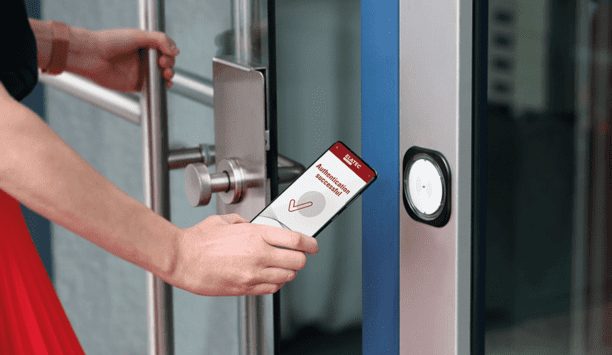
To allow re-entry, Matonog worked with ASSA and Karolinska Huddinge’s security technicians to install card readers on the outside of each door, in areas such as stairwells. Employees can use the stairs and open the doors with their access cards – an improvement from the previous situation where the doors were normally locked. In emergencies, the doors are unlocked and can be opened from the stairwells, allowing rapid re-entry.
After a successful pilot project on 20 doors, the technology is now being implemented on 350 doors across the hospital. And it is now standard for all new construction projects within the hospital – it costs no more than a traditional installation, but provides substantial advantages.