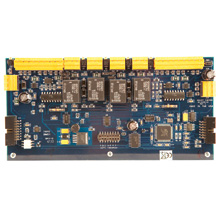
Galaxy Control Systems, a leading manufacturer of integrated access control, video and security solutions, is introducing a new Dual Reader Module (DRM) here at ISC West. The new Galaxy DRM, designed for use with the company’s 635 Dual Serial Interface (DSI), is engineered for use with legacy RS485 UTP cabling. It enables multiple readers to be connected in a variety of configurations without the need to run dedicated cabling from a centralised controller, which significantly reduces installation labor and cabling costs for new and existing access control installations. “Our new Galaxy Dual Reader Module provides tangible benefits to installing dealers and their customers from both economic and functionality perspectives,” said Robert Laughlin, President, Galaxy Control Systems. “Accommodating legacy infrastructure makes it easier and more cost-effective to upgrade older systems by allowing end-users to enhance their access control systems using cabling they already have in place.  Additionally, new installations benefit from the ability to connect multiple readers without having to run dedicated cabling between a central controller and remote readers.”  Galaxy DRMs installed at door locations connect in series to Galaxy’s 635 Dual Serial Interface (DSI), thus eliminating the need to run additional cable from each reader to the centralised controller. For added versatility, the Galaxy DRM is selectable for one or two readers enabling it to configure a single door with a single reader, two individual doors each with a single reader, or a single door with two readers for in/out anti-passback operation. Up to 64 readers can be connected with a Galaxy DSI with a CPU, which greatly simplifies and expedites installations while using significantly less cable.

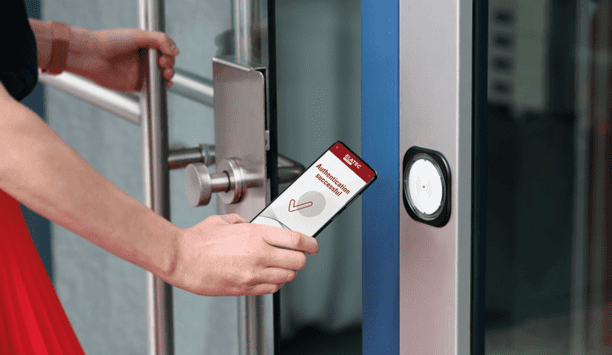
The new Galaxy DRM is engineered for use with legacy RS485 UTP cabling

Galaxy Control Systems, a leading manufacturer of integrated access control, video and security solutions, is introducing a new Dual Reader Module (DRM) here at ISC West. The new Galaxy DRM, designed for use with the company’s 635 Dual Serial Interface (DSI), is engineered for use with legacy RS485 UTP cabling. It enables multiple readers to be connected in a variety of configurations without the need to run dedicated cabling from a centralized controller, which significantly reduces installation labor and cabling costs for new and existing access control installations.

“Our new Galaxy Dual Reader Module provides tangible benefits to installing dealers and their customers from both economic and functionality perspectives,” said Robert Laughlin, President, Galaxy Control Systems. “Accommodating legacy infrastructure makes it easier and more cost-effective to upgrade older systems by allowing end-users to enhance their access control systems using cabling they already have in place.  Additionally, new installations benefit from the ability to connect multiple readers without having to run dedicated cabling between a central controller and remote readers.”

Galaxy DRMs installed at door locations connect in series to Galaxy’s 635 Dual Serial Interface (DSI), thus eliminating the need to run additional cable from each reader to the centralized controller. For added versatility, the Galaxy DRM is selectable for one or two readers enabling it to configure a single door with a single reader, two individual doors each with a single reader, or a single door with two readers for in/out anti-passback operation. Up to 64 readers can be connected with a Galaxy DSI with a CPU, which greatly simplifies and expedites installations while using significantly less cable.

In case you missed it

Responsible AI Adoption Starts With Governance

The eagerness to adopt AI in physical security is increasing as teams want to implement technology solutions for faster, smarter operations. At the same time, the conversations sur...

How AI-Enabled Cameras Are Becoming Operational Sensors That Power Safety, Automation, And Business Intelligence

The biggest return on investment from an AI-enabled camera might have nothing to do with security. Organizations are increasingly discovering that the same cameras installed to pro...

Solink's AI Agents Boost Efficiency Of Existing Infrastructure With Automation

Deploying artificial intelligence (AI) tools should be seen as a business initiative rather than a technology initiative, says Martin Soukup, CTO of Solink, a cloud-based video sec...