SecurityInformed.com
  • Products
    Video Surveillance
    • Surveillance cameras
    • Video Surveillance software
    • IP cameras
    • Digital video recorders (DVRs)
    • Dome cameras
    • Network Video Recorders (NVRs)
    • IP Dome cameras
    • Security camera lenses
    Access Control
    • Access control readers
    • Access control software
    • Access control controllers
    • Access control systems & kits
    • Intercom Systems
    • Electronic lock systems
    • Access control cards/ tags/ fobs
    • Access control accessories
    Intruder Alarms
    • Intruder alarm system control panels & accessories
    • Intruder detectors
    • Intruder alarm warning devices
    • Intruder alarm communicators
    • Intruder alarm accessories
    • Intruder alarm lighting systems
    Enhancing Physical Access Control Using A Self-Service Model
    Enhancing Physical Access Control Using A Self-Service Model
    Dahua Smart Dual Illumination Active Deterrence Network PTZ Camera

    Dahua Smart Dual Illumination Active Deterrence Network PTZ Camera

    Hikvision DS-K6B630TX: Smart Pro Swing Barrier for Modern Access Control

    Hikvision DS-K6B630TX: Smart Pro Swing Barrier for Modern Access Control

    Climax Mobile Lite: Advanced Personal Emergency Response System (PERS)

    Climax Mobile Lite: Advanced Personal Emergency Response System (PERS)

    Hanwha Vision OnCAFE: Cloud-Based Access Control for Modern Enterprises

    Hanwha Vision OnCAFE: Cloud-Based Access Control for Modern Enterprises

  • Companies
    Companies
    • Manufacturers
    • Distributors
    • Resellers / Dealers / Reps
    • Installers
    • Consultants
    • Systems integrators
    • Events / Training / Services
    • Manned guarding
    Companies by Product area
    • CCTV
    • Access control
    • Intruder alarm
    • IP networking products
    • Biometrics
    • Software
    • Digital video recording
    • Intercom systems
    Enhancing Physical Access Control Using A Self-Service Model
    Enhancing Physical Access Control Using A Self-Service Model
  • News
    News
    • Product news
    • Corporate news
    • Case studies
    • Events news
    Latest
    • Suprema BioStation 3 Sets Sales Record In Security Market
    • A Landmark Gathering Shaping The Future Of Real Estate, Investment, Sustainability & Design
    • IDIS Launches New AI PTZ Cameras With NIR Performance
    • Leuze AI Boosts Optical Distance Sensor Accuracy
    Enhancing Physical Access Control Using A Self-Service Model
    Enhancing Physical Access Control Using A Self-Service Model
  • Insights
    Insights
    • Expert commentary
    • Security beat
    • Round table discussions
    • Round Table Expert Panel
    • eMagazines
    • Year in Review 2023
    • Year in Review 2022
    Featured
    • What Are Emerging Applications For Physical Security In Transportation?
    • What Is the Most Overlooked Factor When Installing Security Systems?
    • Amid Rising Certificate Demands, Stricter Compliance And Quantum Threats, PKIaaS Is A Necessity
    • How Should Security Adapt To The Unique Aspects Of Healthcare?
    Enhancing Physical Access Control Using A Self-Service Model
    Enhancing Physical Access Control Using A Self-Service Model
  • Markets
    Markets
    • Airports & Ports
    • Banking & Finance
    • Education
    • Hotels, Leisure & Entertainment
    • Government & Public Services
    • Healthcare
    • Remote Monitoring
    • Retail
    • Transportation
    • Industrial & Commercial
    Enhancing Physical Access Control Using A Self-Service Model
    Enhancing Physical Access Control Using A Self-Service Model
    Alamo Colleges Boosts Safety With Alcatel-Lucent OmniSwitch Platform

    Alamo Colleges Boosts Safety With Alcatel-Lucent OmniSwitch Platform

    HID Mobile Access Enhances University Of Dundee Campus

    HID Mobile Access Enhances University Of Dundee Campus

    ASSA ABLOY Aperio Wireless Locks At The Camp: Secure & Sustainable

    ASSA ABLOY Aperio Wireless Locks At The Camp: Secure & Sustainable

    SBB Secures Perimeters With Hanwha Vision Cameras

    SBB Secures Perimeters With Hanwha Vision Cameras

  • Events
    Events
    • International security
    • Regional security
    • Vertical market
    • Technology areas
    • Conferences / seminars
    • Company sponsored
    Virtual events
    • Video Surveillance
    • Access Control
    • Video Analytics
    • Security Storage
    • Video Management Systems
    • Integrated Systems
    Enhancing Physical Access Control Using A Self-Service Model
    Enhancing Physical Access Control Using A Self-Service Model
    Technology Summit International 2025

    Technology Summit International 2025

    Gartner IT Infrastructure, Operations & Cloud Strategies Conference 2025

    Gartner IT Infrastructure, Operations & Cloud Strategies Conference 2025

    G2E Philippines 2025

    G2E Philippines 2025

    IFSEC India 2025

    IFSEC India 2025

  • White papers
    White papers
    • Video Surveillance
    • Access Control
    • Video Analytics
    • Video Compression
    • Security Storage
    White papers by company
    • HID
    • ASSA ABLOY Opening Solutions
    • Milestone Systems
    • Eagle Eye Networks
    • Software House
    Other Resources
    • eMagazines
    • Videos
    One System, One Card

    One System, One Card

    Aligning Physical And Cyber Defence For Total Protection

    Aligning Physical And Cyber Defence For Total Protection

    Understanding AI-Powered Video Analytics

    Understanding AI-Powered Video Analytics

    Modernizing Access Control

    Modernizing Access Control

About us Advertise
  • Self-Service Access Control
  • AI special report
  • Cybersecurity special report
  • 6
Thermal imaging
  • Home
  • About
  • News
  • Expert commentary
  • Security beat
  • Case studies
  • Round table
  • Products
  • White papers
  • Videos

FLIR Thermal Imaging Cameras Help Prevent Diamond Theft In Namibia

icon Add as a preferred source Download PDF version
A big sign, stating: “Diamond theft hurts us all – Don’t do it”, is one of the first things visitors see when they arrive at the small airport of Oranjemund, Namibia. Oranjemund, meaning mouth of the Orange River is situated in the far south western corner of Namibia. The town was established in 1936, following the discovery of diamonds on the north bank of the Orange River. Accessing the town is impossible without a special permit issued by the Namibian Ministry of Mines and Energy. Diamond theft is a big concern, for Oranjemund which is located within one of the richest diamond fields in the world. In order to prevent diamond theft, Namdeb has installed FLIR Systems thermal imaging cameras. Oranjemund and Namdeb Diamond corporation Diamonds originated deep in the interior of Southern Africa. Over millennia, the Orange River carried them to the Atlantic Ocean where they were deposited on ancient beaches, which in time became part of the mainland. Prior to the discovery of diamonds in the Namibian desert, some prospecting had taken place along the coast as early as 1863. In 1908, a railway worker Zacharia Lewala, stumbled on a shiny treasure that started a major diamond rush. As a result, diamond mining regulations were introduced in 1911 and the Sperrgebiet or “forbidden territory” was declared. In 1920, Sir Ernest Oppenheimer formed Consolidated Diamond Mines of South West Africa (CDM). Oranjemund, a unique town that owes its existence to diamond mining, was established in 1936. It services the Mining Area 1 and Orange River mines. In 1994, an agreement between CDM and the Government of the Republic of Namibia resulted in the formation of Namdeb Diamond Corporation (Pty) Limited. Namdeb Diamond Corporation (Pty) Limited is owned in equal shares by the Government of the Republic of Namibia and De Beers Centenary AG. Namdeb's predecessor, Consolidated Diamond Mines (CDM), was a wholly owned subsidiary of De Beers until 1994. All of the De Beers group's existing Namibian mining licenses and related rights were replaced by a consolidated and rationalised mineral agreement, drawn up under Namibia's postindependence mineral legislation. Different mining processes to find diamonds Diamonds were formed at least 990 million years ago, although some are estimated to be as many as 4.25 billion years old, thereby pre-dating life on this planet.  Diamonds are formed at pressures of 45-60 kbar. This corresponds to a depth of 125-200 kilometers below the Earth’s surface where the pressure is around fifty thousand times that of atmospheric pressure at the Earth’s surface. Different ways exist to extract diamonds: •	Open-pit mining, where diamond deposits are on the surface of the ground - Underground mining, where diamond deposits are below ground •	Alluvial Mining, where diamonds are extracted from alluvial deposits and are removed from sand, gravel and clay •	Alluvial mining is undertaken by either coastal and inland mining where sand and soil are removed to find diamonds or by marine mining where diamonds are extracted from the seabed. Alluvial mining, cleaning the bedrock Namdeb Diamond Corporation (Pty) Ltd. is the world’s leading alluvial diamond miner. It extracts diamonds from sand, gravel and clay using the open-pit method. The process involves removing the overlying ground and then extracting the diamonds. The first step in the mining process is to remove the overburden – the surface material covering the diamonds. This can be up to 40m thick and can vary from loose sand to cemented conglomerate. Most of the ore is excavated by trackdozers and excavators. They create windows from which front-end loaders remove ground and place into haultrucks. The bottom part is called bedrock. This underground is hard as a rock and it is the bed on which the diamonds were deposited by the river so many years ago, and resting. The bedrock is cleaned by workers using a containerised vacuum cleaning system. Once excavated, the ore is transported to ore processing plants where it is crushed to pieces smaller than 150mm. A process of dense medium separation produces a diamond-rich concentrate from the crushed gravel. The final concentrate represents around 1% of the material originally fed to the plant. The concentrate is sent to a central recovery plant, which produces the final 100% diamond product. Mining aria 1 and Bogenfels mines Namdeb currently holds multiple mining licenses from which diamonds are recovered. The Mining Area No.1, Bogenfels and Elizabeth Bay Mining Licenses extend from the Orange River in the south to Lüderitz in the north of Namibia, and approximately 5.5 kilometers off shore in the Atlantic Ocean to approximately 20 to 35 kilometers inland. These areas generate the bulk of Namdeb's production. Diamonds are very small and easy to conceal. Therefore making sure that as little as possible diamonds are being stolen is of the utmost concern to Namdeb. Using ingenious methods to steal diamonds  “Diamond theft is serious issue”, explains Mr. Freddie Groenewald, Security Chief Technician at Namdeb, Oranjemund. “Our mines are very rich and produce stones of the highest quality. Most of our product is gem stone quality, used for jewellery, with only a very small percentage of industrial stones. Our mines are so rich that workers that are working on the bedrock, the bottom layer where the diamonds are situated, regularly spot diamonds with the naked eye. If a worker picks up a diamond and hands it over, Namdeb’s experts will determine the value of the stone and 70% of its value is given to the honest finder. This way we try to discourage theft. Nowhere else can a worker gain this amount of money for a precious stone.” “Still, numerous people are trying to steal the diamonds. At first sight this seems unbelievable since at the “black market” they will only receive a small amount of the stone’s value. The problem is that workers are sometimes under pressure from criminal organisations to steal diamonds. Although strict security measurements are in place, they still try to steal using different methods. Since all people that come out of a secure area are scanned, various methods to conceal diamonds are used, for example hiding them in the heels of shoes or in work tools.” Security at the bedrock area “Needless to say, that the bedrock area is a critical area for security.”, explains Mr. Harold Schoeman, Security Senior Technician at Namdeb, Oranjemund. “We monitor the workers closely to see that they are not trying to take away diamonds. We have introduced movable wireless camera systems called “spider cameras” on the bedrock mining sites. These are small, movable CCTV cameras installed on the bedrock, close to the workers. We can zoom in and follow their activities from a centralised video monitoring facility. The camera systems have assisted us with good quality video footage, which are used as evidence in disciplinary actions and in court cases of diamond theft.” Thermal imaging helps for security during the night “The workers are aware that they are being monitored so they are careful of what they do. Sometimes they hide stones in a remote area of the bedrock area. Once it is dark, they will try to come back and pick up the diamonds. In order to avoid this we have installed thermal imaging cameras.”, says Mr. Groenewald. “We have installed mobile surveillance systems on all active bedrock sites. These systems include a FLIR Systems SR-100 thermal imaging camera.” “There is not supposed to be any activity on the bedrock sites during night time and if anyone does try to access it in darkness to pick up diamonds, we see it immediately on one of our monitors. Since the cameras are installed on a pan/tilt head, we can follow the person while a security patrol is on the way to arrest him. The cameras do not help us only during the night. The area where we are mining is close to the sea and foggy conditions are not unusual. The thermal imaging cameras also help us to see through the fog.” FLIR Systems SR-100 cameras “We recently purchased 16 FLIR Systems SR-100 cameras to overlook the bedrock areas. We had experience with other thermal imaging cameras in the past and were very much aware how thermal imaging can help us. We decided however to buy FLIR Systems thermal imaging cameras for various reasons.”, Mr. Groenewald continues. “The FLIR Systems cameras contain a Vanadium Oxide detector and produce an excellent image on which the smallest of details can be seen. Since they are producing images with a frame rate of 9 Hz we did not need any export license to install them in Namibia. The 9 Hz images are not a problem for us and suit our needs perfectly. Furthermore, the cameras which we had installed previously contained a BST detector. In order to operate well, they contain an internal mechanical chopper that calibrates the image. This chopper was very susceptible to breakdowns. Each time we had to send a camera in for repair it was away for quite some time. By buying FLIR Systems material we are eliminating all these problems. We are convinced that we are getting excellent value for our money.” Operating under climatically harsh conditions “The cameras we are operating on the bedrock areas are operating in extremely harsh conditions. Not only are they installed close to the sea, which means they are susceptible to salt spray, they are also exposed to strong winds. It is like their housing is being sandblasted continuously.”, Mr. Groenewald continues. “Although the cameras are extremely well protected, we decided that they could use some extra protection in these conditions.”, explains Mr. Tinus Diedericks, Timeless Technologies FLIR Systems distributor in South Africa. “Therefore we have constructed “Stainless Steel 316” housing. The FLIR Systems SR-100 cameras are installed in the housing together with a CCTV camera which overlooks the bedrock during daytime. The housing containing the two cameras is installed on a pan/tilt which increases situational awareness and allows following people when necessary. ” “To protect the lens of the SR-100 cameras we have installed an 8 mm thick germanium window. More than 99% of the infrared radiation transmits through it. The germanium window has been hardened with cobalt on the outside and has an anti-reflexive coating on the inside. This way we can assure a perfect image quality and extremely high protection of the thermal imaging cameras.” Movable systems “The cameras and other equipment are powered by solar energy. A solar panel provides more than enough power to operate. Batteries, which can last up to 4 days, are being used as a back-up. The entire system has been installed on a small trailer. This way, Namdeb has the possibility to move it from one mining area to another. Once an area is mined out, they can easily move it to the next one without any problems.”, Mr. Diedericks explains. Monitoring the images in the control room The control room where all the images of the different camera systems are coming in is in Oranjemund. Some mining areas, like e.g. Bogenfels, are more than 200 kilometers away from this control room. “It works really simple!”, explains Mr. Diedericks. “The small spiders cameras installed on the bedrock are connected wireless to the station on which the thermal imaging cameras are installed. From this station, all signals are send wireless to a small local control room. This again allows for moving the cameras easily to a new location. A fiber optic cable goes from these control rooms to the main control room in Oranjemund. There the images of all cameras can be monitored and the cameras can be controlled.” Monitoring the entrance and exit of mining area 1 Not only the bedrocks are being monitored with thermal imaging cameras but also the exit and entrance to Mining Area 1 is being overlooked by a thermal imaging camera. All personnel and equipment that goes in or out, this area undergoes thorough security screening. When coming out of the area, everyone goes through an X-ray machine to check if they have not concealed diamonds. The entrance to Mining Area 1 is in the town of Oranjemund itself. Between the mining area and the town a “no-man’s land” has been created. In this “no-man’s land” dogs are patrolling continuously to make sure that no one tries to enter or leave the area in an unauthorised way. FLIR Systems PTZ-35x140 MS overlooks critical areas “Although we also have other equipment in place, we monitor the entrance and exit to Mining Area 1 and the “no-man’s land” continuously with a FLIR Systems PTZ-35x140 MS thermal imaging camera.”, Mr. Groenewald continues. “The camera is installed on a high mast on which also our communication and other equipment is installed. During daytime, we can use the daylight camera installed in the PTZ-35x140 MS. When it gets dark we switch to thermal. The PTZ-35x140 MS has the ability to zoom in and have a closer look at suspect activities which is perfect for us.” “One of the ways in which people are trying to get diamonds out of the mining area is by shooting crossbow arrows over the “no-man’s land”. The arrows are hollow and the inside is filled with diamonds. An accomplice picks up the arrows on the other side. Thanks to the PTZ-35x140 MS, we can now monitor, in total darkness and also in foggy conditions, what is happening alongside the fence. If we see people approaching and suspect illegal activity we send out a patrol. Since the PTZ-35x140 MS is mounted on a robust pan/ tilt mechanism, we can overlook an entire area and if necessary follow a suspect person so that he cannot get away.” Advantages of thermal imaging compared to fences are clear. More projects are being considered  “Thermal imaging cameras have proven their worth here in Oranjemund.”, continues Mr. Groenewald. “They are an excellent tool for spotting activity in total darkness and in harsh weather conditions.” “Thermal imaging provides us with other options as well. At Namdeb we are trying to work in an ecological friendly way. If a mining area is mined out, we rehabilitate the area to its original state. Although sometimes fences are necessary, we try to avoid them as much as possible. We are investigating thermal imaging to further assist us with perimeter protection. This may reduce the civil works cost for expensive fencing options.” Thermal imaging for more than security only “With the advanced knowledge gained by working with thermal imaging cameras, I also want to use the technology for activities I do in my spare time.”, continues Mr. Groenewald. “Apart from being an amateur photographer I am technically assisting a scientist, Dr. Ingrid Wiesel, with the Brown Hyena Project. We are researching the behavuior of this fascinating animal that lives in the Namibian dessert. We would like to install a small thermal imaging camera, in co-operation with Tinus Diedericks from Timeless Technologies, in front of one of the dens to see exactly what happens during the night. After all, for seeing what is going on in total darkness, for security or any other application, there is no better tool than a thermal imaging camera.”, Mr. Groenewald concludes.
FLIR cameras contain Vanadium Oxide detector and produce excellent image on which the smallest of details can be seen

A big sign, stating: “Diamond theft hurts us all – Don’t do it”, is one of the first things visitors see when they arrive at the small airport of Oranjemund, Namibia.

Oranjemund, meaning mouth of the Orange River is situated in the far south western corner of Namibia. The town was established in 1936, following the discovery of diamonds on the north bank of the Orange River. Accessing the town is impossible without a special permit issued by the Namibian Ministry of Mines and Energy. Diamond theft is a big concern, for Oranjemund which is located within one of the richest diamond fields in the world. In order to prevent diamond theft, Namdeb has installed FLIR Systems thermal imaging cameras.

Oranjemund And Namdeb Diamond Corporation

Diamonds originated deep in the interior of Southern Africa. Over millennia, the Orange River carried them to the Atlantic Ocean where they were deposited on ancient beaches, which in time became part of the mainland.

Prior to the discovery of diamonds in the Namibian desert, some prospecting had taken place along the coast as early as 1863. In 1908, a railway worker Zacharia Lewala, stumbled on a shiny treasure that started a major diamond rush. As a result, diamond mining regulations were introduced in 1911 and the Sperrgebiet or “forbidden territory” was declared.

In 1920, Sir Ernest Oppenheimer formed Consolidated Diamond Mines of South West Africa (CDM). Oranjemund, a unique town that owes its existence to diamond mining, was established in 1936. It services the Mining Area 1 and Orange River mines.

In 1994, an agreement between CDM and the Government of the Republic of Namibia resulted in the formation of Namdeb Diamond Corporation (Pty) Limited. Namdeb Diamond Corporation (Pty) Limited is owned in equal shares by the Government of the Republic of Namibia and De Beers Centenary AG. Namdeb's predecessor, Consolidated Diamond Mines (CDM), was a wholly owned subsidiary of De Beers until 1994.

All of the De Beers group's existing Namibian mining licenses and related rights were replaced by a consolidated and rationalized mineral agreement, drawn up under Namibia's postindependence mineral legislation.

Different Mining Processes To Find Diamonds

Diamonds were formed at least 990 million years ago, although some are estimated to be as many as 4.25 billion years old, thereby pre-dating life on this planet.

Diamonds are formed at pressures of 45-60 kbar. This corresponds to a depth of 125-200 kilometers below the Earth’s surface where the pressure is around fifty thousand times that of atmospheric pressure at the Earth’s surface.

Different Ways Exist To Extract Diamonds:

  • Open-pit mining, where diamond deposits are on the surface of the ground - Underground mining, where diamond deposits are below ground
  • Alluvial Mining, where diamonds are extracted from alluvial deposits and are removed from sand, gravel and clay
  • Alluvial mining is undertaken by either coastal and inland mining where sand and soil are removed to find diamonds or by marine mining where diamonds are extracted from the seabed.

Alluvial Mining, Cleaning The Bedrock

Namdeb Diamond Corporation (Pty) Ltd. is the world’s leading alluvial diamond miner. It extracts diamonds from sand, gravel and clay using the open-pit method. The process involves removing the overlying ground and then extracting the diamonds.

The first step in the mining process is to remove the overburden – the surface material covering the diamonds. This can be up to 40m thick and can vary from loose sand to cemented conglomerate. Most of the ore is excavated by trackdozers and excavators. They create windows from which front-end loaders remove ground and place into haultrucks.

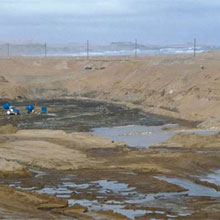
The bottom part is called bedrock. This underground is hard as a rock and it is the bed on which the diamonds were deposited by the river so many years ago, and resting. The bedrock is cleaned by workers using a containerised vacuum cleaning system.
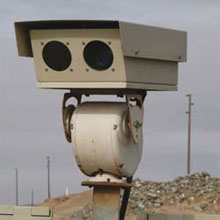
FLIR SR-100 thermal camera is mounted in a stainless steel housing which protects it against harsh weather conditions alongside Namibian coast
Over 16 FLIR SR-100 cameras were installed to overlook the bedrock areas

Once excavated, the ore is transported to ore processing plants where it is crushed to pieces smaller than 150mm. A process of dense medium separation produces a diamond-rich concentrate from the crushed gravel. The final concentrate represents around 1% of the material originally fed to the plant. The concentrate is sent to a central recovery plant, which produces the final 100% diamond product.

Namdeb currently holds multiple mining licenses from which diamonds are recovered. The Mining Area No.1, Bogenfels and Elizabeth Bay Mining Licenses extend from the Orange River in the south to Lüderitz in the north of Namibia, and approximately 5.5 kilometers off shore in the Atlantic Ocean to approximately 20 to 35 kilometers inland. These areas generate the bulk of Namdeb's production.

Diamonds are very small and easy to conceal. Therefore making sure that as little as possible diamonds are being stolen is of the utmost concern to Namdeb.

Using Ingenious Methods To Steal Diamonds

“Diamond theft is serious issue”, explains Mr. Freddie Groenewald, Security Chief Technician at Namdeb, Oranjemund. “Our mines are very rich and produce stones of the highest quality. Most of our product is gem stone quality, used for jewelery, with only a very small percentage of industrial stones. Our mines are so rich that workers that are working on the bedrock, the bottom layer where the diamonds are situated, regularly spot diamonds with the naked eye. If a worker picks up a diamond and hands it over, Namdeb’s experts will determine the value of the stone and 70% of its value is given to the honest finder. This way we try to discourage theft. Nowhere else can a worker gain this amount of money for a precious stone.”

“Still, numerous people are trying to steal the diamonds. At first sight this seems unbelievable since at the “black market” they will only receive a small amount of the stone’s value. The problem is that workers are sometimes under pressure from criminal organizations to steal diamonds. Although strict security measurements are in place, they still try to steal using different methods. Since all people that come out of a secure area are scanned, various methods to conceal diamonds are used, for example hiding them in the heels of shoes or in work tools.”

Security At The Bedrock Area

“Needless to say, that the bedrock area is a critical area for security.”, explains Mr. Harold Schoeman, Security Senior Technician at Namdeb, Oranjemund. “We monitor the workers closely to see that they are not trying to take away diamonds. We have introduced movable wireless camera systems called “spider cameras” on the bedrock mining sites. These are small, movable CCTV cameras installed on the bedrock, close to the workers. We can zoom in and follow their activities from a centralized video monitoring facility. The camera systems have assisted us with good quality video footage, which are used as evidence in disciplinary actions and in court cases of diamond theft.”

Thermal Imaging Helps For Security During The Night

“The workers are aware that they are being monitored so they are careful of what they do. Sometimes they hide stones in a remote area of the bedrock area. Once it is dark, they will try to come back and pick up the diamonds. In order to avoid this we have installed thermal imaging cameras.”, says Mr. Groenewald. “We have installed mobile surveillance systems on all active bedrock sites. These systems include a FLIR Systems SR-100 thermal imaging camera.”

“There is not supposed to be any activity on the bedrock sites during night time and if anyone does try to access it in darkness to pick up diamonds, we see it immediately on one of our monitors. Since the cameras are installed on a pan/tilt head, we can follow the person while a security patrol is on the way to arrest him. The cameras do not help us only during the night. The area where we are mining is close to the sea and foggy conditions are not unusual. The thermal imaging cameras also help us to see through the fog.”

FLIR Systems SR-100 Cameras
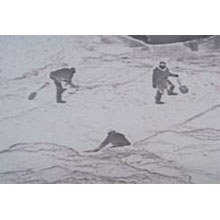
PTZ-35x140 MS has the ability to zoom in and have a closer look at suspect activities which is perfect for Oranjemund, Namibia
FLIR thermal cameras are excellent tool for spotting activity in total darkness and in harsh weather conditions

“We recently purchased 16 FLIR Systems SR-100 cameras to overlook the bedrock areas. We had experience with other thermal imaging cameras in the past and were very much aware how thermal imaging can help us. We decided however to buy FLIR Systems thermal imaging cameras for various reasons.”, Mr. Groenewald continues.

“The FLIR Systems cameras contain a Vanadium Oxide detector and produce an excellent image on which the smallest of details can be seen. Since they are producing images with a frame rate of 9 Hz we did not need any export license to install them in Namibia. The 9 Hz images are not a problem for us and suit our needs perfectly. Furthermore, the cameras which we had installed previously contained a BST detector. In order to operate well, they contain an internal mechanical chopper that calibrates the image. This chopper was very susceptible to breakdowns. Each time we had to send a camera in for repair it was away for quite some time. By buying FLIR Systems material we are eliminating all these problems. We are convinced that we are getting excellent value for our money.”

Operating Under Climatically Harsh Conditions

“The cameras we are operating on the bedrock areas are operating in extremely harsh conditions. Not only are they installed close to the sea, which means they are susceptible to salt spray, they are also exposed to strong winds. It is like their housing is being sandblasted continuously.”, Mr. Groenewald continues. “Although the cameras are extremely well protected, we decided that they could use some extra protection in these conditions.”, explains Mr. Tinus Diedericks, Timeless Technologies FLIR Systems distributor in South Africa. “Therefore we have constructed “Stainless Steel 316” housing. The FLIR Systems SR-100 cameras are installed in the housing together with a CCTV camera which overlooks the bedrock during daytime. The housing containing the two cameras is installed on a pan/tilt which increases situational awareness and allows following people when necessary. ”

“To protect the lens of the SR-100 cameras we have installed an 8 mm thick germanium window. More than 99% of the infrared radiation transmits through it. The germanium window has been hardened with cobalt on the outside and has an anti-reflexive coating on the inside. This way we can assure a perfect image quality and extremely high protection of the thermal imaging cameras.”

Movable Systems

“The cameras and other equipment are powered by solar energy. A solar panel provides more than enough power to operate. Batteries, which can last up to 4 days, are being used as a back-up. The entire system has been installed on a small trailer. This way, Namdeb has the possibility to move it from one mining area to another. Once an area is mined out, they can easily move it to the next one without any problems.”, Mr. Diedericks explains.

Monitoring The Images In The Control Room

The control room where all the images of the different camera systems are coming in is in Oranjemund. Some mining areas, like e.g. Bogenfels, are more than 200 kilometers away from this control room.

“Thermal imaging cameras have proven their worth here in Oranjemund. They are an excellent tool for spotting activity in total darkness and in harsh weather conditions”, says continues Mr. Groenewald, Security Chief Technician at Namdeb, Oranjemund

“It works really simple!”, explains Mr. Diedericks. “The small spiders cameras installed on the bedrock are connected wireless to the station on which the thermal imaging cameras are installed. From this station, all signals are send wireless to a small local control room. This again allows for moving the cameras easily to a new location. A fiber optic cable goes from these control rooms to the main control room in Oranjemund. There the images of all cameras can be monitored and the cameras can be controlled.”

Monitoring The Entrance And Exit Of Mining Area 1

Not only the bedrocks are being monitored with thermal imaging cameras but also the exit and entrance to Mining Area 1 is being overlooked by a thermal imaging camera. All personnel and equipment that goes in or out, this area undergoes thorough security screening. When coming out of the area, everyone goes through an X-ray machine to check if they have not concealed diamonds. The entrance to Mining Area 1 is in the town of Oranjemund itself. Between the mining area and the town a “no-man’s land” has been created. In this “no-man’s land” dogs are patrolling continuously to make sure that no one tries to enter or leave the area in an unauthorized way.

FLIR Systems PTZ-35x140 MS Overlooks Critical Areas

“Although we also have other equipment in place, we monitor the entrance and exit to Mining Area 1 and the “no-man’s land” continuously with a FLIR Systems PTZ-35x140 MS thermal imaging camera.”, Mr. Groenewald continues. “The camera is installed on a high mast on which also our communication and other equipment are installed. During daytime, we can use the daylight camera installed in the PTZ-35x140 MS. When it gets dark we switch to thermal. The PTZ-35x140 MS has the ability to zoom in and have a closer look at suspect activities which is perfect for us.”

“One of the ways in which people are trying to get diamonds out of the mining area is by shooting crossbow arrows over the “no-man’s land”. The arrows are hollow and the inside is filled with diamonds. An accomplice picks up the arrows on the other side. Thanks to the PTZ-35x140 MS, we can now monitor, in total darkness and also in foggy conditions, what is happening alongside the fence. If we see people approaching and suspect illegal activity we send out a patrol. Since the PTZ-35x140 MS is mounted on a robust pan/ tilt mechanism, we can overlook an entire area and if necessary follow a suspect person so that he cannot get away.”

Advantages Of Thermal Imaging Compared To Fences Are Clear. More Projects Are Being Considered

“Thermal imaging cameras have proven their worth here in Oranjemund.”, continues Mr. Groenewald. “They are an excellent tool for spotting activity in total darkness and in harsh weather conditions.”

“Thermal imaging provides us with other options as well. At Namdeb we are trying to work in an ecological friendly way. If a mining area is mined out, we rehabilitate the area to its original state. Although sometimes fences are necessary, we try to avoid them as much as possible. We are investigating thermal imaging to further assist us with perimeter protection. This may reduce the civil works cost for expensive fencing options.”

Thermal Imaging For More Than Security Only

“With the advanced knowledge gained by working with thermal imaging cameras, I also want to use the technology for activities I do in my spare time.”, continues Mr. Groenewald. “Apart from being an amateur photographer I am technically assisting a scientist, Dr. Ingrid Wiesel, with the Brown Hyena Project. We are researching the behavior of this fascinating animal that lives in the Namibian dessert. We would like to install a small thermal imaging camera, in co-operation with Tinus Diedericks from Timeless Technologies, in front of one of the dens to see exactly what happens during the night. After all, for seeing what is going on in total darkness, for security or any other application, there is no better tool than a thermal imaging camera.”, Mr. Groenewald concludes.


Download PDF version Download PDF version
Google logo Add as a preferred source on Google
  • Network / IP
  • Airport security
  • Security installation
  • PTZ cameras
  • Wireless security
  • Industrial surveillance
  • Thermal imaging
  • Day/Night surveillance
  • Fiber Optics
  • Related categories
  • Surveillance cameras
  • Security camera housing
Related white papers
How Security Systems Ensure Healthy Workplaces During COVID and After

How Security Systems Ensure Healthy Workplaces During COVID and After

Download
Delivering a Smart, Secure and Healthy Workplace with Cloud

Delivering a Smart, Secure and Healthy Workplace with Cloud

Download
Building A Safe Ecosystem For Visitors Post COVID-19

Building A Safe Ecosystem For Visitors Post COVID-19

Download
Related articles
What Do You Need To Know About Thermal Imaging Cameras?

What Do You Need To Know About Thermal Imaging Cameras?

Thermal Cameras And Smart Cities: Preventing COVID-19 In Public Places

Thermal Cameras And Smart Cities: Preventing COVID-19 In Public Places

What Are Some Unusual Applications Of Surveillance Cameras You Have Seen Recently?

What Are Some Unusual Applications Of Surveillance Cameras You Have Seen Recently?

Follow us

Sections Products Video Surveillance Access Control Intruder Alarms Companies News Insights Case studies Markets Events White papers Videos AI special report Cybersecurity special report RSS
Topics Artificial intelligence (AI) Mobile access Healthcare security Cyber security Counter terror Robotics Thermal imaging Intrusion detection Body worn video cameras
About us Advertise About us 10 guiding principles of editorial content FAQs eNewsletters Sitemap Terms & conditions Privacy policy and cookie policy Californian Residents (CCPA)
  1. Home
  2. Topics
  3. Thermal imaging
  4. News
  5. Case studies
About this page

"FLIR thermal cameras secure diamond mines in Namibia" is one of 4007 in-depth security application and installation case studies featured in this section. Visit regularly for the latest updates on use cases, installations and deployments of security products from .

Subscribe to our Newsletter

Stay updated with the latest trends and technologies in the security industry
Sign Up

DMA

SecurityInformed.com - Making The World A Safer Place
Copyright © Notting Hill Media Inc. 2000 - 2025, all rights reserved

Our other sites:
SourceSecurity.com | TheBigRedGuide.com | HVACinformed.com | MaritimeInformed.com | ElectricalsInformed.com

Subscribe to our Newsletter


You might also like
Security And Surveillance Technologies For The Casino Market
Modernizing Access Control
Addressing Cybersecurity Vulnerabilities In The Physical World
Enhancing Physical Access Control Using A Self-Service Model
Sign up now for full access to SecurityInformed.com content
Download Datasheet
Download PDF Version
Download SecurityInformed.com product tech spec