 |
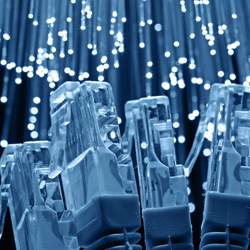
| Fiber optic transmission has played a crucial role in the rise of IP video surveillance |
Changing role of fiber optics within video transmission
Fiber optics have had a role in video transmission for many years, starting in the days when analog video signals commonly traveled using amplitude modulation (AM) and frequency modulation (FM) across fiber optic cables. But that role is changing with the transition to network IP. Now, fiber optics are capable of sending massive amounts of digital information across vast distances, securely and immune to electromagnetic interference. Fiber optics are just part of the picture, and networking of IP-based video is leading a path into greater connectivity and functionality for digital video surveillance systems.
Benefits of fiber optic transmission
Fiber is also less easily tapped into or interfered with, which makes it a more secure means of transmitting data over long distances |
Fiber optics has the ability to send data over longer distances than Cat-5 cabling. The IEEE 802.3ab standard limits each segment of a gigabit Ethernet over copper wiring to a distance of 100 meters (about 110 yards). Alternatively, gigabit Ethernet transmission over fiber optics can extend to dozens of miles. IEEE standards specify gigabit Ethernets using various cable fiber types and wavelengths of light that extend to distances up to 70 km (43 miles), thus expanding the reach of modern digital video systems to remote locations and thus increasing their functionality in a far-flung campus setting..
Further, the core of fiber optic cable is glass instead of metal, which makes it immune to lightning strikes, short circuits, "cross talk" or other electrical problems. It is lightweight, is stable within a wide temperature range and has a long service life; for example, fiber optic cables installed 20 years ago are still in service. Fiber is also less easily tapped into or interfered with, which makes it a more secure means of transmitting data over long distances.
History and evolution of fiber optic transmission
The availability of commercialised fiber optic technology dates back to the 1980s, when telecommunications companies began constructing massive networks using fiber optic cables. The core of a fiber- optic strand is clear glass surrounded by reflective cladding that keeps light traveling along the strand from escaping and redirects it along the fiber. This fiber strand is about the diameter of a human hair. Light pulses are used to transmit information along the fiber strand. A transmitter or transceiver on one end of the fiber transforms electrical pulses from a copper line into light pulses that are beamed along the fiber strand until they are converted back into electronic pulses at the receiving end.
| |
| Fiber optics are just part of the picture, and networking of IP-based video is leading a path into greater connectivity and functionality for digital video surveillance systems |

The terms singlemode and multimode refer to the diameter of the fiber and how light waves travel through the fiber; singlemode fibercore is smaller and uses light that travels a single path or mode through the fiber to achieve a higher transmission rate. Singlemode fiber is less expensive than multimode, but singlemode converters are slightly more expensive than multimode versions.
A consequence of the dot-com boom is the existence of a large amount of unused, "dark" fiber, some installed by telephone companies looking to expand their market. Millions of miles of fiber strands are installed throughout the world -- more than 90 million miles in the US alone. Because installing fiber cables is expensive, often additional or spare fiber is deployed and put in place for possible future use, and this is especially true in schools, hospitals, libraries and other campus settings.
Fiber optic networks, often including dark fibres, are also likely to be available related to a customer's data system or telephone cabling system. This infrastructure can be leveraged as the backbone of a high-speed data network. Extension of fiber to new and remote locations is also necessary given the IEEE distance limitations on gigabit Ethernet.
 | Jack Fernandes President and CEO American Fibertek |