 |
| The system makes it possible for train drivers to have access to live video images of critical areas |
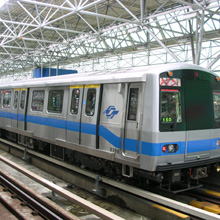
Averaging 1.6 million passengers per day, the Taipei Metro, also known as the Taipei Mass Rapid Transit (MRT) system, is one of the busiest transportation systems in Asia and has become an important driver for business and lifestyle in the island nation. A CCTV-based onboard video surveillance system has been in place on a number of Taipei Metro carriages since 2010 to help ensure smooth and reliable operations and keep a watchful eye on the security and safety of riders. This system makes it possible for train drivers to have access to live video images of critical areas, and video recordings are also available for later review and analysis.
In 2012, the Taipei Metro undertook a project to install an onboard video surveillance system for the Nangang-Banqiao-Tucheng Line. Instead of relying on the analog cameras and DVR systems that are used on the other lines, the Taipei Metro decided to take advantage of the latest in IP video technology, including IP cameras and network video recorders (NVR). IP video technology would enable the Nangang-Banqiao-Tucheng Line to achieve greater video coverage, improved image quality, higher bandwidth, and better system management. By using an open network architecture, the system would also be easier to deploy and integrate into the Taipei Metro's other systems. Finally, IP video technology would make it possible to support live view and video recording, both on the train itself and remotely at train stations and Operation and Control Centers (OCC).
As an essential passenger safety and security system, it was critical for the video surveillance system to meet the Taipei Metro's strict performance and reliability criteria for EMC, vibration, and physical protection. Moxa's IEC 60571-compliant IP cameras, network switches, and network video recorders (NVRs) were found to meet or exceed the system and performance requirements, and were selected to power the system.
Three models of the Moxa IP rolling stock camera line are used in this on-board video surveillance system:
- VPort 16-M12 series - ceiling-mounted, dome-type IP camera for carriage surveillance
- VPort 26A series - ceiling-mounted, low-illumination, dome-type IP camera for surveillance in the driver's cab
- VPort P06HC series - hidden-type IP camera for the intercom system.
All three IP cameras conform to ONVIF standards, meet the rugged EMC, temperature, vibration and shock design requirements of IEC 60571, support Full-HD, 1080P (1920 x 1080) resolution for large images, and are equipped with the newest image sensor to capture high-quality images. Moxa also developed custom hardware and form factors in order to meet special requirements for the Taipei Metro system.
The following Moxa rolling stock NVRs are being used for on-board recording:
- V2416 - smart NVR for video recording in the carriage
- V2616 - smart NVR for video recording, live display, and system management in the driver's cab
These NVRs are designed for reliable operation on moving vehicles and feature a patented anti-vibration kit with hard disk modules that have passed the IEC 61373 vibration test. The hard disk modules can be hot-swapped for easy maintenance and minimal system downtime.
Moxa's rolling stock TN-5516-8PoE Ethernet switches are used for the IP-based communication backbone along the train. The TN models are specially designed to withstand extreme temperatures and vibration, and they feature locking M12 connectors to minimize the chance of disconnection. Since the IP cameras are powered over the switches' PoE ports, the system benefits from greatly reduced cabling. The port-trunking function on the Moxa switches also makes it possible for the system to support wide bandwidth usage, and the advanced switch management features enable system operators to have full control over network performance, security, and configuration.