OPTEX Indoor Security

OPTEX Real-time Flow Control People Counter

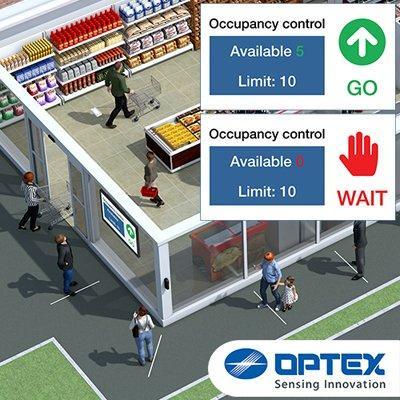
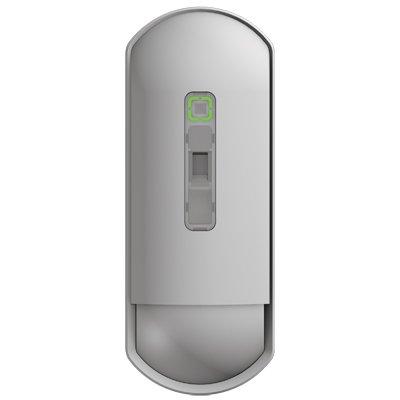
Flow control to support social distancing As the world moves to the new normality and measures are lifted, governments have put in place restrictions to support social distancing and avoid any new spread of COVID-19. Managing and controlling the numbers and access of people in and out of stores and offices, or indeed any building open to the public is in fact crucial in supporting that people maintain a safe distance between them. The importance of real-time data accuracy Measuring occupancy as it happens with immediate update of the people count is therefore critical as it could lead to unsafe situations where too many people are allowed in a space and social distancing is hard to control. The data needs to be gathered real-time and transmitted instantly to the integrated occupancy software platform in order to give an exact picture on how many people are in a store, room or a specific area of a building. Another aspect to consider is the precision in the count of people going in or out of a store, making sure there are no errors in the count that over-time accumulate minimizing the reliability of the information, and which could again create unsafe situations or impact negatively on the store sales, if for instance no access was allowed based on incorrect reporting that occupancy threshold had been reached. The OPTEX Akribos VC-1020 is a real-time and multi-directional indoor people counter that can provide more than 98% accuracy. It ignores trollies and baskets and manages groups of individuals by tracking the direction of every individual, even complicated movements such as people turning back or standing still. Now featuring MQTT protocol, the Akribos sensor can be integrated with third party analytics software transmitting instantly the data gathered which can then be used to create key-performance reports, dashboards and visual displays to control occupancy levels. A long-term solution for businesses Many businesses and retailers are using their security staff to manage access and control queue volumes and as such, installers have an opportunity to become the principal point of contact for bringing new solutions regarding occupancy level and social distancing. The solution with OPTEX Akribos solves the issue created by the pandemic, but also solves the ongoing challenge of efficiently and accurately monitoring occupancy levels within a busy working or retail environment. The analytics and people traffic reporting can help retailers manage their staff and product placement better, and in the office to have a more efficient building management based on occupancy level.

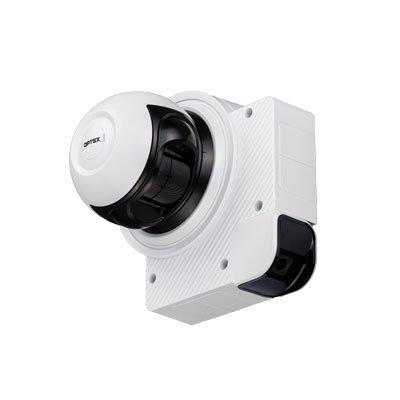
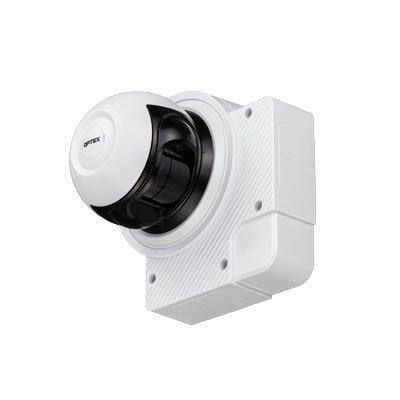
Optex LiDAR security sensor

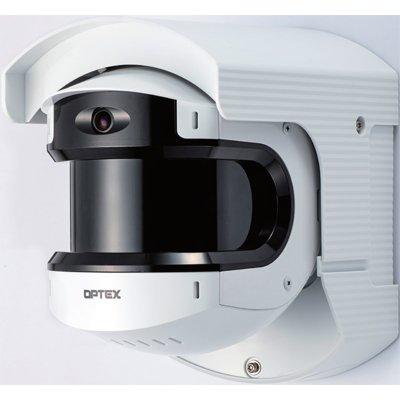
The award-winning REDSCAN Pro range uses LiDAR technology to create a high-resolution virtual laser wall or plane up to 100m long, delivering ideal intrusion protection for many high-security sites, from utilities such as water treatment, telecommunications, transportation hubs, substations, manufacturing, and logistics to campus-style commercial sites. With onboard sensing analytics, REDSCAN Pro can analyse the size, speed and distance of moving objects, providing point detection by tracking the X & Y coordinates of the objects. A further advantage of LiDAR technology is that the detection performance is stable at any time without being affected by light, weather changes or temperature. The sensor can operate from -20 to +60 degrees, and when using a heated lens can extend its operating temperature to -40 degree. Long range and multizone logic detection The new REDSCAN Pro Series sensors can cover large areas with a high degree of accuracy which remains constant over the entire detection area. The RLS-3060V model provides 30x60m coverage, and the RLS-50100V a 50x100m detection area. The rectangular detection pattern (instead of fan-shaped) allows seamless protection from corner to corner, ideal for facades, flat roofs of commercial buildings and perimeter structures of large installations. A key feature of the new LiDAR series is the multizone logic which provides a great level of customisation and flexibility. With just one sensor, customers can create up to eight different detection zones with configurable sensitivity, target size and output, so for instance an immediate alert can be set for restricted areas and a lower sensitivity for lower risk areas. Versatile installation REDSCAN Pro sensors can be installed in different ways to adapt to the area or the application required; they can be mounted indoor or outdoor, in a vertical, tilted or horizontal mode. To make the mounting options easy,  the sensor  has a built-in 95 degree adjustment bracket within its housing, so there is no need for accessories. Assistance camera for easy set up and event reviews To ease the process of set up and configuration, the REDSCAN Pro series features an integrated panoramic assistance camera, that allows the detection area to be visualised to quickly make any optical alignments. Additionally, the camera module can be used to take pre- and post-alarm images for later verification and if necessary, to assist in re-adjusting the detection area. Up to 500 events can be stored onboard. The benefits of ONVIF compliance Through the ONVIF protocol (Profile S), REDSCAN Pro allows alarm outputs and the video stream from the assistance camera to be sent to any ONVIF-compliant network video system or IP network devices. At the same time REDSCAN Pro maintains the REDWALL event codes (REC Codes) so those sites which already have RLS units can easily be updated. Network Security Online security is a major concern for the industry, which is why REDSCAN Pro is a PoE+ sensor that complies with HTTPS, SNMPv3, IEEE802.1X protocols. To ensure the device is secure, installers can also set up encryption and high-level authentication to protect against unauthorised access to the device. The sensor performs a constant health check and is equipped with all the features to provide the highest levels of security. The REDSCAN Pro series includes two models: RLS-3060V: with a detection range of 30 x 60 m RLS 50100V with a detection range of 50 x 100 m

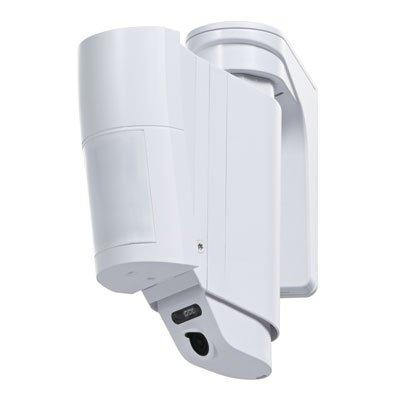
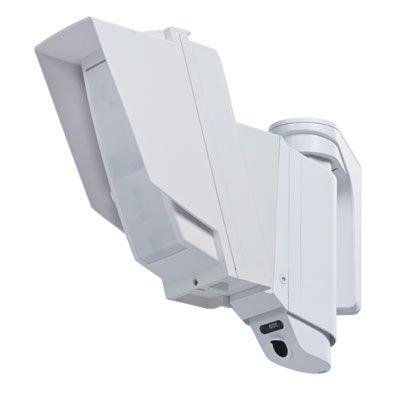
OPTEX RLS-2020A Advanced LiDAR Sensors For Indoor/ Outdoor High-security Applications

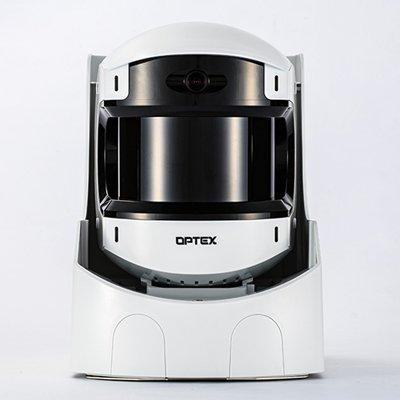
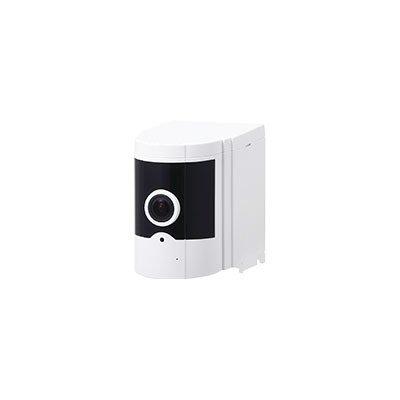
Redscan mini-Pro is a high-performance laser scan sensor that can identify an object's size, distance from the sensor, and speed. In normal mode, a single sensor can be used to cover a 20 x 20 m detection area, ensuring a robust intrusion alert system for both indoor and outdoor environments.Adopting newly developed infrared LED lighting technology and a full-HD camera, Optex's latest laser scan sensor offers improved video-based confirmation functionality for increased ease of use and greater usability in various environments. Features Vertical or horizontal mount is selectable REDSCAN mini-Pro series can be installed vertically, horizontally. Selectable installation method REDSCAN mini-Pro series have 3 installation methods as Wall, Ceiling and Pole. You can select either method to match the installation site. Built-in FHD Camera and IR LED RLS-2020V has a build-in FHD camera with IR LED providing clear image in 1080P resolution. The pre and post alarm camera images are recorded in internal memory of the unit (alarm logs : 500 events) and can be played back for verification. Map Screen Display Both RLS-2020V and 2020A can stream live images instead of video images from the camera. Any photo or image can be used to overlap the detection area. Connectivity and interoperability Redscan mini-Pro is an ONVIF profile S compliant sensor allowing it to send alarm outputs via the ONVIF protocol to any ONVIF compliant networked video system or IP network devices. The video stream of the assistance camera could also be provided to the Video Management Software platform via the ONVIF RTSP protocol. To assure a secure network communication, the REDSCAN Pro is compliant with HTTPS, SNMPv3 protocols. Dynamic Event Filtering A function that determines an alarm after combining object detections in 2 separate areas (Alert area and Judgment area).