360° Surveillance From Eneo: See All-round. Secure All-round. Good All-round
A disadvantage of conventional surveillance cameras is that they capture only a relatively small field of view. And only a few of them generally support a range of more than 90 degrees. If, though, the requirement is to see everything, in particular the area to the left, right and behind the camera, then further cameras are needed. But this can quickly become expensive and complicated. The practical technical solution that is also less of a financial strain is a panoramic camera, because it delivers the 360 degree all-round view as standard, and it is the optimum choice when you need a continuous widescreen panoramic or complete access control. Not all panoramic cameras are the same There are basically three different types of panoramic camera: fisheye, polymorphic and segmented cameras. The last two unquestionably have their strengths and rights to exist, but they are considered to be on the way out and unsightly (polymorphic) or not so widespread (segmented) and relatively expensive (both). The most widespread “panoramic” is the one with a fisheye lens. This ultra-wide-angle lens is installed in a dome housing so that its external picture alone is one of overall style. A single lens and image converter show the entire 360 degree scene in an image with native curvature, the typical fisheye look.
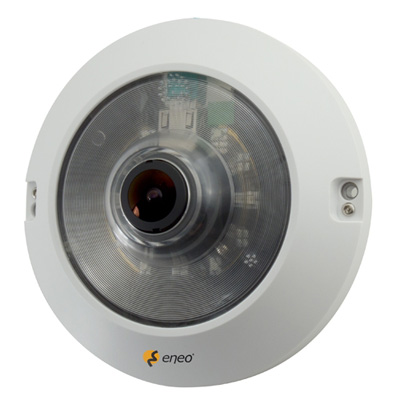
All-round good: PXD-5360F01IR The rule particularly for panoramics is: the larger the area under surveillance, the lower the pixel density. This makes high resolution cameras obligatory and is precisely where the new PXD-5360F01IR eneo fisheye camera shines: fitted with a 5 megapixel image sensor it delivers a maximum resolution of an impressive 2592 x 1944 pixels. Whoever is satisfied with “simply” Full HD with 4080p experiences the 360 degree imagery at up to 30 fps – therefore, or therefore the best, conditions for not only good identification of details close to and below the camera, but also those somewhat further away or at the image edges. But the new 360°-PXD can do even more: the PoE-capable IP camera has a switchable IR cut filter making it a true day & night camera. The integral infrared illumination is exhibited by 6 LEDs that can also be switched off. Digital Wide Dynamic Range and 3DNR are further image-improving features. The maintenance-free EPTZ, as it does without moving parts, allows digital continuous pan, tilt and zoom. Finally, the 360° also sets the right tone to make it completely “round”: the camera has a built-in microphone and speaker.