 |
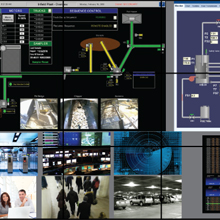
| RGB Spectrum demonstrated its Galileo Display Processor video wall system at the event |
RGB Spectrum recently demonstrated a range of control room solutions, including its award-winning Galileo Display Processor, a powerful and economical video wall system designed around a PC-based architecture, at ASIS International, Booth #3365.
RGB Spectrum is recognized in the security industry for its hardware-based control room systems, which use video to seamlessly link disparate systems. The Galileo processor provides integrated control of multiple security systems, including VMS and access control, as well as external devices, without requiring custom software.
The processor combines the benefits of PC-based systems, such as IP inputs and native applications, with a hardware acceleration engine that ensures real-time performance and 24/7 reliability. Featuring an open architecture that is hardware and software agnostic, the Galileo processor is ideal for a range of security applications.
The Galileo processor supports remote collaboration through two methods. It decodes H.264 graphic and motion video streams, allowing operators to view and control remote sources. In addition, RGB Spectrum’s exclusive VDA remote desktop technology provides operators with responsive keyboard/mouse control over remote systems and equipment via a LAN or WAN. VDA performance is demonstrably superior to the industry standard VNC, particularly at low bandwidth or with high motion graphics and video.
A modular design allows the processor to support a full range of input and output types (IP, analog, DVI/HDMI, 3G/HD-SDI) with resolutions up to 3840x2160 (4K). The Galileo processor can also deliver HDCP protected content to an unlimited number of displays, while other PC systems either do not support HDCP at all or impose severe limitations on wall size.
The versatile Galileo processor can configure an unlimited number of windows on video wall arrays of up to 56 displays. Windows can be displayed anywhere on the video wall, at any size, within or across screens, and in correct aspect ratio or scaled over multiple monitors. Images within individual windows can be panned or zoomed to emphasize detail. The processor’s window layout options are endless, and users can use presets to save and recall preferred configurations to quickly change the appearance of the video wall.
The Galileo system is easy to set up and control. An advanced user GUI provides live thumbnails of sources that users can “drag and drop” to destinations. The user GUI also allows operators to control and display PC applications running on the wall, such as VMS, SCADA and videoconferencing. The processor and applications can also be controlled through a convenient tablet interface.
Combining integrated system control with enhanced reliability and the flexibility of a PC system, the new IP-enabled Galileo display processor is a PC wall done right.