Vigitron, Inc. - Experts & Thought Leaders




Latest Vigitron, Inc. news & announcements
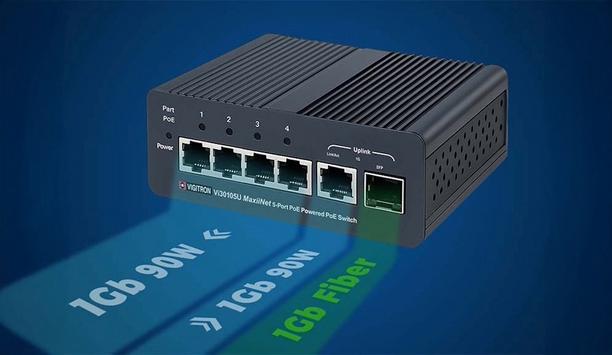
The Vigitron MaxiiNet™ Vi30105U is a high-performance 6-port PoE switch designed for fast and reliable Ethernet transmission. Furthermore, it supports both input PoE and local DC power, delivering up to 90W of PoE per port on four ports to power devices effectively. Additionally, this switch includes a flexible MSA SFP-compliant fiber uplink port for distances up to 80 km. It also features a 1G copper uplink port for versatile connectivity. Moreover, with an operating temperature range from −40°C to 70°C, the Vi30105U performs reliably even in extreme environments. Network packet performance standards In addition, fixed Layer 2 management features include 802.1p QoS for prioritizing data, support for 2K MAC addresses, and learning and aging capabilities. These functions, along with a non-blocking switch fabric, ensure smooth and efficient data transmission. The Vi30105U is MegaPixel Certified (MPC™) and has undergone extensive testing. As a result, it ensures compatibility with major camera manufacturers and compliance with network packet performance standards. This ultimately guarantees error-free operation and high-quality performance in demanding applications. Ideal choice for network security Additionally, the Vi30105U reduces installation costs while maintaining reliable operation Its compact and durable design supports DIN Rail, desktop, and wall mounting, offering flexible installation options. Additionally, the Vi30105U reduces installation costs while maintaining reliable operation. With advanced features, robust construction, and proven reliability, the Vi30105U is, therefore, an ideal choice for network security and industrial applications requiring dependable data and power solutions. Features of Vigitron MaxiiNet™ Vi30105U 6-port fixed Layer 2, 1G PoE powered PoE switch Supports major high-power non-standard PoE-powered devices 100/1000Mbps network speeds, auto-sensing Can be powered from a remote 802.3bt PoE source and provide PoE power to 4 ports Each port can power 802.3bt PoE loads up to 90W, as well as most non-standard PoE up to 72W SFP fiber port supports long distances up to 80 km Automatic PoE port priority allocation Over-current shutdown protection if the PoE budget exceeds Certified Mega Pixel Camera (MPC™) for virtual loss-free transmission of data Type tested to RFC 2544 TCP/IP network bandwidth packet transmission standards Type tested for −40°C to +70°C operating temperature range Complies with major IEEE standards and RFC network protocols for UTP, TCP/IP, HTTP/HTTPS Provides fixed Layer 2 network switch functionality
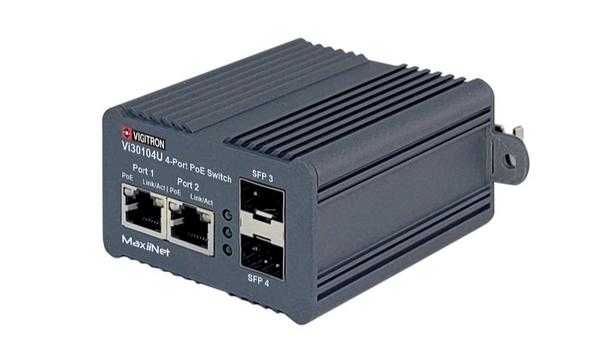
Vigitron, Inc., a global pioneer in network solutions for security applications, is pleased to announce the launch of the Vi30104U, a cost-effective 4-port fixed L2 unmanaged PoE switch designed to meet the growing demands of high-power PoE and high-speed data in security projects. The Vi30104U features two 1G 90W PoE ports compliant with the IEEE 802.3bt standard and offers backward compatibility with most legacy, non-standard high-power PoE devices. The switch also includes two 1G SFP fiber ports for uplink or daisy-chaining applications, providing flexible integration into a wide range of network topologies. Providing flexible integration With its compact design and high output capability, the Vi30104U is a perfect fit for remote deployments—including poles, perimeter fences, and infrastructure expansions—where power and connectivity must be extended efficiently and reliably. Key Features & Benefits: High-Speed & Long-Distance Connectivity – Supports fiber transmission up to 80 km Power Efficiency – Two ports deliver IEEE 802.3af/at/bt up to 90W PoE per port Intelligent Power Allocation – Auto PoE sensing, prioritization & overload protection Extreme Durability – Operates in -40°C to 70°C for harsh environments Ideal Applications: Cost-effective fiber & copper network expansion High-bandwidth multi-sensor & PTZ cameras Drop-and-insert configurations for long-distance camera transmission
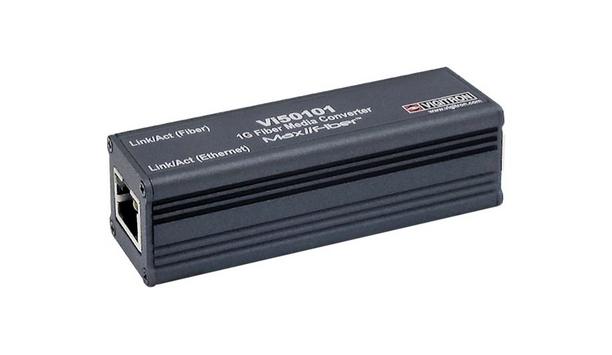
Vigitron, a pioneer in networking solutions for security applications, introduces the Vi50101 Mini Fiber Media Converter, a powerful yet ultra-compact solution designed to expand fiber connectivity with ease. With increasing bandwidth demands from high-megapixel and multi-sensory cameras, fiber usage is rapidly growing, particularly for long-distance transmissions. However, many network switches have limited fiber ports, creating expansion challenges. Vi50101 plug-and-play solution Powered by PoE, the ViSO101 eliminates the need for external power adapters, simplifying installation The Vi50101 addresses this by converting fiber to UTP, allowing seamless fiber port expansion without the need to replace existing equipment. The Vi50101 is a true plug-and-play solution for expanding fiber networks without additional power requirements. Supporting up to 1G Ethernet speeds and transmission distances of up to 80 km, it is ideal for security and industrial applications. Powered by PoE, the ViSO101 eliminates the need for external power adapters, simplifying installation. Its compact design allows for flexible placement, whether in-line, wall-mounted, or on a DIN rail, making it a versatile choice for a wide range of network environments. Key features SFP Standard - Compliant with standard Small Format Pluggable (SFP) fiber converters. PoE-Powered - No external power needed, works directly with PoE from switches. Long-Distance Transmission - Extends fiber connectivity up to 80 km. High-Speed Performance - Auto-select 10/100/1000Base-T Ethernet. Compact & Durable - Built to withstand harsh environments (−10°C to +70°C). Versatile Mounting Options - Supports in-line, wall-mount, or DIN rail installation.
Insights & Opinions from thought leaders at Vigitron, Inc.
If one component within the infrastructure changes, other components may need to be changed too Developing a bill of materials for an infrastructure is not difficult if you have the right information. One word of caution: Infrastructures are unique. Each is individual, so don’t depend on drop-down menus; it simply will not work. If one component within the infrastructure changes, take the time to check and see if the rest of the components need to be changed, too. Let’s look at some questions and considerations when designing a network infrastructure for use by an IP/PoE (Internet protocol/power over Ethernet) video security system. First, you should work with individual collection points. This could be when all devices (cameras/access controller) are routed to a single location or when there are multiple locations as in the case of individual IDFs (intermediate distribution frames). For each location determine the following: Cameras And Number Of Cameras What are the manufacturer and model numbers for each camera? Knowing this will help to determine the bandwidth and PoE requirements. How many cameras are going to this location? If there are different cameras from different manufacturers, please list all of these by number. Break down these numbers further according to those that are 290 feet or less and those greater than 290 feet from a network connection and PoE source. You may think of IP/PoE limits in terms of 328 feet (100m) but conservative planning takes into account wire bends, which can contribute to increased resistance and decreased performance. Type Of Cable What cable is installed? Existing installations, those which will convert from analog to IP, probably already have either coax or fiber. For coax almost all existing installation will have RG59, but it’s important to confirm. Very old installation may even use aluminum shield cable, which will probably have to be replaced due to its high resistance. New installations will use Cat 5e or Cat 6. Fiber is more complex as you have to first determine the mode – single mode or multimode. Then you have to know the fiber size, which is usually a function of the mode. Single mode will generally be 9/1.25 while multimode can either be 62.5/1.15 or 50/1.25, depending on distance. Regardless, your fiber modems must match both of these aspects and bandwidth as well. The type of cable will also determine if you need extra equipment The type of cable will also determine if you need extra equipment as only UTP or Ethernet cable can be directly connected within a network. Coax, single pair and fiber will all require some form of media conversion. Cable Length Choose necessary extenders. As previously noted at each collection point, divide your device connections into those less than 290 feet and those greater than 290 feet. For the latter, use the longest cable distance as your reference and determine the type of extenders required to meet the bandwidth and PoE device requirements. Using any device in the transmission path will require you to take into account its effect on bandwidth and PoE. Network And PoE Source (This Can Be The Most Difficult Part) Managing the variables. While there are many IEEE standards governing network interconnections and PoE, the most important variables we are concerned with have no standards at all. They range from determining a real PoE budget, to how PoE is programmed, if at all, to internal switch bandwidth, sometimes called switch fabric, to the ability of individual ports to pass the required bandwidth from a camera. Two important things to keep in mind. First, your bandwidth must remain consistent throughout the transmission path. Second, your PoE source must be able to provide not only the power required to operate your device and any other devices in the path, but also power in the event of startup surges to avoid PoE shutdowns. Save
IP/PoE systems eliminate the need for local power, thus saving installation costs Cost considerations are an important reason to use existing installed cable as part of a new system infrastructure. Extenders in the form of media converters can help. For almost three decades, video surveillance systems existed in the form of analog systems. Video coaxial cable was the primary method of transmission with a limited distance of about 750 feet. Analog systems required separate power supply located at each security camera site. Today, new technology often solves one problem and creates another. Internet Protocol/Power over Ethernet (IP/PoE) systems eliminate the need for local power supply, thus saving installation costs. The drawback is the restriction to only 328 feet and the required use of Cat 5e or above cable. Extended Transmission Distance So tens of thousands of video surveillance cameras are waiting to be converted to IP, and have been transmitting over coax at distances two-and-a-quarter-times greater than the Ethernet limit. The advent of extenders helps to solve this problem. In addition, the use of extenders for Cat cable and even single-pair alarm wire helps to add to the types of IP/PoE conversions while extending distance as far as three thousand feet. Tens of thousands of camerasare waiting to be converted to IP,and have been transmitting overcoax at distances two-and-a-quarter-times greater than theEthernet limit Considerations While Using Extenders Use of extenders requires taking several considerations into account. First and most important is a careful reading of specifications. A statement can be true while not applying to your applications. Let’s take IP/PoE transmission over coax as an example. A manufacturer’s product can state it has this feature and will meet your transmission requirement of X number of thousand feet. However, a careful reading reveals that achieving this requires RG 6 cable while you have RG 59 installed. You need to maintain a 100Mbps bandwidth and provide your cable with 12.95 watts of power. But as both bandwidth and power decrease with distances obtainable from many types of extensions, you realize that both are much less at the extended distance you require. In short, just depending on a product to make a simple specification statement is not enough when it comes to infrastructure considerations and especially with regards to extenders. Save Save
When a manufacturer states a specific PoE power for a camera, always count on the maximum class power source Power over Ethernet (PoE) is an important consideration in IP video security infrastructures, and many people believe Institute of Electrical and Electronics Engineers (IEEE) standards are the last word. However, when it comes to PoE, there is a wide range of both voltages and wattages that can qualify as being within an individual IEEE power class. This applies to both the device being powered and the source of the PoE. A video surveillance camera may require the highest source voltage of 48 volts and highest source wattage of 15.4 watts to be considered as IEEE 802.3af, Class 3. However, a PoE source output of only 37 volts and 7 watts can also be considered as Class 3-compliant under the standard.Surge Factor In PoE-Powered DevicesThe surge factor is another consideration with regard to PoE-powered devices. In any consideration of power, it always takes more power to turn a device on than to maintain its operation. For video security cameras, this requirement applies both to startup and also to when we activate accessory functions such as day/night operation, LEDs, and auto back-focus to name just a few. If the surge applied when turning on these functions exceeds the ability of the source to provide it, or rises for more than approximately 40 milliseconds, the PoE source will stop transmitting power based on the safety built into the 802.3 PoE standards. It remains in that state until the port is reset either by turning power to the port off and on, or by disconnecting and reconnecting the Ethernet cable.A customer might interpret this type of problem to be a camera failure – it was working during the day and failed at night. He might return the camera to the manufacturer, only to be told there is nothing wrong. The solution is simple and two-fold: First, even when a manufacturer states a specific PoE power for a camera, always count on the maximum class power source. For example, if a manufacturer states a camera requires 10 watts and is 802.3af Class 3, you should always have a PoE source of 15.4 watts. Next, estimate any surge that might be present as requiring at least 20 percent more power. So in the case of the 10-watt security camera, that would really need about 12 watts, in this case putting it within the limits of a full Class 3 source of 15.4 watts. The problem will usually occur when the surge exceeds a particular class, especially at the transition from Class 3 to Class 4. The considerations regarding bandwidth and PoE are the same as with the camera or remote device Network PoE SwitchOnce we have determined the power requirements of the connected or remote site device, we need to turn our attention to the source that will provide PoE power and receive the signal. Often this is a network PoE switch. The considerations regarding bandwidth and PoE are the same as with the camera or remote device. The concerns here again are with the lack of standards and how specifications are determined. There are several factors to take into consideration.First, networking equipment in general is tested and specifications are determined using a packet size of 64 bytes. However, even the smallest one- to two-megapixel cameras will approach the limits of packet size testing at around 1,538 bytes, while cameras with two megapixels and above are even higher. In short, networking products are not tested using packet sizes comparable to those required by video cameras.Switch Specifications Once we have determined the power requirements of the connected or remote site device, we need to turn our attention to the source that will provide PoE power and receive the signal While many switch specifications will state they handle Jumbo frames, that ability is restricted to port programming at 1 Gbps speeds. In networking, the 100 Mbps output of a video camera must match the bandwidth input speed of the switch port.The second switch consideration is called the switch fabric, which connects all the switch ports. Its bandwidth must be at least two times greater than the sum of the highest bandwidth of all the ports. There is no standard for this, and the actual bandwidth is a reflection of switcher cost. With regard to PoE, be careful not to mistake the total power supply for the PoE budget for the power allocated for camera PoE power. They are different. If the total power were allocated to PoE, there would be no power left for switch functions. In addition, if all ports required PoE, the switch could easily overheat and fail. There should be anywhere from a 10 to 25 percent separation between the total switch power supply and the PoE budget. Finally, there are no standards for the methods used to allocate PoE power within a switch. It could be equally divided as more ports are connected. It could be programmed, or it could be fixed to each port. Save Save