UNV Uniview - Experts & Thought Leaders


Latest UNV Uniview news & announcements

DNAKE, a trusted provider of IP video intercom and solutions, is thrilled to announce its compatibility with Uniview IP Cameras. The integration helps the operators improve control over home security and building entrances with an easy-to-manage feature, increasing both productivity and premises security. Residential and commercial The uniview IP camera can be connected to the DNAKE IP video intercom as an external camera. The completion of the integration creates a more efficient and convenient security solution, allowing users to check the live view from Uniview IP cameras through the DNAKE indoor monitor and master station. This adds protection for the residential areas or commercial premises that require higher security levels. Benefits of integration To put it simply, the integration between DNAKE intercom and Uniview IP camera enables the users to: Connect to external IP cameras for full coverage – Up to 8 Univeiw IP cameras can be connected to the DNAKE intercom system. The user can check the live views by DNAKE indoor monitor anytime with the camera installed in or out of the house. Open door & monitor at the same time – The operator opens the door from the monitoring window of the selected intercom with a single touch of a button. When there is a visitor, the user can not only see and talk to the visitor in front of the door station but also watch what’s happening in front of the network camera through the indoor monitor, all at the same time. Increase security –When the Uniview IP camera is used along with the DNAKE IP intercom, the security guard can observe the building entrance or identify the visitor with live video streaming from the camera on the DNAKE master station to increase security and situational awareness.
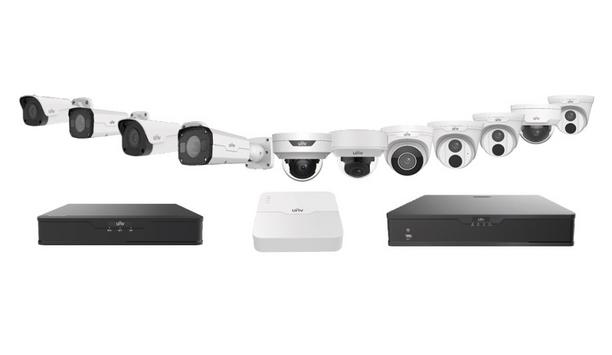
Pioneering security solutions developer, designer, and provider, Videcon have joined forces with the global CCTV manufacturer Uniview to introduce a new range of products to the UK market, including innovative NDAA-compliant technology. The new range, consisting of 14 cameras and recorders will sit alongside Videcon’s Aspect and Concept Pro ranges and will be split across three tiers: Easy, Prime-I, and Prime-III, with each product providing a premium quality performance suitable for all business and domestic needs. Each camera comes with human body detection as standard, allowing for the recognition of people within a configured area. The Prime-III range will utilize innovative LED lighting to provide crisp color imaging 24 hours a day. Non-HiSilicon components We’re delighted to be able to partner with Uniview on this new range of CCTV product" The Videcon Uniview range will be the first in the UK to introduce non-HiSilicon components within the products. Adhering to the United States’ NDAA which has prohibited the use of certain video surveillance, telecommunications services, equipment, and components from selected vendors to potentially lessen the threat posed to their cyber security. Videcon Managing Director, Matt Rushall said: “We’re delighted to be able to partner with Uniview on this new range of CCTV products. Our team are dedicated in providing our customers with the best technology on the market and their hard work has allowed us to be the first in the UK to provide the industry with these NDAA-compliant products.” Videcon Uniview range “We’ve developed a faster delivery system, allowing anyone to order products for next day delivery up to 5pm, with a full on-boarding program being introduced which includes demonstration centers across the UK for customers to experience the products for themselves.” “The Videcon Uniview range is just the beginning of our mission to provide our customers with the best products, best service, and crucially the best prices to ensure that security is accessible for all businesses.”
Uniview is one of the most popular video surveillance systems on the market. Uniview devices secure thousands of homes, offices, shops, hospitals, and even cities: Troyes in northern France or one of the most densely populated areas of Seoul, Gangnam. A user can now view Uniview video streams in the Ajax app. With an integrated security system, the user can check at any time whether the stove is turned off, where is their cat, whether the children are back home, or what triggered the motion detector alarm. Ajax helps to create such a system using cameras, detectors, and home automation devices. And the user can control it from anywhere in the world with a free app. Video surveillance device Using the Ajax app, the user can watch streams from Uniview cameras and DVRs and pause them to take screenshots. The connection is extremely simple: Log in to Uniview account Choose which cameras (or DVRs) will be available in the Ajax app Up to 10 cameras can be connected to Hub and up to 25 cameras to Hub 2. However, in order to monitor large facilities, the user may need more CCTV devices. Hub Plus can help with that. It can manage up to 50 cameras. And if the user needs even more cameras try DVRs. The application will treat each video recorder as a single video surveillance device regardless of the number of cameras linked to it. Encrypted streaming process Even if there will be more than a hundred cameras, they can still switch between while watching the stream. The streaming process is encrypted and the application never saves it on their servers. This is how it goes. First, the stream from a camera or a video recorder is broadcasted to the Uniview cloud. Then, it is transferred to the Ajax application using Uniview SDK. Only the user and the people with the corresponding rights can access the video streams within the Ajax app.
Insights & Opinions from thought leaders at UNV Uniview

Remarkable changes are happening in the video camera market for surveillance applications, including the emergence of lower-priced products that offer features that previously were only available at a much higher price point. Deflating prices of cameras are sometimes referred to as a “race to the bottom” – foreshadowing a market of low-cost cameras that all provide similar features. We asked this week’s Expert Panel Roundtable to comment on camera pricing trends and how customers can continue to find real value in the changing environment. Specifically, we posited: Lower-cost cameras have more features than ever. Why should a customer continue to buy “premium” cameras?

A technology poised to transform the physical security market is deep learning, which is a neural network approach to machine learning, differentiated by an ability to train using large data sets for greater accuracy. In effect, the system “learns” by looking at lots of data to achieve artificial intelligence (AI). Phases Of Deep Learning I heard a lot about AI, including how it can transform the physical security marketplace, when I attended NVIDIA’s GPU Technology Conference (GTC) in San Jose recently. Recognizing images, including video images, is a big focus of AI. In the past, you needed programmers to spend months telling a computer how to recognize an image. In deep learning, instead of programming the computer, you just show it many different images and it "learns" to distinguish the differences. This is the "training" phase. After the neural network learns about the data, it can then use "inference" to interpret new data based on what it has learned. In effect, if it has seen enough cats before, it will know when a new image is a cat. Factors enabling AI Deep learning and AI are fast-growing areas for a wide range of uses – physical security is just one. It is all made possible by the coming together of three factors. One is the availability of lots of data. This is the “big data” we have been hearing about; in effect, a proliferation of sensors (including video cameras) has produced a large enough mass of data to enable systems to be trained effectively. The second factor is the development of new algorithms to train neural networks faster, and the third is the availability of computer hardware (specifically GPUs, graphics processing units), that is capable of rapidly completing the involved calculations. NVIDIA manufactures those GPUs and sponsors the annual GTC conference, all about how they can be used more effectively. “Deep learning is about teaching technology to understand the world around us in a way that is similar to how we understand it” Deep learning and neural network computing is everywhere. It is now widely available in on-premises computers, in systems embedded in edge devices, and even in the cloud. The edge is particularly important in the video surveillance market, enabling systems to function despite any bandwidth or latency issues that would limit the effectiveness of a central server-based system. Edge-based functionality also limits concerns about the privacy of information, and eliminates dependence on the availability of 3G connectivity. NVIDIA AI City Initiative Video analytics applications fall under NVIDIA's “AI City” initiative, which they describe as a combination of "safe cities" (video surveillance, law enforcement, forensics) and "smart cities" (traffic management, retail analytics, resource optimization). Depending on the application, AI City technology must function in the cloud, on premises and/or at the edge. NVIDIA’s new Metropolis initiative offers AI at every system level, from the Jetson TX2 "embedded supercomputer" available at the edge, to on-premises servers (using NVIDIA’s Tesla and Quadro) to cloud systems (using NVIDIA’s DGX). “AI City applications need an edge-to-cloud architecture,” says Jesse Clayton, Senior Manager, Product Management, Intelligent Machines, at NVIDIA. “Some applications, such as body cameras and parking entrance applications, have to have AI at the edge. But for other problems, you need to aggregate multiple sources of information, such as using AI on an on-premises server for hundreds of video cameras.” The sheer volume of installed cameras in the world makes video an AI problem – more than 1 billion cameras worldwide by 2020 will provide 30 billion frames of video per day. The existing limitations of current video systems to adapt and function well in real-world conditions point to a need for better technology, as do the traditional shortcomings of video analytics systems. Video systems can achieve "super-human" results, identifying and classifying images using artificial intelligence. NVIDIA’s GPU Technology Conference offered a chance for Avigilon to interact with others focused on AI AI In Video Surveillance AI is steadily making its way into video surveillance. Multiple security industry partners are using NVIDIA GPUs to boost the effectiveness of their systems. Many companies highlighted their initiatives at ISC West in April and again at NVIDIA’s GPU Technology Conference. Among them are Avigilon’s Appearance Search and BriefCam’s real-time video synopsis system. Hikvision uses the technology for a six-fold improvement detecting pedestrians in the rain, while Dahua is speeding up its license plate recognition system by five times. Other companies using the technology are UNV Uniview (vehicle classification), SeeQuestor (investigations), Xjera Labs (people and attribute detection) and Sensetime (object detection). NVIDIA’s Quadro GPU system enables Avigilon network video recorders (NVRs) to search simultaneously across hundreds of cameras to find images that are similar in appearance, such as faces that match an example. The GPU’s fast and efficient processing power, available in a small and affordable form factor, provides a system that is scalable and cost-effective but can run complex algorithms to provide rapid results. Beyond recognizing objects, the system can also learn about how objects interact in the environment, and look for anomalies “Deep learning is about teaching technology to understand the world around us in a way that is similar to how we understand it,” says Willem Ryan, Senior Director, Global Marketing at Avigilon. “What seem simple to us in terms of how we perceive the world is complex for a machine to do, but a machine learns faster. Deep learning allows you to teach a machine how to make connections that we make every day. Using GPUs, a system can make assumptions and calculations instantaneously.” Beyond recognizing objects, the system can also learn about how objects interact in the environment, and look for anomalies or non-typical events. For example, if the system sees a car go onto a sidewalk, it could provide an alert. How Will AI Develop? NVIDIA’s GTC conference offered a chance for Avigilon to interact with others focused on AI, and to share Avigilon’s knowledge of the unique AI challenges of the video surveillance market. “This is the heart of the development of AI and deep learning,” said Ryan at the GTC conference. “To be involved and part of this is exciting to Avigilon, and we can expose people here to how AI can be used in a way they may not be familiar with. We have talked to people who didn’t realize how video surveillance happens currently, and how AI is changing it. “ “We want to continue to support the idea of GPU processing and how using it can make video surveillance solutions more effective, and change how people interact with video,” he added. “That’s where we see the impact. There have been challenges we have struggled to overcome in the security industry, and these are the breakthroughs that will help us overcome those challenges. So, we want to be at the forefront and involved in those discussions.” The impact of AI and deep learning on the physical security industry is only beginning. The full realization of that impact over the next few years will be fascinating to watch.