Raytec Ltd - Experts & Thought Leaders






Latest Raytec Ltd news & announcements
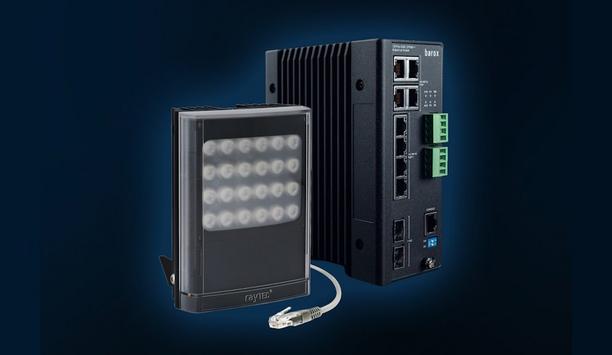
barox Kommunikation AG has partnered with Raytec to confirm compatibility of its range of PoE Ethernet switch and media converter products to power Raytec’s VARIO2 IPPoE LED illuminator products. Raytec is a UK-based manufacturer of LED lighting for security, surveillance and critical infrastructure applications, as well as hazardous area, industrial and transport lighting. Raytec's lighting solutions support CCTV and security systems in over 500,000 locations across more than 70 countries. In response to client and project demand, and to support systems integrators with their specification and set-up of reliable PoE when installing Raytec LED illuminators, barox and Raytec have concluded in-depth ‘proof of concept’ testing. The testing involved Raytec’s VARIO2 IPPoE network range of illuminators which included IR, WL and Hybrid options, and was performed to assess device performance and compatibility with barox’s range of PoE Ethernet switches and media converters. PoE Ethernet switches In the test, the range of barox PoE switches and media converters were assessed for their reliable delivery of power to the VARIO2 IPPoE range of illuminators. In addition, the ability to remotely switch the illuminators On and Off via the barox Smart functionality was also tested. “The device test yielded excellent results, with PoE being supplied to the Raytec illuminators and sustained by the barox switches,” says Rudolf Rohr, barox Co-founder & Managing partner. “The certified barox/Raytec PoE integration enables LED lighting solutions to be configured and installed with complete confidence. barox switches, which cater for the demands of any PoE device, supply their 30, 60 or 90 Watts PoE in compliance with the IEEE802.3af/at/bt standards.” Operation of critical devices The use of barox switches to supply PoE also allows remote on and off powering to the Raytec illuminators and surveillance cameras, potentially removing the need for engineers to go to site in instances where an IP device has just dropped offline. In the case of a power outage, the efficient PoE management features available on barox switches also allow the ability to maintain the operation of critical devices and extend UPS battery life. “On losing mains power supply, CCTV systems can provide temporary back-up power via a UPS battery pack,” Rudolf Rohr continues. “However, if the loss of mains power is prolonged, the local battery power can become depleted and the system blacks out. In this scenario, it would be ideal to prevent the total loss of power and system down-time by remotely switching off certain cameras and/or illuminators. Unlike with simple network PoE injectors, by using barox switches and its efficient PoE management, non-critical cameras or Illuminators can be automatically controlled, to extend battery autonomy.” Cost-effective solution The ability to deliver and support multiple IEEE802.3 PoE standards – up to 90 Watts - on a single edge switch, stands barox apart from multiple Ethernet vendors in the market, enabling end users and systems integrators to support/power cameras, other IP devices and lighting solutions from a single switch. The barox approach simplifies equipment, reduces both points of failure and configuration time on site, whilst also providing the most energy efficient and cost-effective solution. "We're always pleased to work with barox. The compatibility between our illuminators and their PoE switches and converters gives customers real confidence when specifying PoE for the VARIO2 range. This testing in particular confirmed that barox switches deliver reliable, sustained power to our VAR2-IPPOE-i6 and VAR2-POE-i8-1 illuminators, exactly the kind of proven compatibility systems integrators are looking for," Charlotte Lowdon-Smith, Marketing Communications Manager, Raytec. To support the installation of Raytec VARIO2 LED illuminators with barox PoE, configuration information is available from barox on request.

Raytec Ltd, a pioneer in LED lighting for security and safety-critical applications, announces the acquisition of Atexor Oy, a Finnish specialist in portable ATEX and IECEx lighting. This strategic acquisition broadens Raytec’s product portfolio and reinforces its commitment to delivering high-performance lighting for any hazardous location. Raytec’s own commitment “Atexor’s reputation for technical excellence and quality perfectly complements Raytec’s own commitment to innovation in illumination." "Bringing Atexor into the Raytec family strengthens our market position and allows us to serve our customers with a broader portfolio of hazardous area lighting to suit any hazardous area requirement,” David Lambert, Managing Director of Raytec Ltd. EU and accelerate growth in the hazardous area Founded in 1983, Atexor Oy is a well-established manufacturer known for its robust, portable and temporary lighting systems designed for demanding hazardous area applications. Its products are trusted across industries including oil and gas, petrochemical and manufacturing. The acquisition enables Raytec to expand its footprint in the EU and accelerate growth in the hazardous area lighting segment. Customers will benefit from the combined expertise, enhanced R&D capability and an expanded service and support network. New opportunities for continued development “The sale marks an important step for Atexor Oy, opening new opportunities for continued development under the new ownership. We look forward to building on our strong foundation and continuing to serve our customers with the same commitment and quality,” Jukka Viitasalo, Managing Director of Atexor Oy. Atexor Oy will continue to operate as an independent company and brand, ensuring continuity for existing customers and partners.
Raytec Ltd, a pioneer in LED lighting for security and safety critical applications, is acquiring Atexor Oy, a Finnish specialist in portable ATEX and IECEx lighting. This strategic acquisition broadens Raytec’s product portfolio and, according to the company reinforces its commitment to delivering high performance lighting for any hazardous location. Hazardous area lighting “Atexor’s reputation for technical excellence and quality perfectly complements Raytec’s own commitment to innovation in illumination. Bringing Atexor into the Raytec family strengthens our market position and allows us to serve our customers with a broader portfolio of hazardous area lighting to suit any hazardous area requirement,” says David Lambert, Managing Director of Raytec Ltd. Founded in 1983, Atexor Oy is a well-established manufacturer known for its robust, portable and temporary lighting systems designed for demanding hazardous area applications. Its products are trusted across industries including oil and gas, petrochemical and manufacturing. Expanded service and support network The acquisition enables Raytec to expand its footprint in the EU and accelerate growth in the hazardous area lighting segment. Customers will benefit from the combined expertise, enhanced R&D capability and an expanded service and support network. "The sale marks an important step for Atexor Oy, opening new opportunities for continued development under the new ownership. We look forward to building on our strong foundation and continuing to serve our customers with the same commitment and quality," comments Jukka Viitasalo, Managing Director of Atexor Oy. Atexor Oy will continue to operate as an independent company and brand, ensuring continuity for existing customers and partners.
Insights & Opinions from thought leaders at Raytec Ltd

Many security manufacturers are working towards ISO 14001, an internationally-recognized standard for the environmental management of businesses How green are security industry manufacturers? As innovation (much of it driven from home video and mobile phones) continues, it’s likely that our sector’s carbon footprint will decrease since compact products use up fewer raw materials. Even casual observers will note that integrators are falling over themselves to gain environmental accreditation since it’s often a prerequisite at tender stage. In the integrator community, environmentally-aware practice will soon become the default way of working and barely worth mentioning as a credential. For the major sources of potential improvement in environmental impact we should look to manufacturers. Are they trying to be environmentally-friendly in terms of material consumption, recycling and waste management? Working Towards Green Marketing Campaigns A cynic will say that the only real motivation towards being green is when good environmental practice also benefits the bottom line. Fortunately, there are many cases where green initiatives do make business sense. Researching manufacturers while preparing this article, I discovered that as an industry dealing to a large extent with crime, we are probably slow to play the ‘green card’ even when our practices are essentially sound. Our marketing must have a high level of integrity. There are horror stories of promotional ‘greenwash’ in other sectors, notably an outrageous claim by Shell that they were “using waste CO2 to grow flowers.” Friends of the Earth scrutinised this and found that just 0.325 percent of Shell’s output was used in such a manner and the (UK-based) Advertising Standards Authority insisted that the campaign be pulled. Many security manufacturers are quietly working towards ISO 14001, an internationally-recognized standard for the environmental management of businesses. However, take-up in the US (where the standard is regarded with less respect than in Europe) is lamentably slow. As it moves from a criterion for “conformance” to one of “compliance”, ISO 14001 is likely to acquire more teeth. Security products deemed to originate from manufacturers with a poor environmental record can be simply thrown out and the consultant told to look for an alternative Achieving ISO 14001 Environmental Management Certification SourceSecurity.com reports regularly on manufacturers gaining ISO 14001, most recently HID Global. Within CCTV, Pentax was one of the first manufacturers to be awarded the standard. There are many other examples. Raytec is not just preventing light pollution with its products but is minimizing pollution in the conventional sense with environmental policy that meets ISO requirements. The company has focused on electricity consumption, use of non-recyclable packaging and generation of non-recyclable waste. Its ultimate goal is being carbon neutral and many of Raytec’s suppliers are based locally, a policy that reduces truck miles. For large units and consignments, the company has introduced ‘rotate and re-use’ packaging systems with distributors. Samsung Techwin is also environmentally aware with scrupulous analysis of any hazardous materials generated by production processes and a green procurement and supplier program involving over 300 companies. Tyco’s record in terms of environmental practice is also exemplary; there are initiatives in place to collaborate with waste haulers on maximisation of recycling and reduction in materials sent to landfill. Analysis of Tyco’s working practices has broadened my own terms of reference: it’s easy to focus exclusively on fossil fuels in this type of discussion but every element of environmental impact should be considered and Tyco is able to boast that its strategy at manufacturing facilities has reduced water usage by 11%. American LEED Certification Vs. UK-Based BREEAM Standard Under pressure from environmentally-aware clients on major civils projects at tender stage, construction companies and M&E sub-contractors are scrutinising the green credentials of every single component. Security products deemed to originate from manufacturers with a poor environmental record can be simply thrown out and the consultant told to look for an alternative. (The London borough councils are particularly vigilant in this area.) Consultants are now arbitrating on the green credentials of products in their initial designs, especially when the client is working to the American LEED green building certification system which evaluates projects against common green criteria including stewardship of resources. A rival code of practice is the UK-based BREEAM standard which has been developed to provide information to the building industry on sustainable development. Both certifications analyze energy usage in cooling of electrical components which is a significant factor for security manufacturers. Chinese manufacturers are experiencing greater pressure from global sales markets to conform to environmental standards for security products Eco-Friendly Challenge For Chinese Security Product Manufacturers A development that should surprise nobody is stringent requirements from standards bodies on likely product lifecycles. The (abysmal) norm of built-in redundancy after three to five years that is tolerated in the IT sector has never been accepted by users of security products. Requirements from the International Organization for Standardization may soon codify the product lifecycle that manufacturers should strive for but without impeding R&D. Despite all the success stories, there is an elephant in the room that should not be ignored. Chinese manufacturers must realize that if their products are to be used on the world stage then green isn’t optional anymore. It should of course be said that regulatory frameworks in China are lacking (there has been some improvement since 2014) and legislation is complicated by the fact that individual provinces have a level of autonomy. Sadly, there also appears to be a lack of will. Here is just one statistic. The Environmental Protection Agency in the United States currently has 15,000 employees compared with 200 at its Chinese equivalent. All of this puts the onus on Chinese manufacturers to self-supervise in terms of environmental impact.