Omdia - Experts & Thought Leaders












Latest Omdia news & announcements
Kaseya, the global provider of AI-powered cybersecurity and IT management software, announces findings from a new study by Omdia, a global technology research and advisory firm, highlighting the measurable business value achieved by MSPs and internal IT teams that standardize on Kaseya's unified IT service delivery solution. The study found that organizations using Datto RMM, Autotask PSA and IT Glue improved operational efficiency, reduced costs and increased service capacity by bringing together endpoint management, service desk operations and IT documentation into a unified workflow. Lower operational costs The key benefits reported by organizations interviewed by Omdia include: Significant cost savings: MSPs reported average savings of approximately $2,600 per technician per month, while internal IT teams reported approximately $2,900 per staff member per month. For a 10-person MSP team, this equates to more than $312,000 in annual savings and for an IT team, they are saving approximately $350,000. Lower operational costs: MSPs reported approximately 33% lower IT operating costs and 12% higher contract margins, while internal IT teams reduced IT operating costs by approximately 24% and redirected nearly 19% of their budgets toward strategic priorities such as cybersecurity and employee training. Greater technician capacity: MSPs reported managing 27% more endpoints, handling 23% more tickets and supporting 15% more clients per technician. Internal IT teams handled 14% more tickets per staff member and supported up to 10% more users and endpoints without increasing headcount. Faster service delivery: MSPs improved ticket resolution times by 32% and reduced first-response times by 36%. Internal IT teams reported 11% faster ticket resolution, enabling quicker support for end users. Stronger service and user experiences: MSPs improved SLA compliance by 17%, with an average of 83% of tickets resolved within SLA targets, while internal IT teams reported a 10% increase in employee satisfaction driven by proactive issue prevention, faster resolution times and improved communication. Improved financial performance "Do more, with less is the mandate for IT organizations tasked with supporting more users and devices with limited resources" said Devan Adams, principal analyst, Omdia. "Better operational efficiency, higher-quality service delivery and improved financial performance, were the outcomes that organizations we interviewed achieved and reported meaningful gains after standardising on a unified approach to IT operations. With IT solution consolidation being a top priority for over 40% of IT organizations, the focus has shifted from how do we add more technology and staff to how do we get more from what we already have. The results demonstrate how unified IT service delivery solutions can enhance scalability and service levels while freeing current resources for higher-value initiatives.” Customer satisfaction score "Migrating to Kaseya’s IT Service Delivery solution has helped my team better serve clients through tighter integration of key tools and easier access to client information,” said Jason Comstock, president, Clarity Technology Solutions. “Additionally, it has improved remote support capabilities, allowing us to assist users more efficiently. With Kaseya, we have maintained a customer satisfaction score above 98%, and it has also helped us measure and reduce ticket response times more effectively.” The study also highlighted qualitative benefits beyond the measurable operational improvements. Respondents cited greater visibility into their environments, improved collaboration across teams, reduced administrative burden and the ability to focus more time on strategic initiatives rather than routine operational tasks. One MSP interviewed for the study noted that increased efficiency enabled the organization to support additional customers without adding staff, creating new opportunities for growth while maintaining service quality. Maintaining service quality "This research reinforces a clear trend we hear from our customers every day: IT teams are looking for technology that helps them achieve more with less complexity," said Johnny Ghibril, general manager of endpoint solutions, Kaseya. "Datto RMM is proof of what that looks like in practice. The AI driven innovation we shipped over the past year is already delivering measurable efficiency gains for MSPs, and paired with the power of IT Service Delivery, it's helping organizations increase productivity, improve customer experiences, and drive stronger business outcomes while creating capacity for future growth." Enhanced API capabilities Omdia’s research findings align with Kaseya’s continued investment in Datto RMM, which has introduced a series of innovations over the last 12 months aimed at improving technician productivity and operational efficiency. Recent enhancements include AI-enhanced Smart Insights, Dynamic Grouping Policies, expanded Microsoft 365 integrations and enhanced API capabilities. The study was commissioned by Kaseya and conducted by Omdia between March and April 2026. Omdia conducted 16 in-depth interviews with eight MSPs and eight internal IT teams in North America that adopted Kaseya’s solution after using competitive offerings as well as five non-Kaseya customers.
Omdia market share data for 2025 continues to show Milestone as the market pioneer across the EMEA region, with a 19 per cent share of a market now worth USD 573 million. Milestone Systems is the largest single provider of video management software (VMS) and Video Surveillance as a Service (VSaaS) in Europe, the Middle East and Africa (EMEA), according to 2025 market share data from technology research and advisory group, Omdia. Milestone has nearly one-fifth (19.1 per cent) of the overall EMEA market, which includes the UK and Ireland – a market-pioneer position that hasn’t altered since 2021. More informed decisions Across the EMEA region, the VMS and video surveillance as a service (VSaaS) market grew 10 per cent in 2025 to USD 573 million, and the Middle East and Eastern Europe saw particular growth. Omdia’s figures come at a time when organizations across EMEA are increasingly using video to support operational decision-making alongside security. Across traffic management, transportation, retail and manufacturing, video data is helping organizations better understand how sites and services perform and make more informed decisions. Morten Illum, Chief Revenue Officer, Milestone Systems, said: “This ranking reflects what customers across EMEA continue to look for: open, flexible video technology that gives them choice today and room to evolve tomorrow. Together with our partner community, we help customers design systems around their specific needs, while future-proofing their investment as AI and cloud technologies transform the value of video beyond security.” Strategically important markets Milestone’s leading position is built on three key offerings: Milestone XProtect® video management software, Milestone BriefCam® AI-powered analytics and Milestone Arcules® cloud VSaaS. Together, they give organizations the flexibility to deploy video on premises, in the cloud or across hybrid environments, while adding analytics without replacing existing systems. The UK and Ireland remain strategically important markets for Milestone. Earlier this year, the company opened its London Concept Centre, an interactive space where end users, integrators and partners can explore Milestone technology alongside solutions from partners including Axis, Bosch, Gallagher, Hanwha, Honeywell, i-PRO, ADI, Oprema, Zenitel and 2N before designing a system. AI anonymisation technology Martin McGrath, Sales Director for UK and Ireland at Milestone Systems, said: “The UK is a demanding market, and rightly so. Organizations increasingly expect their video systems to support business decisions as well as security needs, while continuing to adapt as their operations evolve. Our leading position across EMEA gives customers confidence that the platform they choose today will remain open, supported and continuously developed in the years ahead.” Milestone is also investing in the data foundations behind video AI through Project Hafnia, its regulatory-compliant video data library, and brighter AI anonymisation technology. Together, these initiatives are designed to give customers greater transparency into how AI models are trained.

Corelight, a pioneer in enabling the defensible AI SOC, today announced new solutions to accelerate the adoption of the AI SOC without surrendering the transparency, auditability, and control that network defense demands. Corelight released the Agent Builder Library and Natural Language Query to best leverage the speed and functionality of AI and address the state of constant vulnerability most enterprises now face. Corelight is also expanding its detection coverage beyond identifying which AI applications are in use to catching AI supply-chain compromise, anomalous AI activity, and stealth command-and-control (C2) and exfiltration — all feeding directly into the same expert-authored, auditable investigation logic behind its AI capabilities. Enterprise patching cycles Attackers are using AI models to accelerate vulnerability discovery and exploitation, compressing the window defenders have to respond. While typical enterprise patching cycles can still run from 60 to 150 days, the median time to exploit has fallen to roughly five days. In addition, with Mythos-class AI models, defenders are expecting to see vulnerabilities exploited before there is broad knowledge that there is even a hole to be patched. Faster patching simply is not the answer – AI-speed attacks require AI-speed defense. However, widespread adoption of AI in the SOC is progressing slower than attacker adoption of AI, held back by two persistent barriers: a network expertise gap and a query language expertise gap. Corelight’s latest release eliminates both. Network forensics knowledge "The instinct is to fight AI-speed attacks with AI-speed defense, and that's right. But speed without expertise is just fast guessing,” said Vijit Nair, senior vice president of product at Corelight. "We’ve packaged a decade of network forensics knowledge into building blocks that any AI agent can execute, whether it’s ours or the customer’s own. The result is an AI investigation that’s transparent enough for a skeptical analyst to verify line-by-line, accessible enough for a day-one hire to use immediately, and operational enough to put these agentically validated, pre-triaged threats directly in front of the human as quickly as possible.” Challenging cyber threat Corelight has spent more than a decade turning ground-truth network evidence into the standard that the most attacked, hardened security teams rely on. Earlier this year, Corelight also introduced Agentic triage, category-first AI capabilities that help modern SOCs automate the most repetitive tasks consuming security teams, dramatically improving analyst efficiency and speed while also building trust through complete transparency. This launch extends that same expertise into tools that let every SOC operate as elite network defenders, ready to combat the most challenging cyber threat in history. Corelight Agent Builder Library — Tackling the expertise barrier, Corelight provides a structured set of triage playbooks, field explanations, entity-pivoting guides, and investigation decision trees, distilled from more than a decade of Corelight's network forensics expertise. Because the logic is deterministic and documented rather than probabilistic, it is fully exportable — security teams can bring it into their own AI agents, SOAR workflows, or private LLM environments, including air-gapped and classified networks with no cloud connectivity. Natural Language Query (NLQ) — Addressing the query syntax barrier, Corelight lets analysts ask plain-English questions about network evidence and receive working, LogScale queries that are automatically validated and executed against their data. Orchestrated AI sub-agents analyze each question, build a query plan, and return results with full chain-of-thought reasoning visible to the analyst. The generated query is editable so analysts can learn from the construction and refine as needed – removing the need to learn specialized syntax before investigating. Primary evaluation criterion "Security teams are increasingly investigating the use of AI to combat the accelerating speed of threat actors who have been early adopters of the technology," said Andrew Braunberg, principal analyst, Omdia. "The ability to automate security workflows are quickly becoming expected capabilities in SecOps solutions but the tools that become widely adopted in the SOC will need to do more than just automate, they will need to document, evaluate, and explain. Inspectable logic that can run outside the vendor's cloud isn't a nice-to-have anymore; for a lot of buyers, especially in regulated and air-gapped environments, it's a primary evaluation criterion." Suspicious AI gateway Unlike AI investigation tools that operate as opaque scoring engines, every Corelight-generated verdict is traceable to the specific playbook invoked, the behavioral signals that triggered it, and the evidence that supports it — a distinction critical to both to skeptical analysts and to regulators. The capabilities are designed to support documented, defensible incident response under frameworks such as NIS2, DORA, SEC disclosure rules, and CMMC 2.0. Alongside these AI investigation capabilities, Corelight is expanding beyond identifying which AI applications are in use to detecting when AI-related activity becomes a security threat. New AI threat detections identify known AI supply-chain compromise indicators, suspicious AI gateway and provider activity, attacks against exposed AI infrastructure, and anomalous AI application behavior. Combined with expanded behavioral analytics for command-and-control and data exfiltration, Corelight gives defenders visibility across both emerging AI threats and the broader attacker path. The expansion adds three capabilities aimed at threats that don't leave a signature behind. Detect known AI threats — Corelight identifies AI supply-chain compromise indicators, known exfiltration infrastructure, suspicious AI gateways and providers, and reconnaissance or exploitation attempts against exposed AI endpoints. Detect anomalous AI activity — Application anomaly detection surfaces new or unusual AI usage and behavior that deviates from established patterns, helping analysts identify potentially compromised or misused AI applications even when no known signature exists. Detect stealth C2 and exfiltration — Corelight combines 31-day subnet-level destination history with per-host upload baselining to surface connections to never-before-seen countries and unusual outbound data transfers, exposing C2, staging, and data theft that static blocklists or thresholds can miss. Every signal generated by the expanded Anomaly Engine feeds directly into the Corelight Agent Builder Library's playbooks and into Agentic Triage, so behavioral detections don't just fire an alert — they trigger the same expert-authored investigation logic that produces an auditable, evidence-backed verdict.
Insights & Opinions from thought leaders at Omdia
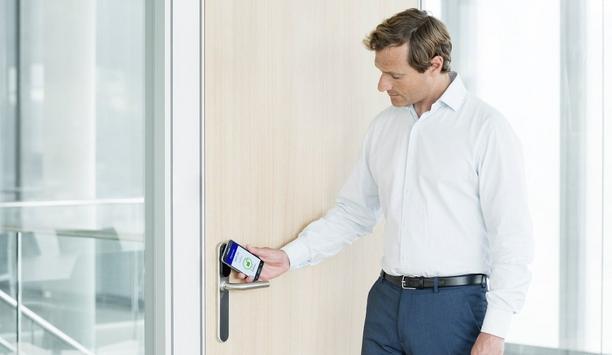
The 2020s will be a wireless decade in access control, says Russell Wagstaff from ASSA ABLOY Opening Solutions EMEA. He examines the trends data, and looks beyond mobile keys to brand new security roles for the smartphone. The benefits of wire-free electronic access control are well rehearsed. They are also more relevant than ever. A wireless solution gives facility managers deeper, more flexible control over who should have access, where and when, because installing, operating and integrating them is easier and less expensive than wiring more doors. Battery powered locks Many procurement teams are now aware of these cost advantages, but perhaps not their scale. Research for an ASSA ABLOY Opening Solutions (AAOS) benchmarking exercise found installation stage to be the largest contributor to cost reduction. Comparing a typical installation of battery-powered Aperio locks versus wired locks at the same scale, the research projected an 80% saving in installers’ labor costs for customers who go cable-free. Battery powered locks all consume much less energy than traditional wired locks Operating costs are also lower for wireless: Battery powered locks all consume much less energy than traditional wired locks, which normally work via magnets connected permanently to electricity. Wireless locks only ‘wake up’ when presented with a credential for which they must make an access decision. AAOS estimated a 70% saving in energy use over a comparable lock’s lifetime. Find out more about wireless access control at ASSA ABLOY's upcoming June webinar Deploying wireless locks In short, every time a business chooses a wireless lock rather than a wired door, they benefit from both installation and operating cost savings. A recent report from IFSEC Global, AAOS and Omdia reveals the extent to which the advantages of wireless are cutting through. Responses to a large survey of security professionals — end-users, installers, integrators and consultants serving large corporations and small- to medium-sized organizations in education, healthcare, industrial, commercial, infrastructure, retail, banking and other sectors — suggest almost four locations in ten (38%) have now deployed wireless locks as a part or the whole of their access solution. The corresponding data point from AAOS’s 2014 Report was 23%. Electronic access control Electronic access control is less dependent than ever on cabling Without doubt, electronic access control is less dependent than ever on cabling: Even after a year when many investments have been deferred or curtailed, the data reveals fast-growing adoption of wireless locks, technologies and systems. Is mobile access control — based on digital credentials or ‘virtual keys’ stored on a smartphone — an ideal security technology for this wire-free future? In fact, the same report finds mobile access is growing fast right now. Among those surveyed, 26% of end-users already offer mobile compatibility; 39% plan to roll out mobile access within two years. Before the mid-2020s, around two-thirds of access systems will employ the smartphone in some way. The smartphone is also convenient for gathering system insights Driving rapid adoption What is driving such rapid adoption? The convenience benefits for everyday users are obvious — witness the mobile boom in banking and payments, travel or event ticketing, transport, food delivery and countless more areas of modern life. Access control is a natural fit. If you have your phone, you are already carrying your keys: What could be easier? IBM forecasts that 1.87 billion people globally will be mobile workers by 2022 Less often discussed are the ways mobile management makes life easier for facility and security managers, too. Among those polled for the new Wireless Access Control Report, almost half (47%) agreed that ‘Mobile was more flexible than physical credentials, and 36% believe that mobile credentials make it easier to upgrade employee access rights at any time.’ IBM forecasts that 1.87 billion people globally will be mobile workers by 2022. Workers in every impacted sector require solutions which can get the job done from anywhere: Access management via smartphone offers this. Site management device The smartphone is also convenient for gathering system insights. For example, one new reporting and analytics tool for CLIQ key-based access control systems uses an app to collect, visualise and evaluate access data. Security system data could contribute to business success. The app’s clear, visual layout helps managers to instantly spot relevant trends, anomalies or patterns. It’s simple to export, to share insights across the business. Reinvented for learning — not just as a ‘key’ or site management device — the phone will help businesses make smarter, data-informed decisions. The smartphone will also play a major role in security — and everything else — for an exciting new generation of smart buildings. These buildings will derive their intelligence from interoperability. Over 90% of the report’s survey respondents highlighted the importance of integration across building functions including access control, CCTV, alarm and visitor management systems. Genuinely seamless integration They offer greater peace of mind than proprietary solutions which ‘lock you in’ for the long term Yet in practise, stumbling blocks remain on the road to deeper, genuinely seamless integration. More than a quarter of those polled felt held back by a lack of solutions developed to open standards. ‘Open standards are key for the momentum behind the shift towards system integration,’ notes the Report. As well as being more flexible, open solutions are better futureproofed. Shared standards ensure investments can be made today with confidence that hardware and firmware may be built on seamlessly in the future. They offer greater peace of mind than proprietary solutions which ‘lock you in’ for the long term. Open solutions and mobile management are critical to achieving the goals which end-users in every vertical are chasing: scalability, flexibility, sustainability, cost-efficiency and convenience.