Citilog - Experts & Thought Leaders





Latest Citilog news & announcements
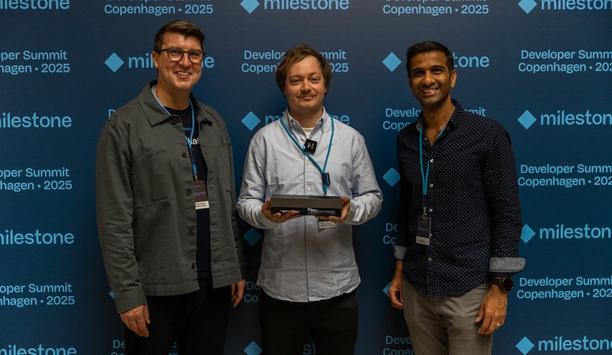
The Milestone Developer Summit 2025, dedicated to innovators, developers, and technology partners in video technology, took place at the historic Carlsberg Museum in Copenhagen—a venue renowned for scientific breakthroughs, including the invention of the pH enzyme, a milestone in biochemical innovation. This legacy of discovery provided the perfect global stage for a new era of open platform development, responsible AI, and, not least, the Hackathon. Essence of Milestone’s open platform Sebastian Döllner, VP of Technology Partnerships & Open Platform, said: “Technology is evolving faster than ever, and no single company has all the answers. The winners are those who can bring together the best technologies, the best minds, and the best ideas. The essence of Milestone’s open platform is to empower innovation. We’re building more than video management software—we’re building an ecosystem that allows partners and customers to innovate on top of it.” With keynotes from, e.g., NVIDIA, AWS, Dell, and Intel, breakout workshops and the Hafnia Hackathon, participants from all over the globe were able to share insights and predictions on what the future might look like. First access to the future Before the summit, AI developers from 15 different countries had early access to Milestone’s upcoming specialized VLM. The VLM is developed using NVIDIA Cosmos-Reason and post-training it with Hafnia’s domain-specific data library to better understand city-specific visuals, languages, symbols, events, weather, lighting and more. The Hackathon challenge: create innovative integrations with third-party applications and leverage the VLM via API to enhance smart city solutions. Generative AI-powered plugin for XProtect Now, millions of video cameras capture valuable footage that could improve everyday life. Yet much of this potential remains untapped due to the time-consuming task of reviewing and analyzing countless hours of video to uncover meaningful insights. In addition to the specialized VLM, Milestone is also launching a generative AI-powered plugin for XProtect Video Management Software. The upcoming generative AI-powered plugin for XProtect is designed to improve traffic management across cities, ports, airports, and other urban areas. It delivers advanced video intelligence by automatically converting video footage into detailed written reports, summaries, and validated real-time alerts. Innovative integrations from all finalists Of the participating developers, six were shortlisted, and a panel of judges from Milestone and NVIDIA selected the top three. The winner: Thomas Kreutz, who used Hafnia’s VLM API to turn live city cameras into instant, privacy-aware answers to real-time questions, said: “I wanted to build something that is relevant and useful in real life. What I liked the most about the hackathon was how easy it was to get started. The API and documentation made it simple to build a demo quickly, brainstorm more ideas, and try them out.” Thomas Kreutz took home €5,000 and the NVIDIA Jetson AGX Thor Developer Kit. Roland Harwood, Community Lead - Hafnia, commented: “We are very impressed with the innovative integrations from all finalists. But Thomas Kreutz and Ask The City really nailed it. The hackathon's success is promising for the future use of our platform and data library to train computer vision models on compliantly sourced, curated, extensively annotated, and anonymized real-world data.” FACTS: The six Hackathon finalists ranked from the winner Ask The City/Thomas Kreutz Turns live city cameras into instant, privacy-aware answers to real-time questions. Pick a place on the map, ask in natural language, and get a response derived only from the last few seconds of video. Powered by Hafnia’s VLM API. VLM for Emergency Response/Flynn Owen, Dan Towers & Tom Aldridge (Blaize) Leverages edge AI devices to generate events and contextualize, triage, and create response plans for emergency situations in near real-time. SmartMap/Gabriel Crosnier de Bellaistre (Citilog) Uses Hafnia’s VLM to unify incident detection, traffic levels, and weather/visibility data into live map overlays with operator-ready actions, enabling faster decisions and better visualization. RevoFlow/Rawinder Singh A no-code workflow builder that lets security integrators create AI-powered video analytics through drag-and-drop design, powered by Milestone's VLM API. Audience Award winner. Clipnotes/Magnus Guldberg Pedersen Converts short video clips into structured, interpretable insights in seconds using Hafnia’s Vision-Language Model. Hafnia Video Event Analyzer/Jojy Saju JosephS A multimedia intelligence platform that uses a VLM API to analyze images and video, generate semantic metadata, and enable advanced search, summarization, and event detection.

Located in downtown Houston, Texas, USA at the George R. Brown Convention Center (GRB), the Houston Living Lab (HLL) serves as a testing ground for city departments and partners to test and validate new technology. In 2017, the Houston First Corporation (HFC) established the lab following a successful collaboration with Milestone Systems and several other security manufacturers to rapidly deploy video technologies for nearly one million attendees at the Super Bowl Live festival. Now HLL develops smart city solutions for deployment across Houston. Security technology solutions With the help of the Houston First Corporation — a local government corporation created to operate the city's convention and performing arts facilities — the City of Houston hosts many high-profile events annually. One of HFC's long-term goals is establishing Houston as a pioneer in smart city initiatives to further promote the region as a tourism and convention business destination. City of Houston and HFC needed to bring together technology partners and build on living infrastructure To accomplish this goal, the City of Houston and HFC needed to bring together technology partners and build on existing infrastructure to further enhance public safety and security during events. In 2017, the city hosted Super Bowl LI, an event that became a literal game changer in how the city rapidly deploys integrated security technology solutions. Legacy security systems The 10-day Super Bowl Live festival at the 12-acre Discovery Green featured free well-known music artist concerts and other attractions. The neighboring GRB hosted the NFL Experience event with interactive activities and player appearances. When hosting large events spread out over several venues, the city found that the added congestion from portable event stages, booths, and attendees changed the environment. This rendered the standalone legacy security systems inadequate when hosting the events. “In these situations, the green space is no longer open; it’s cluttered with event structures, banners, and everything that comes with a festival. We found that our existing camera system was getting either visually or audibly interfered with,” said Jack C. Hanagriff, former Program Manager for the City of Houston’s Office of Public Safety and Homeland Security. Access to the camera system In the six-month planning period before the festival, Verizon installed fiber-optic cable for the event Determining a temporary system was needed to provide security at Super Bowl Live, Hanagriff and his team brought in Milestone Systems on the recommendation of HFC's long-time integrator Teksys and manufacturer Axis Communications. Milestone helped design and test a rapidly deployable, fully integrated supplemental camera and video management software (VMS) system at Discovery Green. In the six-month planning period before the festival, Verizon installed fiber-optic cable for the event. This allowed access to the camera system with Axis F Series modular cameras, Q Series PTZ dome cameras, and thermal imaging systems. Milestone open platform Using a Milestone open platform system design, the temporary festival infrastructure easily integrated with the non-Milestone VMS already used at GRB. The system was built on the Milestone design. “We were able to tie both VMS networks into our existing homeland security network. We converged the two systems to give law enforcement, the fire department, and other agencies access to all systems seamlessly,” said Jack C. Hanagriff, adding “Again, this system did not exist just four days prior.” Houston Living Lab inspires Smart City R&D HLL allows city departments and partners to test and validate technology in an active environment After successfully collaborating with Milestone Systems and other security manufacturers for the Super Bowl Live events, HFC established the Houston Living Lab. The HLL allows city departments and partners to test and validate technology in an active environment. Technology partners include Milestone Systems, Axis Communications, Cradlepoint, Dell Technologies, Haystax, Acre Comnet (formerly Razberi), Siklu, and Verizon. Video analytics are provided by Athena Security, Citilog, EAGL Technology, Evolon Technology, Irisity (formerly Agent Vi), Sound Intelligence, and AirSight (formerly 911 Security). Technology Partnerships Enhance Public Safety The 1.9 million-square-foot GRB Convention Center has diverse security needs. Beyond public safety and monitoring aggressive behavior in and around the center, the security team proactively improves traffic at intersections and manages four large parking garage operations. In 2021, HFC worked with Houston Public Works (HPW) on designing and installing an on-premises software solution to easily bring together the latest technologies at GRB. The 1.9 million-square-foot GRB convention center has diverse security needs Milestone video management technologies provide seamless integrations with cutting-edge security applications. Nearly 600 legacy Axis Communications cameras are integrated with Milestone Smart Walls in multiple security and parking command centers spread across facilities in the theater and convention districts, providing complete situational awareness at any given moment. Relationships built at the HLL HFC wanted to be able to identify dangerous situations and be proactive rather than reactive to help mitigate risks. They now have visibility into different situations, such as vehicles driving the wrong way, large crowds gathering in an area or even listening for glass breaking, car alarms, gunshots, or aggressive behaviors. “The relationships built at the HLL were instrumental in helping us support the needs at other high-profile sites throughout the city that were identified with concerns regarding general public safety and quality of life,” added Jack C. Hanagriff.

By providing an open platform and access to documentation, software development kits (SDKs), and application programming interfaces (APIs), individual developers and partner organizations can explore the full potential of Axis products and solutions. And by doing so, creating advanced applications that bring new and compelling use cases to market. Long-time Axis Communications (Axis) partner, Citilog has been developing traffic management analytics applications alongside Axis for more than a decade. Citilog’s Vice-President Jean-Marie Guyon helped understand the benefits that the Axis Camera Application Platform (ACAP) brings to the company’s business. Axis ADP Program Axis Communications is a company that truly believes that ‘the whole is greater than the sum of the parts' Axis Communications is a company that truly believes that ‘the whole is greater than the sum of the parts’. Through the Axis Developer Community, which is open to all developers, whether already working within an Axis partner company or not, and the Axis Application Development Partner (ADP) Program, the company provides a wealth of resources that connect the ecosystem around Axis products and technologies. In doing so, and particularly in giving early access to new technology, innovation is accelerated, and connections are made that bring benefits to partners and customers alike. Within the ADP Program and through the Axis Developer Community, partners and developers gain access to the Axis Camera Application Platform (ACAP), which specifically allows for the development of applications that sit within surveillance cameras themselves (and an increasing number of other products). As the capabilities of Axis surveillance cameras increases and particularly, cameras are now available, which includes a Deep Learning Processing Unit (DLPU). ACAP represents a place where some of the most cutting-edge innovation is taking place. A fundamental change to the business The partnership between Axis and Citilog, a specialist in advanced traffic management analytics applications, began in 2009, at around the same time that ACAP itself was created (and well before Citilog was acquired by Axis in 2016). Jean-Marie Guyon, Vice President at Citilog, talks about how the first possibilities of developing in camera analytics would fundamentally change their business. He explains how the company immediately saw the opportunity in ACAP when it was first announced. He said, “Citilog had already been an Axis partner for a number of years when the capacity of the camera processors became sufficient to port our applications on the edge.” Jean-Marie adds, “But, as soon as we saw the possibilities for developing analytics applications that were integrated into surveillance cameras themselves, we knew it would fundamentally change our business, even if it took longer for customers to realize the potential!” Decreased need of bandwidth with rise of edge analytics By analyzing the video within the camera, we only need to transfer the data that matters rather than everything" Prior to the ability to develop in-camera analytics applications, often known as ‘edge analytics’, the analysis of video took place on centralized hardware and servers, either housed within the customer’s own premises or within a data center. This meant the transfer of huge amounts of video footage from the camera to the data center, with associated demand for bandwidth and the inevitable cost. Jean-Marie continues, “We immediately saw the opportunity to remove a significant proportion of the bandwidth demands through in-camera analytics. Put simply, by analyzing the video within the camera, we only need to transfer the data that matters rather than everything. For cameras that are monitoring roads 24 hours a day, seven days a week for incidents that can be relatively rare, it’s obvious to see what a difference this could make.” Market slow to respond But as Jean-Marie mentions, while Citilog’s developers immediately saw the potential, the market was, as usual, slower to respond. He stated, “Over the past decade we’ve done a lot of promotion and evangelizing of the benefits of in-camera analytics. It takes time for sectors to change and adapt new approaches, and not least when it requires a change in hardware and the first few years were tough going.” Jean-Marie adds, “However, persevering has been worth it, and today more than 70% of our business is based on ACAP. More than that, in the past few years we’ve seen the majority of tenders demanding in-camera analytics.” Change in capabilities of in-camera analytics At its heart, ACAP is a platform for innovation and Citilog is always looking towards the future. Deep learning represents the next area of innovation. Jean-Marie expands on this by stating, “With the combination of our current deep learning-based solution (CT-ADL: Citilog Applied Deep Learning) and the evolution of the in-camera processing capabilities, it feels like we’re on the cusp of a real step-change.” Jean-Marie adds, “With the AXIS Q1615-LE Mk III, we have the first Axis camera in the market that includes a deep learning processing unit (DLPU) which combined with the CT-ADL makes it the first operational DL-based solution running on the edge. It’s difficult to overstate the scale of the step forward that this represents.” Deep learning (DL) But deep learning is something that requires huge amounts of processing power Deep learning (DL) is a subset of Artificial Intelligence (AI). In very simple terms, in relation to video analytics on the edge, the primary benefits relate to much greater accuracy in the detection, identification, and classification of all types of object - a generic ‘vehicle’ becomes a car, lorry, bus, or motorcycle and critically, objects that aren’t relevant can be safely ignored. But deep learning is something that requires huge amounts of processing power and while this was previously only available through the use of remote servers, it’s now accessible in the camera itself. Reduced number of false alarms In a sector such as traffic management, the ability to differentiate between a greater number of objects is critical, as Jean-Marie explains, “One of the biggest issues for any surveillance operation is the cost of false alarms: alerts being triggered that required attention and prompt action, but which aren’t actually materially important.” He adds, “In traffic management, as an example, traditionally one of the most common causes of false alarms is shadows and rain puddles. These can often be mistaken as a vehicle, and if they’re in the fast lane of a motorway, will create an alert. The power of deep learning reduces these false alarms substantially. In fact, that’s an understatement as we’re typically finding that the number of false alarms is reduced by a factor of 10.” Reduced need for hardware These ‘lighter’ solutions are therefore easier to maintain and further reduce operational costs Such a substantial reduction in false alarms is one obvious benefit to customers, but the switch from processing power in the server and data center to the camera also means a reduced need for hardware. These ‘lighter’ solutions are therefore easier to maintain and further reduce operational costs. They also open up new use cases for in-camera analytics where lack of available bandwidth would have previously made it impossible. High potential for deep learning edge analytics While Citilog’s focus remains on traffic management and through that, using the analytics and data created to deliver on the vision for smart cities, the potential for deep learning edge analytics is there for every industry sector and use case. Harnessing the creative power of the largest number of people has always been at the heart of the Axis ethos. Through the Axis Developer Community, Axis ADP, and ACAP, the opportunities for all developers and partners to learn, experiment, and innovate are infinite.