Access IS - Experts & Thought Leaders


Latest Access IS news & announcements
Taglio, the globally renowned independent provider of smart card technologies, has announced that it has joined the PSIA. The company, based in Austin, Texas, was established in 2012, and its products and services have been integrated with many millions of smart cards, devices, and mobile phones worldwide. Physical access “Working with our OEM partners, Taglio’s products are deployed in identity and logical access projects, both large and small,” said GW Habraken, Co-Founder and Managing Director of Taglio. GW Habraken adds, “Physical Access is the next frontier. Our customers want a single credential that can be used for both logical and physical access. The PSIA’s introduction of a card version of its Public Key Open Credential (PKOC) specification will be a perfect complement to this objective. Taglio looks forward to joining the PKOC/SCI working group and supporting its initiatives going forward.” Asymmetric encryption PKOC can provide customers with a migration path, allowing a planned transition" David Bunzel, PSIA Executive Director, shared, “Taglio has recognized that PKOC and more specifically the new PKOC on a Card specification will support a critical market need – a bridge from cards to mobile credentials." David Bunzel adds, "While mobile offers exciting opportunities for the future, there will be a gradual transition away from cards. In the meantime, PKOC can provide customers with a migration path, allowing a planned transition in technologies. In addition, PKOC will drive further acceptance of asymmetric encryption in physical access control.” PKOC-enabled cards Taglio has already successfully demonstrated PKOC-enabled cards on a wide range of readers supporting the PKOC specification. The company has recently announced the commercial availability of PKOC-enabled cards. The Physical Security Interoperability Alliance (PSIA) and a number of its partner companies will be present at ISC West in Las Vegas in April of 2024. Taglio will be part of a growing list of PKOC card and reader partners who will be showing products supporting this exciting technology. Explainer video PKOC is featured in products from ELATEC, Kastle Systems, INID, JCI, Last Lock For a better understanding of PKOC, the PSIA has added an Explainer Video to its site. This video is less than a minute and demonstrates how the PSIA’s PKOC specification works and will disrupt the access control market. The PSIA approved its PKOC NFC Card Specification in December of 2023. As noted above, it is already available in commercial products. PKOC is featured in products from ELATEC, Kastle Systems, INID, JCI, Last Lock, rf IDEAS, SAFR Scan (RealNetworks), Sentry Enterprises, and Taglio. Physical security and access control The PSIA has been active in developing and promoting open specifications that support interoperability in the physical and logical security industries. Industry publication, Security Technology Executive, declares interoperability 'The Next Great Phase of Physical Access Control'. SecurityInfoWatch.com expounds on the predicted demand for PACS interoperability by saying, “Open protocols, standards, and industry-accepted conformant products that focus on unbridled interoperability between manufacturers and vendors will be critical as advanced technology, such as analytics and ancillary devices, enter the realm of physical security and access control.”
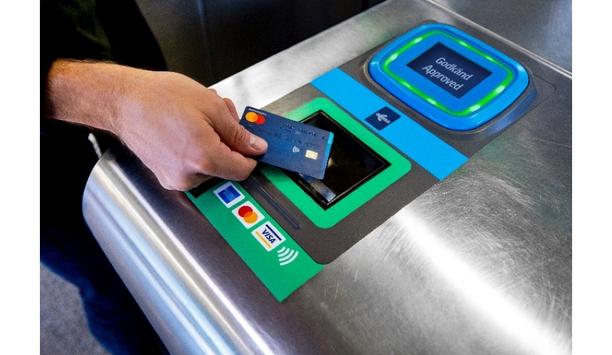
Access IS, part of HID Global, is delighted to celebrate the successful launch of contactless payments across the Stockholm region by SL (Storstockholms Lokaltrafik). Building on the successful mass deployment of Access-IS ticket readers and validators back in 2019, the latest upgrade to the system sees Access-IS devices in train gates and ticket offices as well as bus mounted validators being upgraded to permit full cEMV contactless payment capability. Contactless ticketing Ticket reading is fast and dependable with clear visual indications when tickets and cards have been successfully read Stockholm is leading the way with this deployment of contactless ticketing across a true multi-modal transit network. Barcode and NFC tickets, as well as bank and credit cards by VISA, Mastercard or American Express are all presented to a single, intuitive-to-use, point of presentation. Ticket reading is fast and dependable with clear visual indications when tickets and cards have been successfully read, meaning passenger throughput is maximized for a great user experience and reduced operational costs. Access IS transit validators and readers Common to many Transit Authorities, SL continues to operate its ‘Accesskort’ proprietary closed loop ticketing scheme in tandem with the new upgrade. However, plans are in place to migrate ‘Accesskort’ to a new SL transit (EMV technology) closed loop card, which will be read/processed on the Access-IS reader, making a single point of presentation for all tickets and payments. All of the Access IS transit validators and readers are non-proprietary, open architecture units, which free the city to use any software backend system they desire. Access IS and SL partnership When Access IS first started to work with Storstockholms Lokaltrafik (SL), it was the beginning of a journey to modernize ticketing across Stockholm. At any ticket reader on buses, metro barriers, commuter trains and boats, rail or tram platform, or with the tram conductor, passengers can now simply tap to make a payment using all major payment schemes, as well as Apple Pay, Samsung Pay, Google Pay via their mobile devices’ digital wallet. A single tap buys them a single trip, priced at SEK 38, the same as the SL app, the ticket machines, or the ‘SL Accesskort’. Initially the system has gone live with adult tickets, but concession tickets for pensioners, students or children will follow. Contactless cards for passengers For passenger security, SL does not see debit card numbers or card account The ticket becomes valid the moment a passenger taps on their contactless card for the first time, at the start of their journey and remains valid for 75 minutes. All of a passenger’s journeys are tallied up and debited as a single payment the following day, making travel payments easy to understand and simple to track for the passenger. For passenger security, SL does not see debit card numbers or card accounts, but uses a technology where the correct card number is exchanged for a random number. This means that SL cannot see which person the payment card is linked to. Deployment of contactless transit payments Speaking about the project, Charlotte Modig, Payments and Cards Senior Business Manager for SL Stockholm said, “As we modernize our ticketing system to be leading edge, the learning curve for all involved is steep. Close cooperation between SL and Access has managed to overcome challenges and deliver a service we are all rightly proud of.” Speaking about the project, Cliff Hunter, Head of Sales for Access IS said, “Our relationship with SL goes from strength to strength with a great deal learnt on all sides during this ‘the largest of its kind’ deployment of contactless transit payments.” Cliff adds, “We champion software agnostic transit products to give operators flexibility in how they implement their mobile ticketing and payment schemes.”