 Ipsotek and Kingston University in southwest London, both leaders in visual surveillance, are working together to create advanced motion tracking and object classification modules.
The project is a Knowledge Transfer Partnership (KTP), a business support scheme run by the Technology Strategy Board. A recent graduate is employed to work on a strategic project for a company, jointly supported by a company supervisor and an academic expert. KTPs receive funding of up to 60% of the project costs. London-based Ipsotek's objective is to optimize modules for motion tracking, object classification and event detection.
Dr Dimitrios Makris, a senior lecturer at Kingston University, said, "In our collaboration with Ipsotek we want to create a general platform that will allow users to inform the surveillance system of scenarios that are of interest and the system will then identify those situations for them. "
He continued, "The programme is not about devising single algorithms but detecting many different events. A major challenge has been creating mathematical models that are resistant to variation in illumination and weather conditions."
The platform will learn to classify objects including but not limited to pedestrians, cars, buses, bicycles and wildlife, as well as differentiating them from complex backgrounds. Once objects are classified, the system can ask the user about any possible threat level.
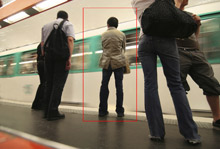
Dr Makris identified a scenario of interest to transport providers. He said, "A passenger on a metropolitan or suburban railway who leans close to the rails and allows several trains to pass without boarding them could easily be eccentric or unsure of their route but they could also be contemplating suicide and a railway operator would wish to be alerted to such a combination of behaviour."
Object classification combined with detection is particularly effective for transit authorities when policing bus lanes. Thus it would fall within the remit of the current research to identify different types of road-users such as buses, taxis and emergency services, and then create an alert if vehicles other than these enter the bus lane which in this instance is being treated as a sterile zone.
Chris Gomersall, CEO of Ipsotek, said, "We pride ourselves on being aware of the latest academic advances and so maintain links with the research community. We are particularly pleased to be working closely with Kingston University which has a well-known research team in digital imaging. We are confident that the Knowledge Transfer Partnership will help us generate innovative products as well as giving our academic partners further exposure to real-world applications."