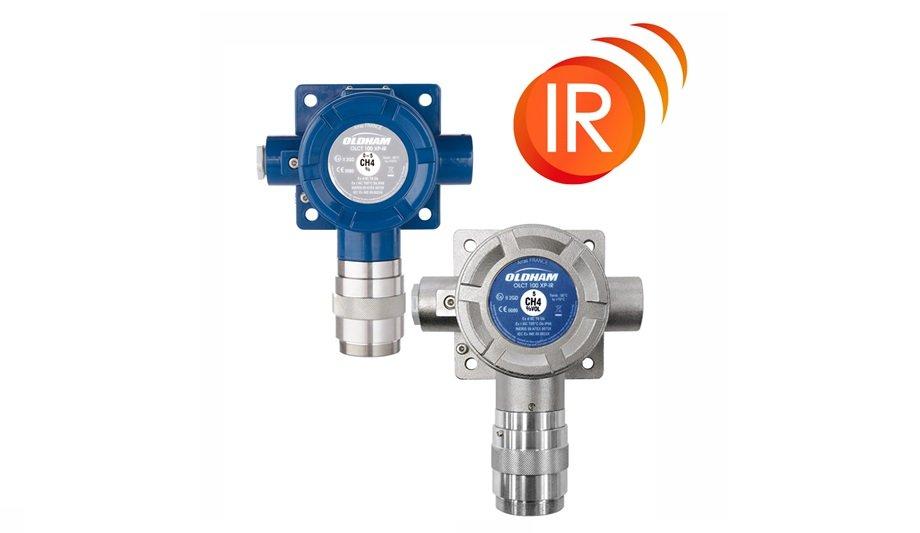

Teledyne Gas and Flame Detection is introducing a new infrared (IR) sensor for its class-pioneering OLCT 100 XPIR (explosion-proof IR) fixed gas detector that will bring the advantages of stable and reliable methane detection measurements to the industrial, utility, and laboratory markets.
Methane detection
Methane poses many threats. Not only does it form potentially explosive mixtures with air, but it can also prove harmful to humans and the environment.
For these reasons, many sectors are keen to improve their methane detection capabilities. Increasing demand from the industrial, utility, and laboratory markets stems from the need for enhanced measurement stability, aligning with the trend of lower alarm thresholds.
IR technology
IR technology becomes apparent when considering factors such as TCO especially where methane is present
The economic advantage of investing in IR technology becomes apparent when considering factors such as total cost of ownership (TCO), especially in environments where gases such as methane are present.
In such applications, IR technology outperforms catalytic oxidation, a process that typically requires recurring sensor replacements and frequent calibration.
IR methane sensor
To meet market demand for a more robust and cost-effective solution, Teledyne GFD is releasing a new IR sensor dedicated to methane detection.
Designed for the company’s highly popular OLCT 100 XPIR fixed gas detector, the IR sensor ensures measurement stability and is impervious to catalytic poisons. Moreover, the solution offers a long lifespan, even with the presence of background gas, to deliver 100% LEL methane detection.
Operation principle
As IR sensors do not require oxygen to operate, these sensors are also suitable for use in 0-100% by volume
To explain the principle of operation, IR methane sensors deploy two wavelengths of IR energy: one active wavelength for gas absorption and one providing a reference wavelength to compensate for the impact of temperature and humidity.
As IR sensors do not require oxygen to operate, these sensors are also suitable for use in 0-100% by volume methane gas environments. The ATEX-approved OLCT 100 XPIR, a proven performer in the detection of refrigerant, CO2, and combustible gases, comes with 4-20mA output ensuring safe and reliable operation.
Reliable, and cost-effective detection
“Our new OLCT 100 XPIR with IR methane sensor ensures the protection of workers, assets, and the environment from the potentially damaging and harmful effects of methane,” explains Régis Prévost, Product Line Manager at Teledyne Gas and Flame Detection.
Régis Prévost adds, “Our expert design and development team is constantly looking at ways to meet the demands of customers, helping them overcome real market challenges. With this new product, they have access to a stable, reliable, and cost-effective way of performing methane detection measurements.”
Availability with gas detectors
Finally, the same IR sensor technology is available with Teledyne Gas and Flame Detection’s 700 series of fixed gas detectors. These advanced instruments display sensor status information on a built-in alphanumeric LED screen.