Colt Technology Services, a digital infrastructure company, has unveiled its key predictions for enterprise technology trends expected to dominate CIO agendas by 2026.
Based on inputs from customer insights, market intelligence, and proprietary research, Colt highlights AI Inference, the evolution to 'NaaS 2.0', and quantum-safe security as the pivotal factors shaping the technology landscape over the next year.
Regulatory Challenges and Opportunities
CIOs will continue to navigate complex transformations in 2026, often revolving around AI, while managing cost reductions amidst a constantly evolving regulatory scene, according to Buddy Bayer, Chief Operating Officer at Colt Technology Services, who stated, "CIOs will continue to face headwinds in 2026 as they balance complex business transformation programs."
Despite these challenges, opportunities abound as AI programs mature and digital infrastructure expands in capacity, heralding innovative solutions like NaaS that are reshaping digital experiences.
Monetizing AI
Despite significant investments in AI, many companies are yet to see proportional returns. Colt's research reveals that one in five global firms spends $750,000 annually on AI, yet a recent MIT report indicates that 95% of those surveyed see no ROI.
As AI projects evolve in 2026, businesses may start witnessing ROI. More vendors are expected to introduce AI maturity assessments and ROI models to help businesses track and quantify value across their AI tools.
AI Inference and Agentic AI
The advancement of AI inference is set to reach a new maturity level, transitioning from experimentation to enterprise IT integration, enabling real-time, context-aware decisions.
McKinsey forecasts AI inference will dominate AI workloads by 2030. This development extends beyond enterprises, influencing the automation and digitalization of everyday consumer tasks through Agentic AI, as reported by the IEEE.
AI WAN and Sustainable Networking
Customer discussions at Colt frequently focus on digital infrastructure's role in optimizing AI workloads. AI WAN is moving towards software-driven wide area networks, optimizing AI traffic for peak performance.
Additionally, AI workload transmission over transatlantic cables is set to grow, from 8% capacity in 2025 to 30% by 2035, necessitating innovative technologies to boost performance without increasing energy consumption or carbon emissions.
Sovereign AI Gains Ground
As countries invest in AI amid emerging governance regulations, the concept of sovereign AI is gaining traction. These advancements prioritize local data, infrastructure, and regulations to ensure technological control and data protection, increasingly important in today's AI-driven world.
The Evolution of NaaS 2.0
The NaaS market is expanding, driven by AI, edge computing, and cloud adoption. With 58% of surveyed CIOs planning to increase NaaS usage due to AI demands, NaaS 2.0 is poised to evolve, offering real-time performance and autonomy for AI-driven enterprises.
Investments in Quantum Security
Amid emerging risks, CIOs are investing in quantum security to protect data and infrastructure. Forrester's report predicts quantum security spending will exceed 5% of enterprises' IT budgets, and the quantum security market is set to grow significantly.
Technologies like post-quantum cryptography and quantum key distribution will see development to safeguard data.
Low Earth Orbit and Quantum Advancements
2026 is expected to drive significant progress in Low Earth Orbit satellite launches and services, critical for global telecom infrastructure and resiliency. Colt plans to trial satellite connectivity for quantum key distribution to enhance secure encryption key exchanges, overcoming terrestrial connectivity limits.
Hybrid Cloud Computing and Edge Expansion
The shift towards multi-cloud models is becoming the norm as enterprises seek more flexibility. As edge computing grows, driven by AI inference and real-time analytics, next-gen cloud providers are enhancing infrastructure deployment at the edge. This trend supports both localized and centralized cloud architectures, meeting demand across various geographies.
Regulatory Frameworks and Compliance
In 2026, CIOs will face new regulatory requirements, notably under the EU AI Act, EU Cyber Resilience Act, and other frameworks like the ISO/IEC 42001:2023 global standard for AI governance. In the UK and Asia, legislative impacts from the Cyber Security and Resilience Bill and Singapore's NAIS 2.0 are anticipated, shaping AI and cybersecurity strategies further.
Colt Technology Services (Colt), the global digital infrastructure company, released the key enterprise technology and market trends it expects to dominate the CIO agenda in 2026.
Based on customer insights, market intelligence and its own proprietary research, Colt anticipates AI Inference, the evolution of NaaS to ‘NaaS 2.0’ and quantum-safe security to shape the technology landscape over the next 12 months.
Ever-changing regulatory environment
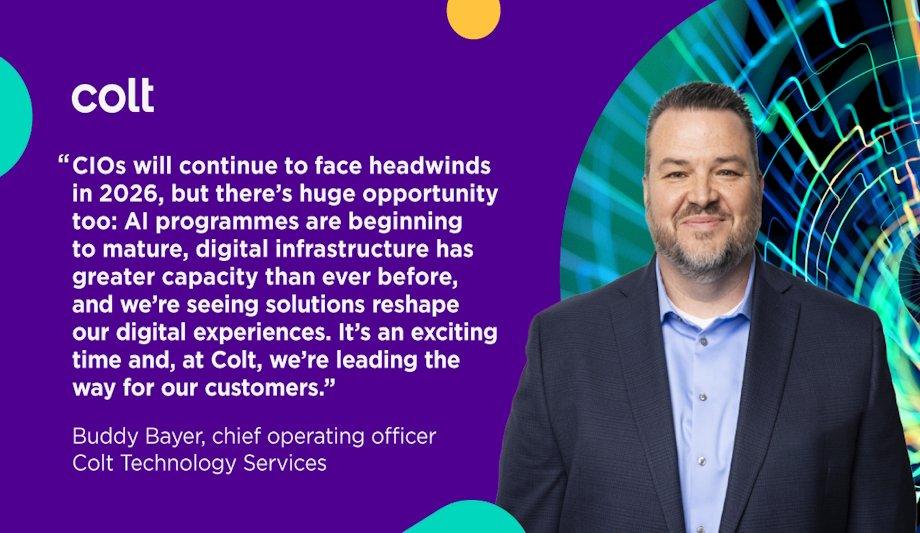
“CIOs will continue to face headwinds in 2026 as they balance complex business transformation programs at scale – often centered around AI – with ongoing cost-reduction programs in an ever-changing regulatory environment,” said Buddy Bayer, chief operating officer, Colt Technology Services.
“But there’s huge opportunity too: AI programs are beginning to mature, digital infrastructure has greater capacity than ever before, and we’re seeing an evolution of solutions like NaaS which are reshaping our digital experiences. It’s an exciting time and, at Colt, we’re leading the way for our customers.”
New ways to generate ROI from AI
Businesses continue to drive major investments in AI, but ROI, value creation and monetization are proving elusive. Colt’s research finds one in five global firms spend US$750,000 annually on AI while 95% of the respondents in a recent MIT report study see no return on their investments.
This misalignment between spending and measurable returns will shrink in 2026, as AI projects mature and begin to generate ROI, and as businesses find new ways to create value from AI. More vendors will build in AI maturity assessments and structured ROI models to help businesses define, track and quantify value across their AI tools.
AI inference and Agentic AI
2026 will see AI inferencing reaching the next level of maturity, shifting from experimentation to integration into the enterprise IT environment, extracting insight, making predictions, and enabling smarter, context-aware decisions in real-time.
McKinsey expects AI inference to account for a majority of AI workloads by 2030. This won’t just be limited to enterprises: Agentic AI, driven by inference, will be the force behind the automation and digitalization of day-to-day consumer tasks from privacy management and healthcare to scheduling assistance and management of household chores, according to research from the IEEE.
AI Wide Area Networking (WAN)
Many of Colt’s conversations with customers center around digital infrastructure’s ability to manage and optimize the performance, latency and security needed for AI workloads. AI WAN moves the conversation towards software-driven wide area networks, built for AI workloads, which dynamically manage AI traffic for peak performance and ensure application-level security of critical data.
Innovation in sustainable networking technologies
Similarly, AI workloads transmitted over transatlantic cables will grow in 2026 and are projected to surge from just 8% of total capacity in 2025 to 30% by 20351, placing additional strain on global network routes. Innovative tech trials and global partnerships are pioneering technologies which boost performance without increasing energy consumption or carbon emissions.
Sovereign AI
As nations grow their AI investments and regulations around AI governance come into force across many of the world’s major economies, sovereign AI is gaining momentum. It will rise up the CIO’s agenda as countries and organizations build and run their own AI systems using their own data, infrastructure, people, and rules.
Sovereign AI is becoming more prevalent and increasingly important as nations look to stay in control of their technology, protect their data, and stay resilient in a world increasingly shaped by AI.
NaaS 2.0
The NaaS market continues to grow, driven by a number of factors from AI, edge computing and cloud adoption to enterprises’ need to build in flexibility as they navigate dynamic global markets. Colt research found 58% of the 1500 CIOs it questioned said they were increasing their use of NaaS features due to growing AI demands.
In 2026 and beyond, people will see NaaS evolve to meet the demands of the AI era, moving beyond its traditional role in supporting digital experiences. The next generation of NaaS will be intelligent, automated, and outcome-focused, designed to deliver real-time performance, adaptability, and autonomy for AI-driven enterprises.
Quantum security
Rise in quantum security investment as Q Day gets nearer
CIOs are under constant pressure to protect their data and infrastructure from emerging risk, and as governments and businesses develop a deeper understanding of quantum’s power and potential, attention and investment turn to quantum security.
In its 2026 Technology and Security Predictions report2, Forrester forecasts that quantum security spending will exceed 5% of enterprises’ overall IT budget next year, while a report from The Quantum Insider estimates the quantum security market to grow at over 50% CAGR to 2030, reaching $10 billion.
Traditional data cryptography methods are at risk of being deciphered by quantum computers. The point at when this happens is known as Q Day, and latest estimates suggest it could come as soon as 2030.
Technologies such as post-quantum cryptography (PQC) and quantum key distribution (QKD) protect traffic from this risk as it travels across a network. 2026 will bring developments, trials and innovation in protecting data from quantum risk.
Low Earth Orbit technologies – and quantum
2026 is set to be a breakthrough year for Low Earth Orbit satellites, with organizations launching new satellites and new services. These services are a vital part of global telecoms infrastructure, providing connectivity in underserved or rural areas, and providing resiliency to businesses looking for back-up options for their enterprise infrastructure.
Colt is looking to trial low earth orbit satellite connectivity for quantum key distribution: this will enable secure and protected exchange of symmetric encryption keys using quantum technology, while overcoming the distance limitations of terrestrial connectivity. 2026 will see Colt and partners trialing space-based and subsea techniques which extend quantum security to global networks.
Hybrid cloud computing models
2026 will see multi cloud models becoming the default, as enterprises look for more ways to build in flexibility and resilience to their infrastructure and move beyond single-provider strategies. Increasingly, APIs and secure interconnects between providers and hyperscalers are streamlined, complementary and competitive in pricing terms and accessible through aggregators.
Edge computing will continue to grow through 2026 and beyond, driven by factors such as AI inference expansion, the rise in real-time analytics, and increasing data sovereignty requirements.
Next-generation cloud providers
Next-generation cloud providers are prioritizing deployment of infrastructure at the edge, processing data closer to where it’s generated, while hyperscalers focus on scale and compute power in centralized locations.
Both strategies are needed and complementary: Edge requires highly distributed, localized infrastructure which complements centralized cloud, used for heavy compute and storage. As demand for Edge grows in 2026 and beyond – one forecast estimates a CAGR of 33.0% from 2025 to 2033 - expect rising demand for distributed architectures across new geographies.
Tighter regulatory frameworks
In 2026, expect to see a slew of reporting obligations, regulations, strategies and guidelines impacting CIOs, particularly in AI and cybersecurity. Most of the obligations under the EU AI Act will apply from 2 August 2026, while implementation of certain requirements for high-risk AI systems may be postponed.
Reporting obligations for the EU Cyber Resilience Act are expected from September 2026, with phased obligations continuing from September 2026 onward under the EU Data Act.
Cyber Security and Resilience Bill
Peolpe also see the ISO/IEC 42001:2023 global standard for AI governance, which will lead CIOs and CAIOs to integrate AI governance into enterprise architecture and procurement decisions, as well as operational impacts for the Digital Services Act and the Digital Markets Act.
In the UK, all eyes will be on the Cyber Security and Resilience Bill, while across Asia, Japan will see the impact of its AI Promotion Act and major initiatives following Singapore’s National AI Strategy 2.0 (NAIS 2.0) are also expected to come into effect in 2026.