

Gun violence remains one of the most unpredictable threats in today’s physical security landscape. When it strikes, seconds matter. The ability to detect and respond to gunfire almost instantaneously can determine outcomes.
Security pioneers and first responders know this, and yet too many gunshot detection systems in operation today are shackled by outdated assumptions and aging architecture. The demand now is not for incremental improvements, but for a complete rethinking of how these systems function.
Prevailing model
For years, the prevailing model has relied on server-heavy frameworks and complex sensor networks that introduce unnecessary latency and complexity. Systems that depend on sending audio data to remote servers for analysis are inherently slower.
In a live gunfire situation, waiting even a few seconds for confirmation can be the difference between life and death. The expectation in 2025 is clear: detection and actionable intelligence must occur in real time, with no delays.
Edge-based intelligence: The new standard
Deploying three or more sensors to cover an area imposes significant cost and operational burdens
To minimize points of failure and latency, the future of gunshot detection lies in edge processing. Intelligence must reside inside the sensor itself, not in a data center or a remote server. Edge-based acoustic sensors can now detect and geolocate gunshots in under three seconds without external dependencies. They do not require triangulation or corroboration from multiple devices. One sensor, one shot, one instant location—that is the new standard.
Consider the limitations of traditional perimeter-based systems. Deploying three or more sensors to cover an area imposes significant cost and operational burdens. Maintaining this infrastructure often means trade-offs in coverage and flexibility. For example, if a detection system can only triangulate within a ring of sensors, there will be no information available for shots fired outside this restricted perimeter, even from a short distance away. Worse, these older models are prone to false positives triggered by fireworks, construction noise, or other environmental sounds. Each false alert erodes confidence in the system and burdens response teams unnecessarily.
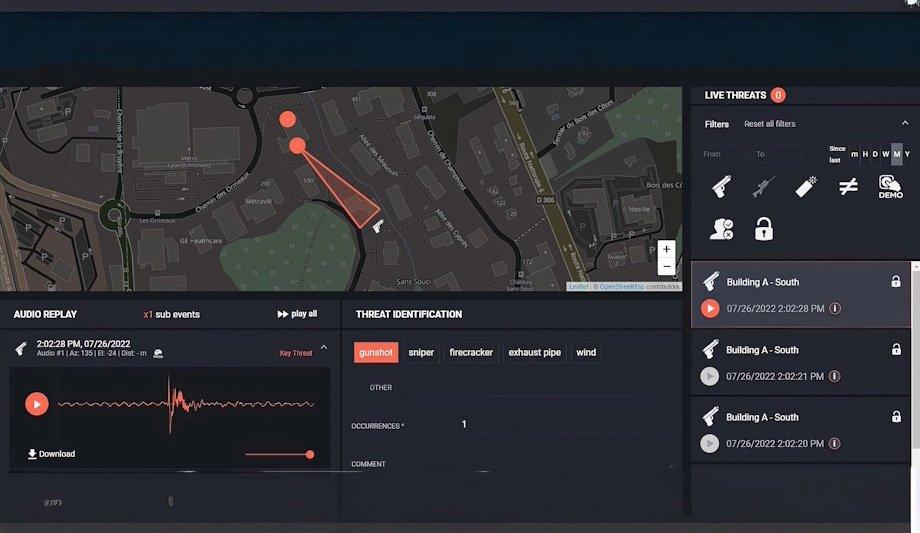
Contrast this with modern edge-AI sensors that not only detect the muzzle blast of a firearm but also analyze the ballistic wave of a hypersonic projectile in motion. This dual-signature capability delivers a level of accuracy far beyond what older systems can offer. When a shot is fired, the sensor detects, classifies, and pinpoints the event almost instantly. There is no reliance on back-end processing or corroborative triangulation. The sensor acts autonomously and decisively.
Real-time response with visual confirmation
The level of integration changes gunshot detection from a passive alerting tool into an active part
These advancements do not stop at detection. Integration with existing security infrastructure is crucial. Modern sensors leverage open standards such as ONVIF Profile S to control pan-tilt-zoom (PTZ) cameras directly. As soon as a gunshot is detected, the sensor can automatically cue a camera to the exact coordinates of the event.
This process happens in less than three seconds, giving operators live visual intelligence of the situation as it unfolds. The days of security personnel scouring multiple camera feeds or responding to vague reports are over.
Today, they can focus their attention on the precise location of the threat. This level of integration transforms gunshot detection from a passive alerting tool into an active part of situational awareness. It provides command centers and first responders with actionable intelligence, enabling them to make informed decisions in real time. It is not enough to know that a shot was fired; security teams need to see where it happened and assess the scene immediately.
Adapting to the environment
Environmental adaptability is another area where modern edge-based systems excel. Acoustic detection has long struggled with ambient noise. Urban environments are filled with loud, impulsive sounds that can easily be mistaken for gunfire. However, edge-AI sensors can now be trained to understand the acoustic profile of their specific environment.
They learn what constitutes normal background noise and adjust accordingly. If a venue frequently hosts fireworks displays or is situated near construction zones, edge-processed AI systems can be trained to differentiate those sounds from genuine threats. This site-specific learning dramatically reduces false positives and enhances overall system reliability.
Flexibility in deployment
A single intelligent sensor can now provide broad coverage with minimal setup
Flexibility in deployment is equally important. Today’s security needs are not confined to permanent installations. Large public events, temporary venues, and rapidly evolving threat environments require portable solutions. Edge-based sensors can be deployed on mobile platforms such as trailers or temporary masts, providing high-precision detection wherever it is needed. Because all processing occurs at the edge, these mobile systems do not rely on centralized servers to function effectively. The sensor is the system.
This shift represents a fundamental change in how security professionals approach gunshot detection. The industry is moving away from reactive, infrastructure-heavy models toward proactive, efficient, and adaptable solutions. A single intelligent sensor can now provide broad coverage with minimal setup. It detects, locates, and visually confirms threats autonomously.
Interoperability further enhances the value of modern systems. By embracing open protocols, these sensors integrate seamlessly with existing video management systems (VMS) and security platforms. Organizations are no longer locked into proprietary ecosystems. They can deploy best-in-class solutions that work together harmoniously. This openness accelerates deployment and reduces friction, a critical advantage when securing dynamic environments on tight timelines.
Privacy by design
Alert signals contain location, timing, and sound type data only with no continuous listening
Privacy concerns are front and center in any surveillance deployment and the thought of an audio listening device can raise eyebrows. Modern gunshot sensors are event-driven and only share short recordings (such as a 1.5-second clip for verification) triggered by gunshot levels (over 100 dB).
Conversations and other ambient audio are neither captured nor stored. Alert signals contain location, timing, and sound classification information only with no continuous listening or streaming.
Closing the gap between detection and response
Ultimately, doing gunshot detection right demands a new mindset. Edge processing is not a technical novelty; it is an operational necessity. Security pioneers must expect and demand more from their detection systems—faster alerts, smarter filtering, real-time visual confirmation, seamless integration, and scalable deployment.
The technology to achieve this exists today. High-accuracy, real-time gunshot detection is not a future promise; it is a present reality. The responsibility now lies with the industry to embrace this better way forward. Communities and the professionals who protect them deserve solutions that rise to meet today’s challenges with intelligence, speed, and precision.